
Selling Off-Plan Property in Dubai: Team Roles and Follow-Up
By Dealora Written Published Reviewed by Ali Darwish 11 min read
Selling off-plan property in Dubai with several developer launches running at once needs clear roles, lead rules by project and a fixed follow-up routine. Here is the operating model and how to set it up in a CRM.

Selling off-plan property in Dubai across several launches works when four roles are separate: a lead handler who responds and qualifies, off-plan specialists who own projects, a developer liaison who keeps availability and documents current, and a team lead who enforces time limits. Leads are split by project tags, and every stage has an exit rule and a next contact date.
Selling off-plan property in Dubai goes well when every enquiry has one owner, every developer launch has one person who knows its units, and every buyer has a next contact date. A Dubai off-plan brokerage team that sells several developers at the same time needs four separate roles (lead handler, off-plan specialist, developer liaison, team lead), leads split by developer or project, and a follow-up cadence that the CRM enforces instead of people's memory. Dealora, a cloud platform for brokerages in Egypt, Saudi Arabia and the UAE, supplies the CRM pieces for this, and the model works with any system that can hold the same rules.
Why selling off-plan property in Dubai needs its own team structure
Off-plan is a large part of the Dubai market, so it is not a side line for a brokerage's sales floor. Of 31,361 Dubai property sales recorded by the Dubai Land Department between 1 April and 22 June 2026, 23,854 were off-plan sales of apartments, townhouses and villas, about 76%, according to Cavendish Maxwell's analysis of DLD transactions. Nearly 67% of the off-plan sales in that period were studio and one-bedroom units. Around 49,700 off-plan transactions were recorded in the first five months of 2026, 7.1% fewer than in the same months of 2025, while project launches moderated. These shares move with the period and with whoever runs the analysis, so read them as direction, not as a fixed rule.
What this means on a sales floor is practical. When most sales are small units, the same buyer can reasonably be shown similar units from three developers. Several launches can overlap, each with its own price list, payment plan and availability, and one launch can bring hundreds of enquiries in a weekend. If the same agents answer new enquiries, present projects, chase developers and register bookings, something drops, and it is usually the follow-up.
The steps of a single sale are covered in the off-plan sales process walkthrough, and the preparation before a launch in the off-plan launch checklist. What stays open is how to organize people and routines when launches overlap, which is the subject here.
The four roles in an off-plan sales team
Separating these roles is the core of an off-plan sales team structure. Each role has one job that can be measured.
- Lead handler. Owns the first response and qualification. Calls and messages every new enquiry, records unit type, budget, project interest, investor or end user, and cash or mortgage, then passes a qualified client to a specialist. This role is about speed and accurate records, not about closing.
- Off-plan specialist. Owns a set of developers or projects and the buyers who asked about them. Presents the project, runs meetings, sends the deal request and follows the client to booking. A specialist knows two or three developers deeply instead of fifteen shallowly.
- Developer liaison. Owns the relationship with the developers' sales teams: which units are available, which price list and payment plan is current, who to call to reserve, and when the next launch opens. After a booking, this person confirms with the developer that the sale has been submitted for registration.
- Team lead. Owns distribution rules, time limits and the weekly review. Watches who holds how many clients, which leads sat idle, and which projects get enquiries but no meetings.
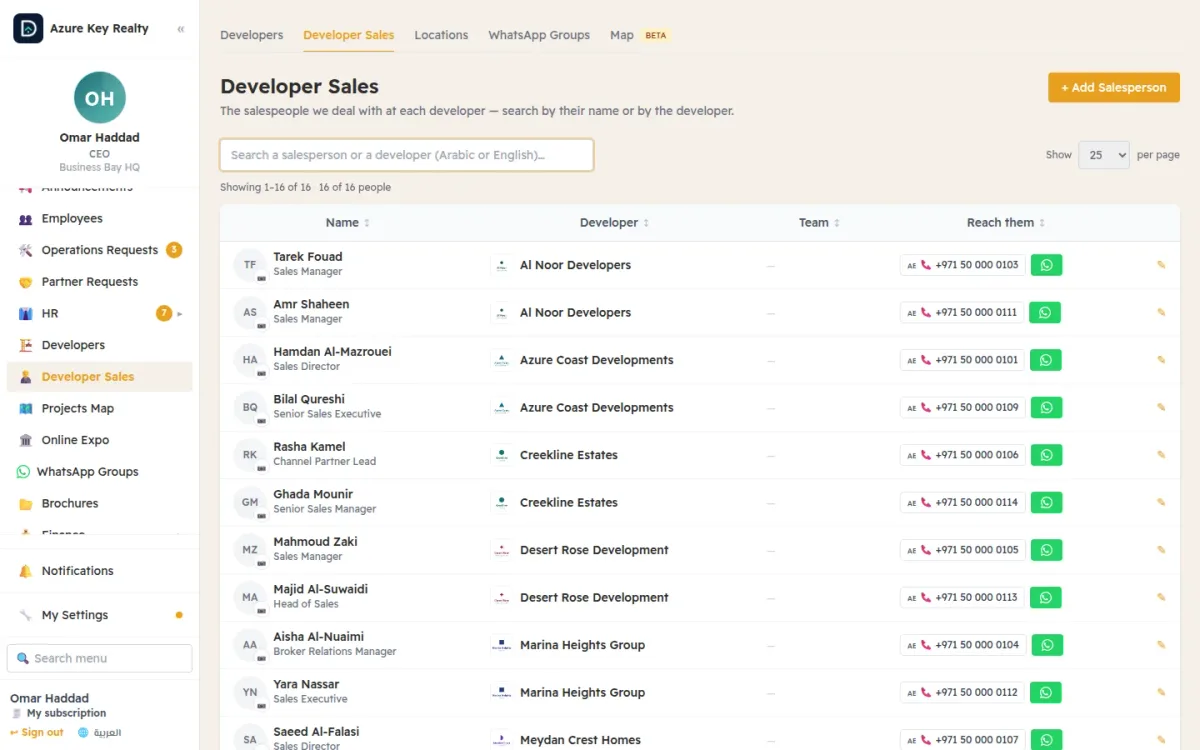
The liaison keeps specialists from quoting a unit that sold out last week, or sending a payment plan the developer has replaced. In Dealora, the Developers & Projects module gives the liaison one place for each developer's projects, phases, master plan, brochure, payment plan and floor plans, plus the developer's own salespeople with their numbers and e-mails. The Developer Sales index, on the same Starter plan, lists those contacts with call and WhatsApp buttons.
With four or five people, one person can hold two roles. Team lead and liaison can sit together, since both work on rules and availability rather than on individual clients. Do not combine lead handler with specialist on launch days, because first response is exactly what slips when a specialist is in a meeting.
How to split off-plan leads by developer or project
Split by what the buyer asked about, not by who is free. Tag each enquiry with its developer or project when it arrives, from the ad form, the website or the lead handler's call. Then link tags to pools: a pool for each developer, or for a group of projects handled by the same specialists.
In the Dealora CRM, pools link tags to salespeople or whole teams. When a lead arrives for a client nobody owns yet, the matching pool picks the owner by its strategy: least loaded, weighted, first in first out, or round-robin. Round-robin suits specialists of equal seniority, and weighted suits a team where a senior specialist should take a larger share. The real estate lead distribution rules explain how to choose between these and how to set reassignment limits.
Three habits keep this clean during launches:
- One client, one owner. The CRM matches phone numbers and e-mails to one client record, so a buyer who registered on three forms does not reach three agents.
- A temporary pool for each major launch. Create it before the launch, link it to the launch tag, and retire it when the launch window closes.
- The Leads Bank for overflow. A salesperson with spare capacity presses one button and receives unassigned leads, within ceilings per press, per day and per month. This prevents hoarding and stops leads waiting for a manager's Sunday morning split.
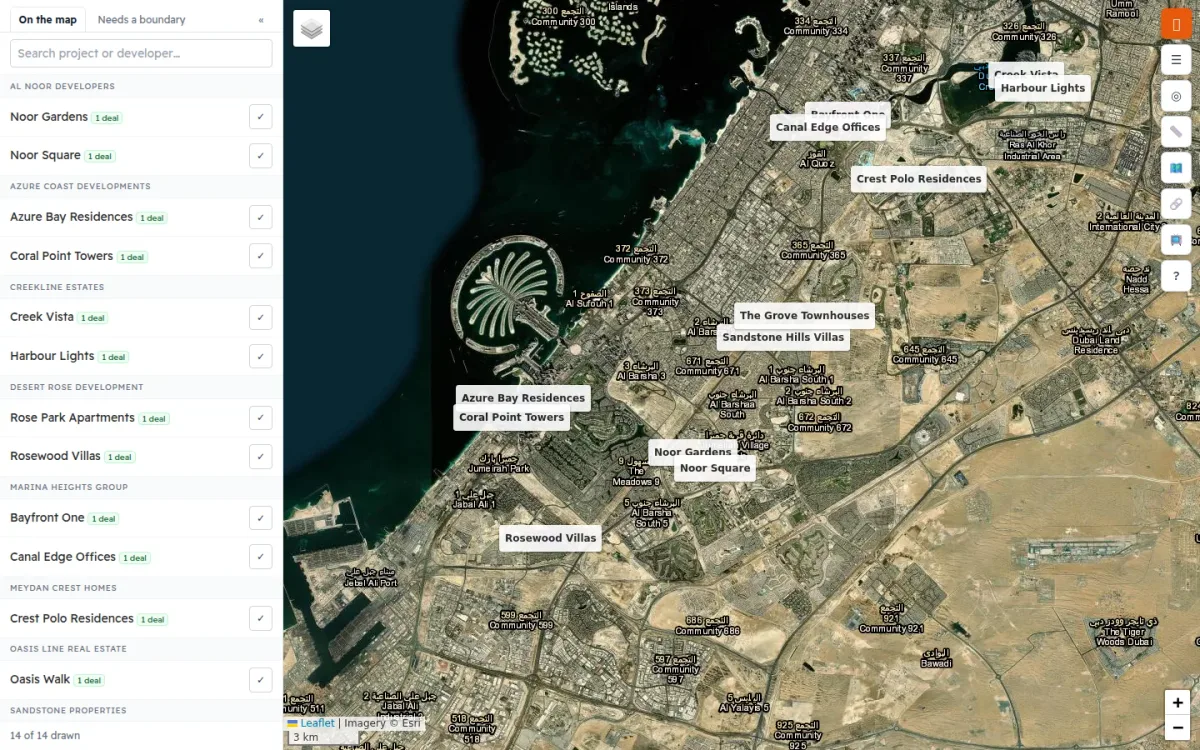
When a buyer wants units from two developers, the owner stays the same and brings in the second specialist as support. The comparison itself follows the method in how to compare developer projects for one client. The Projects Map, also on the Starter plan, helps a specialist show where each project sits.
Pipeline stages and rules for off-plan lead follow-up in a CRM
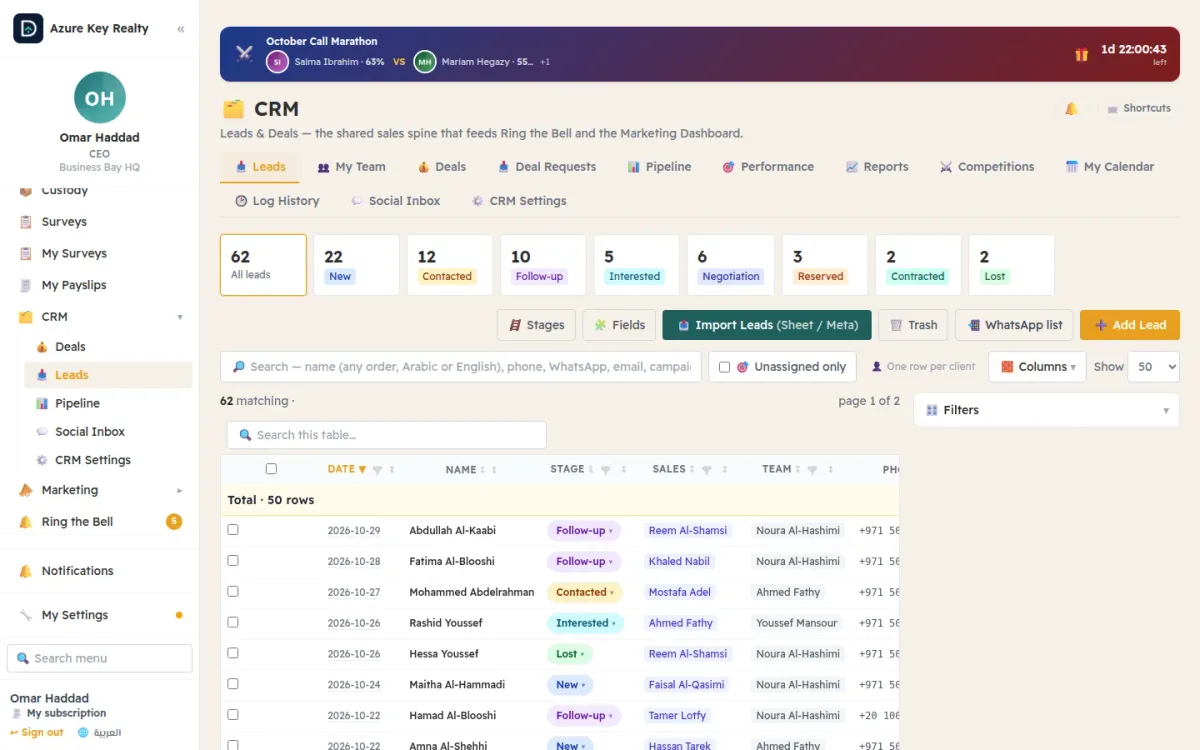
A pipeline works when each stage has an exit rule: something that must be true, and logged, before the client moves on. In the Dealora CRM the CRM Admin sets stages, sources, pools and targets in CRM Settings, so the stages below can be built as they are. They are a suggestion, so rename them to match your floor.
- New. Exit: first contact attempted and logged.
- Contacted. Exit: the client answered and the lead handler recorded requirements (unit type, budget, project) and tags (investor or end user, cash or mortgage, launch name).
- Qualified. Exit: the owner is a specialist from the right pool.
- Presented. Exit: project details sent and a meeting proposed, logged on the client's Sales Activity timeline.
- Meeting. Exit: a meeting or site visit held and a next step agreed with a date.
- Deal request, EOI, Contracted. The specialist sends a deal request for one unit; the CRM Admin approves, holds or rejects it, and the deal moves from Deal to EOI to Contracted.
Two features carry most of the discipline. Pipeline SLA gives each stage a maximum idle time. A lead that sits too long without a sales action is pulled and re-distributed, with a scan every 30 minutes and quiet hours at night. Pipeline Rules can require a logged action before a lead moves forward, for example no move to Presented without a logged call or message. A unit can sit on one live deal only, which settles the launch-day argument over two agents reserving the same unit for different buyers.
Add one rule just before booking. Require the specialist to log that the buyer's e-mail address, ID or passport copy and, for a financed purchase, the bank letter are in hand. In Dubai the developer registers an off-plan sale through the Oqood portal, and the result is sent by e-mail to the purchaser, so a wrong address on the booking documents means the buyer never sees it. For an individual buyer the registration needs a copy of the sale and purchase contract, a copy of a valid UAE ID, and a copy of a valid passport for a non-resident. A minor's guardian signs and attaches the guardian's passport or ID. A financed buyer follows a separate Oqood service in which the developer registers the sale and the mortgage together, and the bank letter must state the mortgage value and date. Tagging cash or mortgage at qualification means nobody finds this out on booking day.
A follow-up cadence from first enquiry to booking and after
A cadence is a schedule of touches with an owner and a record for each. The timings below are starting points for off-plan property sales follow-up. Adjust them after a month of data on what your buyers actually answer.
| Touch | Timing | Owner | What happens | CRM record |
|---|---|---|---|---|
| First response | Day 0, within minutes | Lead handler | Call, then a WhatsApp message naming the project asked about; ask unit type, budget, investor or end user, cash or mortgage | Requirements and tags filled; stage Contacted |
| Handoff | Day 0, same working day | Lead handler to specialist | Client reaches the right pool and gets an owner | Stage Qualified; owner set |
| Project details | Day 1 | Specialist | Send brochure, payment plan and floor plans for the right phase; propose a meeting | Activity logged; stage Presented |
| Second attempt | Day 3 | Specialist | Call again; if no answer, change the channel | Next contact date set |
| New information | Day 7 | Specialist with liaison | Send an availability update or a comparison of similar units | Activity logged |
| Launch window | Weekly | Specialist | Short update on what is still available and when the next release is | Next contact date reset |
| After a meeting | Same day | Specialist | Written recap and the agreed next step | Meeting logged with a dated next step |
| Booking | Booking day | Specialist and liaison | Confirm e-mail, ID or passport, and bank letter if financed; liaison confirms the developer has submitted the registration | Deal at EOI or Contracted; documents logged |
| After booking | At construction milestones | Specialist | Share project progress; ask for referrals | Activity logged on the client page |
For progress updates after booking, the Dubai Land Department's free Project Status Enquiry lets anyone check a project's completion percentage and details by entering the land number, project number or project name. It is available on the DLD website, in the Dubai REST app and on WhatsApp at 8004488 with the virtual assistant Malik, and the answer is immediate. A specialist can use it to answer a buyer's progress question the same day.
What to write in each message matters as much as when to send it. The Keys of Success guide on what to send at each stage of a property follow-up gives wording for stages like these.
Targets for each role
Targets that only count bookings punish the lead handler for a specialist's work, and the other way round. Give each role a measure it controls, and read them together in the CRM reports, which count clients per salesperson and team.
| Role | Measures |
|---|---|
| Lead handler | Time to first response; share of enquiries qualified with complete requirements; meetings booked |
| Off-plan specialist | Meetings held; deal requests and EOIs; bookings for the projects they own |
| Developer liaison | Launch packs ready before the launch date; how recent the availability notes are; booked sales confirmed as submitted for registration |
| Team lead | Leads pulled by the stage time limit; balance of clients per specialist; projects with enquiries but no meetings |
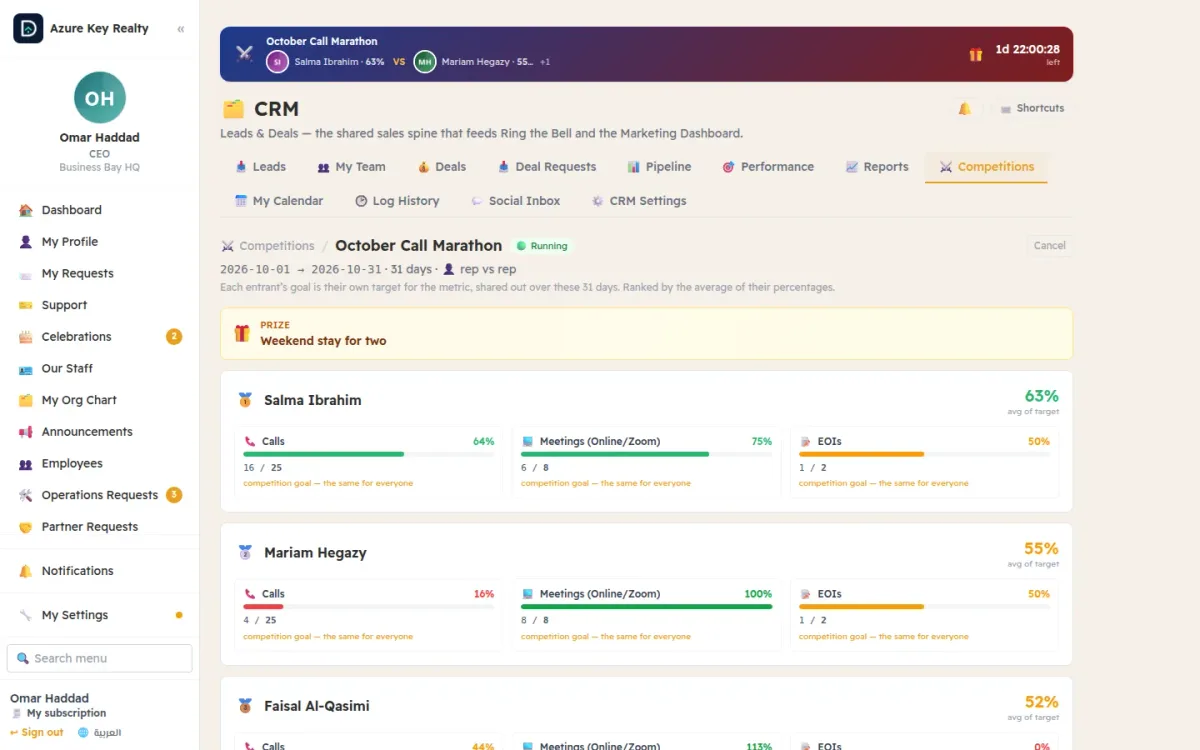
The team lead can also use My Team in the CRM to see what each person holds, move all clients of one salesperson to another, and pull back clients still held by people who left. For a launch week, a sales competition between specialists or teams, with a target and a deadline, keeps pace up. Competitions is on the Growth plan and above.
Setting it up before the next launch
Work in this order, and do it before the launch, not during it:
- Name the four roles and who holds each. Write down who covers when someone is out.
- Add each developer and project in the developers module, with phases and files, and ask the liaison to keep availability current.
- Create tags for developers, projects, buyer type and cash or mortgage, then link them to pools.
- Set stages with exit rules, a time limit for each stage, and the pre-booking rule above.
- Agree the cadence and the targets with the team, and review them weekly for the first month.
The CRM, Developers & Projects, Projects Map and Developer Sales index are all in the free 3 months on the Starter plan, so the pools, stages and developer data can be built and tested on real enquiries. You can create a free Dealora account and build the pools and stages with your own team. If you are still choosing a system for a UAE brokerage, real estate software in the UAE by brokerage size covers what to check. The Dealora CRM page lists the distribution and pipeline settings in full.
Sources
Frequently asked
What roles does a Dubai off-plan brokerage team need?
Four jobs cover it: a lead handler who responds fast and qualifies, off-plan specialists who each own a set of developers or projects, a developer liaison who keeps availability, price lists and contacts current, and a team lead who enforces time limits and balances load. In a small team, one person can hold two of these jobs.
How should I split off-plan leads between agents?
Tag every lead with the developer or project it asked about, then link each tag to a pool of specialists. Within a pool, choose how the next owner is picked: least loaded, weighted, first in first out, or round-robin. Keep one owner per client, even when the buyer asks about several projects.
How often should I follow up an off-plan buyer?
Reply within minutes on day 0, send project details the next day, call again around day 3, and send something new, such as an availability update, around day 7. During a launch window keep a weekly touch, then move to a slower rhythm. Treat these timings as starting points and adjust them to your team.
Who registers an off-plan sale in Dubai?
The developer registers it, not the buyer or the broker. The developer logs in to the Oqood portal, selects the provisional sale registration service, fills in the details, attaches the documents and submits online. The result goes by e-mail to the purchaser, so the buyer's e-mail address must be correct on the booking documents.
How can a buyer check how far an off-plan project has progressed?
The Dubai Land Department offers a free Project Status Enquiry. Entering the land number, project number or project name returns the project's completion percentage and details immediately. It is available on the DLD website, in the Dubai REST app and on WhatsApp at 8004488 with the virtual assistant Malik.
Can a three-person brokerage use this model?
Yes, with roles combined. One person handles first response and qualification, one or two act as specialists split by developer, and the owner or senior agent acts as developer liaison and team lead. Keep the same stages, rules and follow-up dates, because the routine matters more than the headcount.
Read next
- How to Test a CRM Free Trial: A 30-Day Plan for Brokerages A week-by-week 30-day plan for brokerage owners: import real leads, run the pipeline with real reps, check dev
- Real Estate Sales Dashboard: 3 Views Every Manager Needs One screen, three views: agent, team and project or developer. Which number goes where, who reads it, and whic
- Off-Plan Launch Checklist: 10 Checks for Brokers Before Day One Ten checks a brokerage sales team completes before a developer opens sales, each with an owner and a due date,
- How to Send Project Details to a Client: A Same-Day Routine A fixed order for brokers: find the project on the map, pick the current files, send them from one place and r