
How to Scale a Real Estate Brokerage: Systems at 20, 50, 100 Reps
By Dealora Published Reviewed by Ali Darwish 11 min read
A stage-by-stage map of the systems a brokerage needs at about 20, 50 and 100 salespeople: what breaks at each size, which Dealora module fixes it, and the lowest plan that includes it.

Scale a real estate brokerage by adding systems in the order they break. At about 20 salespeople, fix lead handling with a CRM and distribution rules. At about 50, add team structure, an org chart and marketing tracking. At about 100, add hiring, attendance, payroll and target systems, ideally in one connected platform.
The way to scale a real estate brokerage is to add each system just before its absence starts costing you deals, not all at once. At about 20 salespeople the weak point is lead handling. At about 50 it is management visibility and team structure. At about 100 it is hiring, payroll, targets and marketing tracking. Each size has a Dealora module that fixes what breaks, and each module below is named with the lowest plan that includes it. Dealora is sold to real estate companies in Egypt, Saudi Arabia and the United Arab Emirates, in Arabic and English.
How to scale a real estate brokerage: what breaks at each size
The sizes are approximate. Your breaking points depend on how fast you hire, how many branches you run and how many lead sources feed the sales floor. What stays constant is the order: leads first, then management, then the back office.
| Size | What breaks | System to add | Dealora module | Lowest plan |
|---|---|---|---|---|
| About 20 | Leads pasted into sheets, duplicates, idle leads | One client record, distribution rules, stage time limits | CRM | Starter |
| About 20 | Staff list in a spreadsheet | One staff file with manager and probation status | Employees | Starter |
| About 50 | Unclear reporting lines | Org chart built from the staff file | Org Chart | Growth |
| About 50 | Client messages on personal phones | Shared inbox inside the CRM | Social Inbox | Growth |
| About 50 | Ad spend not tied to sales | Spend to leads to sales view | Marketing Dashboard | Growth |
| About 50 | Tasks and notices lost in chat groups | Task boards, notices with acknowledgement | Task Management, Announcements | Growth |
| About 100 | Hiring and joiner or leaver steps | Hiring pipeline, handover checklist | ATS Hiring, Employee Lifecycle | Business |
| About 100 | Attendance, paperwork, policies | Check-in, document follow-up, acknowledged policies | Attendance & Leave, Document Compliance, Company Policy | Business |
| About 100 | Salaries and target-based pay | Monthly payslip run | Payroll | Enterprise |
Plan limits count users: Starter allows up to 10, Growth up to 50, Business up to 150, and Enterprise has no limit. Past a limit you add users, which is an add-on from Starter, or move up a plan. Individual, for a solo broker or a tiny team of up to 3 users, is a separate plan and sits outside this ladder. Plan contents, user limits and add-ons are listed on the Dealora pricing page.
Stage 1: about 20 salespeople, one client record and fair distribution
At this size the founder still knows most leads, and that hides the problems. A campaign for a new compound brings two hundred registrations over a weekend. Someone pastes them into a sheet, the sales manager splits them on Sunday morning, and the hottest leads have already spoken to a competitor. The same buyer registers on three forms and lands with three salespeople. A consultant sits on forty leads without calling, and when that consultant resigns, the clients leave with their phone.
Dealora's CRM answers each of these, and it is on the Starter plan:
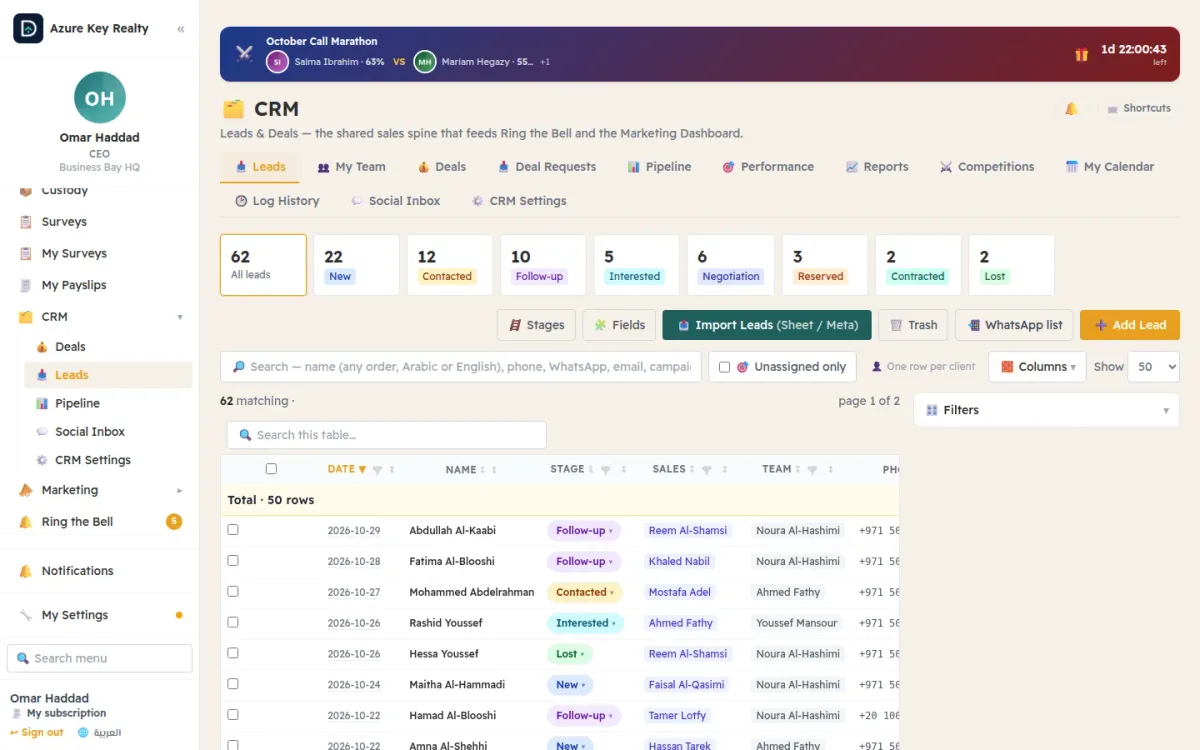
- One client record. Every phone number and email is matched to the same client, so a person who registered three times is one row with three requests behind it.
- Distribution by rules. Pools link tags to salespeople or whole teams and pick the owner by least loaded, weighted, FIFO or round-robin. A Leads Bank lets a salesperson press one button and receive unassigned leads, within ceilings per press, per day and per month. The logic behind these choices is covered in real estate lead distribution rules, time limits and reassignment.
- Time limits. Pipeline SLA gives each stage a maximum idle time. A lead that sits too long without a sales action is pulled and re-distributed, with a scan every 30 minutes and quiet hours at night.
- Deals with approval. A salesperson sends a deal request for one unit, the CRM Admin approves, holds or rejects it, and a unit can sit on one live deal only.
Create the staff file at the same time. Employees, also on Starter, keeps each person's branch, department, job title, direct manager, contacts and papers. Anyone who joined in the last three months starts as On Probation and moves to Active when the three months end. A 20-person team is already past Starter's 10-user limit, so add users or move to Growth when you onboard everyone.
Stage 2: about 50 salespeople, team structure and manager visibility
At 50, the owner no longer sees the floor. Team leaders exist, but the reporting line lives in people's heads. A manager cannot say quickly what each salesperson is holding, and nobody can tie ad spend to closed deals. This is the stage where a brokerage either builds structure or starts losing clients quietly.
Team structure that matches the real reporting line
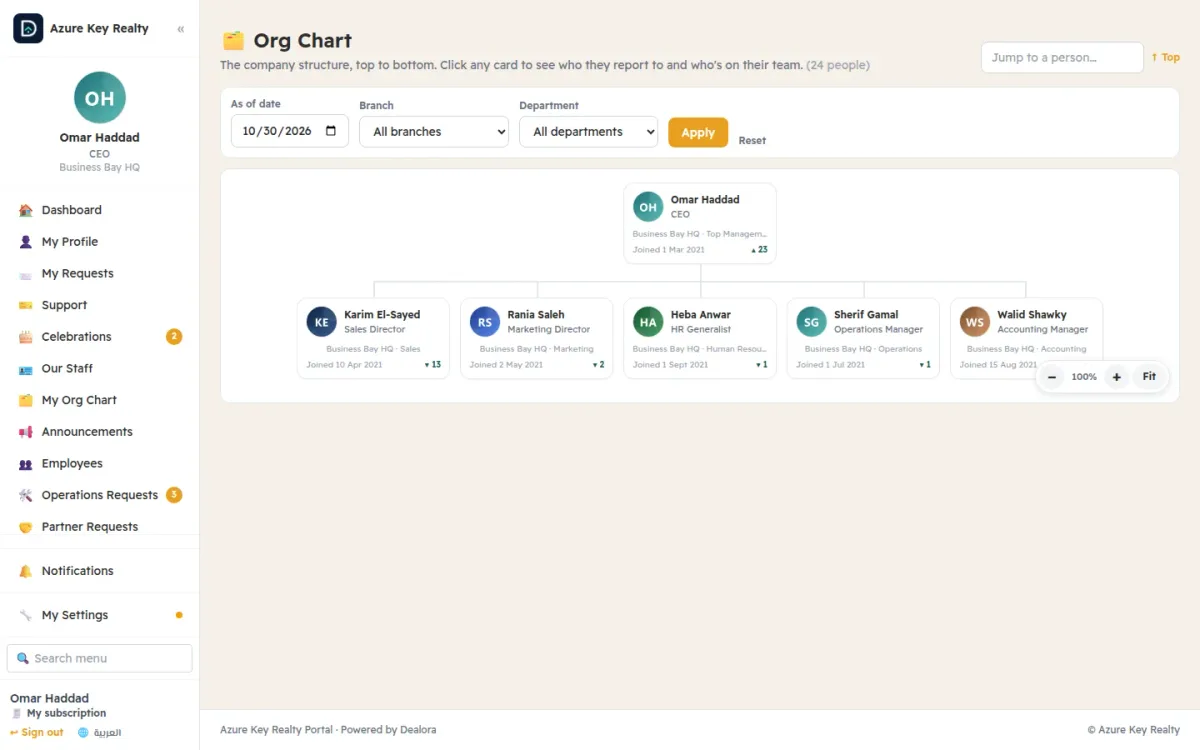
In Employees, departments can have sub-departments, and each job title can be marked as a management role, so only real managers are offered as someone's direct manager. The Team filter shows a manager's whole reporting line at every level. When a manager is marked as Left, the portal asks for a replacement and moves the whole team under them. In the CRM, My Team shows what each person holds, moves all clients of one salesperson to another, and pulls back clients still held by people who left.
Org Chart turns the same staff file into a tree, so there is no second drawing to maintain. It starts on the Growth plan.
Dashboards and marketing tracking
Managers need a few fixed views, read the same way every morning. The CRM Reports count clients, not registrations, and the sales dashboard article describes three views every manager needs. On Growth, the Marketing Dashboard adds the spend to leads to sales view, with cost per lead and return on ad spend. It only means something when leads from ads arrive in the same CRM that records the deals.
Messages, tasks and notices
- Social Inbox (Growth) brings Facebook, Instagram and WhatsApp messages into the CRM. It works with the company's own Meta connection: its Facebook page, Instagram and WhatsApp Business number. A salesperson sends free-form replies only while the 24-hour window is open. After it, the Send button becomes Log sent: the salesperson writes from their own phone and Dealora records it.
- Task Management (Growth) gives task boards with workspaces, a calendar, files and comments.
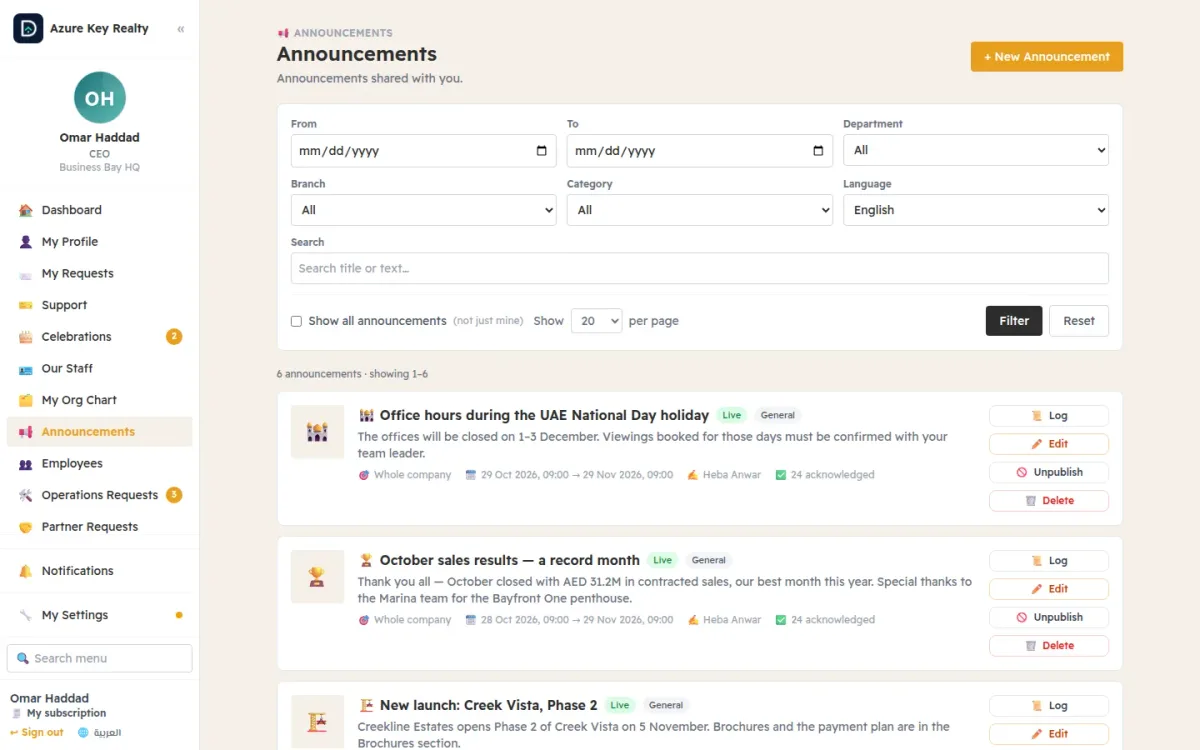
- Announcements (Growth) are management notices that employees must acknowledge, with history.
Stage 3: about 100 salespeople, HR, payroll and targets
At 100, the problems move from the sales floor to the back office. Hiring comes in waves, paperwork goes missing, attendance is argued about at month end, and pay depends on targets that someone calculates by hand. Business is the lowest plan with the HR modules, and Payroll is on Enterprise.
ATS Hiring: the hiring pipeline
ATS Hiring is the hiring pipeline of job openings, candidates and offers, and it is on the Business plan. Its dashboard shows follow-ups due and the candidate pipeline by stage. The Careers public page, also on Business, adds shareable job links where anyone can apply. Together they replace the sheet of candidates that a recruiter keeps on a personal laptop.
Joining, leaving, paperwork and Company Policy
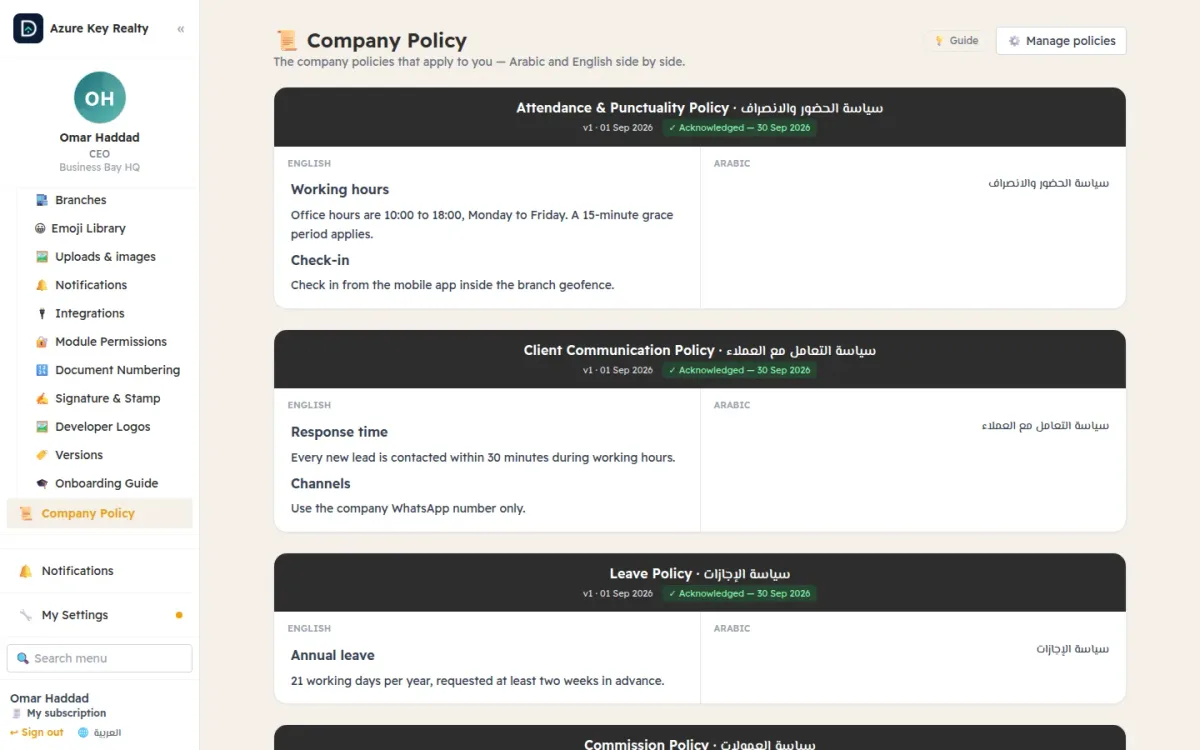
Employee Lifecycle, on Business, hands each step of an employee joining or leaving to a responsible person. Document Compliance follows up with employees who have not completed their paperwork. Company Policy collects acknowledgement of policies every employee must read, and shows the status of each one.
Time and pay: Attendance & Leave and Payroll
Attendance & Leave (Business) covers mobile check-in and out, shifts, leave types, holidays, deductions and monthly reports. Payroll (Enterprise) covers salaries, allowances, advances, bonuses and deductions, and the monthly payslip run. Bank Account Opening, also Enterprise, gives new hires the bank, the steps and whom to contact. The method for tying targets to pay is in how to link sales targets to payroll in a brokerage.
Competitions: targets visible between pay runs
The Competitions module, on the Growth plan, runs sales competitions between salespeople or teams, with a target, a deadline and a winner. A live competition shows each rep's progress on calls, meetings and EOIs (expressions of interest) against goals, so people see where they stand before the month closes.
Marketing and AI tools
These come last, once the basics are tracked:
- Meta Ads and Google Ads are included on Enterprise and are add-ons from Growth, charged as a monthly subscription. Meta Ads works with the company's own Meta connection, and Google Ads with its own Google Ads connection.
- AI Sales Agent, which phones clients and records each call with a verdict, is an add-on from Starter, charged as a monthly subscription plus the calls.
- Chat Agent is on Growth and above, answers customers on Instagram, Messenger, WhatsApp and TikTok, and is charged by use. It works only with the AI Sales Agent add-on and the company's own Meta connection.
Hiring in waves: probation and licence rules by country
Growing a real estate sales team means onboarding many people at once, and the rules differ by country and by contract. Confirm the current text for your case before you fix a probation clause or a licensing step.
- Egypt. Labour Law No. 14 of 2025 replaced Labour Law No. 12 of 2003. Check the probation limit in its current text and in your contract before you fix the clause.
- UAE. Under Article 9 of Federal Decree-Law No. 33 of 2021, an employer may appoint a worker on probation for no more than six months from the start of work, and may end the service in that period with at least 14 days' written notice. A worker may not be placed on probation more than once with the same employer, and a probation period that is passed counts within the service period.
- Saudi Arabia. An individual applying to REGA for a brokerage licence must be 18 or older, have no previous criminal charges or misconduct violations, subject to the exceptions REGA states, and pass the qualification programme for each activity. Under the Implementing Regulations of the Real Estate Brokerage Law, a licensed broker puts the licence number in the brokerage contract and in all transactions related to brokerage, and uses the contract templates approved by REGA.
Dealora's Employees module tracks probation and every status change (Active, Probation, On leave, Left), and keeps the old title in Position History. It records the dates; the limit that applies is the one in your country's law and your contract.
Why one connected platform beats a patchwork
Each stage above can be solved with a separate spreadsheet or tool. The cost appears at the joins. A resignation has to be typed into the staff sheet, the CRM, the org chart and the payroll file. Spend sits in an ad account while sales sit in another file, so cost per closed deal is a guess.
In Dealora the modules share one set of people and one set of clients. The staff file supplies the reporting lines that the CRM and org chart use, so when someone is marked as Left, their team and clients can be moved from the same screens. The thinking behind this is laid out in real estate ERP software: sales, HR and marketing in one place, and the list of every Dealora module by team, plan and dependency shows how they fit together. Keys of Success built Dealora and runs it.
A connected platform does not mean buying everything on day one. Start with what breaks now and add the next module when the next problem appears. When hiring, attendance and paperwork start to take a person's full time, it is time to add the HR modules.
First steps this month
- Create the account and load your staff into Employees with branches, departments, job titles and direct managers.
- Set up CRM stages, sources and at least one pool, then switch on Pipeline SLA so idle leads are pulled back.
- Import or enter current clients, so that every phone number sits on one record.
- Read the CRM Reports weekly with your team leaders, and note which problem from the table above you feel next.
Employees and CRM are both on the free Starter trial. Create a free Dealora account: 3 months free on the Starter plan.
Sources
Frequently asked
How do you grow a brokerage from 20 to 100 agents?
Add systems in the order they start to fail. First put every lead in one CRM with distribution rules and time limits. Then give managers team views, an org chart and spend-to-sales tracking. Finally add hiring, attendance, payroll and policy tools, so that growth does not depend on spreadsheets and memory.
What does a 20-agent brokerage need first?
A CRM that keeps one record per client, hands new leads to salespeople by rules, and pulls leads that sit idle, plus one staff file with branch, department, title and manager. In Dealora, the CRM and Employees modules cover both and are on the Starter plan.
When should a brokerage add payroll and HR modules?
When hiring, attendance and paperwork start to take a person's full time, it is time to add HR modules. In Dealora, ATS Hiring, Employee Lifecycle, Attendance & Leave and Document Compliance start on the Business plan, and Payroll is on the Enterprise plan.
Which Dealora plan fits a brokerage of about 50 salespeople?
Growth is the lowest plan with Org Chart, Social Inbox, Marketing Dashboard, Task Management and Announcements, and it allows up to 50 users. Past that limit you add users, which is an add-on from Starter, or move up to Business, which allows up to 150.
Can I try Dealora before choosing a plan?
Yes. Every new company gets 3 months free on the Starter plan. The trial holds Employees, CRM, Developers & Projects, Projects Map and Developer Sales index, with no data export. Modules on higher plans are judged from their pages and a talk with the Dealora team about the plan.
How long can probation last for new salespeople?
It depends on the country and the contract. Egypt's Labour Law No. 14 of 2025 caps probation in the contract at three months under Article 90. The UAE's Federal Decree-Law No. 33 of 2021 allows up to six months under Article 9. Check the current text for your case.
Read next
- Software for a 20 Agent Brokerage: What to Require A requirements list for a brokerage of about 20 agents: what the software must do on day one, what can wait, h
- Real Estate Sales Dashboard: 3 Views Every Manager Needs One screen, three views: agent, team and project or developer. Which number goes where, who reads it, and whic
- Real Estate Sales KPIs: An 8-Number Weekly Scorecard per Rep A one-page weekly scorecard for each salesperson: four activity numbers, four outcome numbers, how to calculat
- Lead Source Report for Real Estate: Build One to Closed Deals A lead source report should end at signed contracts, not enquiry counts. Fix the source list, require a source