
How to Link Sales Targets to Payroll in a Brokerage
By Dealora Published Updated Reviewed by Ali Darwish 11 min read
Closed deals in the CRM, attendance on WhatsApp and pay in a spreadsheet make every month end a dispute. Here is the data that should flow into the payslip, who owns each step, and what to check first.

To link sales targets to payroll, keep deals, targets, attendance and pay in one system with one staff file. Contracted deals and targets come from the CRM, attendance totals come from a closed month, and bonuses and deductions are approved lines on the payslip run. Each step has one named owner and a fixed order.
To link sales targets to payroll, put closed deals, targets, attendance and pay on the same staff file, and let each month move in a fixed order: deals confirmed in the CRM, attendance closed, payslip drafts generated, bonuses and deductions approved, payslips published. When those steps live in different tools, the accountant becomes the person who reconciles them by hand, and every number can be argued. Each step needs one named owner, and the order does not change.
What breaks when deals live in the CRM and pay lives in a spreadsheet
A brokerage rarely feels this problem on the 10th of the month. It feels it in the last days, when three separate records have to agree: what the salespeople closed, when they were actually working, and what they are owed.
The month-end reconciliation
The sales manager sends a list of contracted deals. HR sends absences, usually from a chat thread. The accountant opens last month's salary file, adds the advances notebook, and tries to make everything match. Each source is typed by a different person, so each has its own mistakes, and the payslip goes out late with a figure nobody can explain.
Disputed bonuses
A salesperson says a deal counts toward the target. The manager says it was only an EOI. Someone approved the bonus by voice note and nobody can find the message. Without a deal record that both sides can open, the argument is about memory, and nobody can settle it with evidence.
Missing attendance data
Sales teams are not at one desk. Some go straight to site visits, some work on a weekend, some took a half day that a manager approved on WhatsApp. If attendance is rebuilt at month end, lateness deductions and leave balances become guesses, and a deduction that cannot be shown to the employee will be challenged.
Why the pay deadline makes month-end rework expensive
Rules on when and how wages are paid differ by country, and a manual month end leaves little room against them. Treat the table as a summary, and confirm the current text with your legal or payroll adviser before you rely on it.
| Market | What a brokerage should know |
|---|---|
| UAE | From 1 June 2026, private-sector employers registered with MOHRE must pay the previous month's wages by the first day of each Gregorian month through the Wage Protection System or another MOHRE-approved channel (Ministerial Resolution No. 340 of 2026). Any salary paid after the due date is considered delayed. A company counts as compliant if at least 85% of total wages due are paid by the deadline. If wages are unpaid, MOHRE sends alerts, may suspend new work permits from the fifth day after the due date, and applies administrative fines from the 11th day for repeated violations within six months. |
| Saudi Arabia | Private-sector salaries must be paid through approved channels and reported on the Mudad wage protection platform. Mudad raises alerts when deductions exceed 50% of a worker's wage, when a basic wage has not been recorded for over 90 days, or when wages are not paid. If the wage file is more than 20 days late, Mudad triggers an inspection visit, with reminders on the due date, after 10 days and a final warning on day 15. |
| Egypt | Labour Law No. 14 of 2025 took effect on 1 September 2025 and replaced Law 12 of 2003. An employer is discharged from wage liability only on proof of payment and on giving the employee a statement detailing the wage components. |
The UAE rule is the sharpest: with wages due on the first day of the month, the reconciliation has to happen before the month ends, not after it. A payslip history that shows why each line exists also fits Egypt's requirement for a statement of wage components.
How to link sales targets to payroll: which data flows where
Linking sales and HR does not mean one giant spreadsheet. It means each fact is entered once, at the place where it happens, and the next step reads it. This is the flow we recommend a brokerage map out, and the owner who is accountable at each point.
| Data | Where it is born | Where it lands | Owner |
|---|---|---|---|
| Who works here, branch, title, direct manager | Employee file | CRM reporting lines, org chart, payroll file | HR |
| Personal target per salesperson | CRM Settings, Targets | Reports, competitions, the bonus decision | CRM Admin |
| Deal moving from Deal to EOI to Contracted | CRM, with approval | The evidence behind a bonus line | CRM Admin, sales manager |
| Check-in, lateness, leave, permissions | Attendance | Monthly report, deduction ladder | Attendance officer, line manager |
| Closed month of attendance | Close month | Payroll run | Attendance officer |
| Bonus or deduction with reason | Payroll request, approved | Payslip line | Requesting manager, approver |
| Advance instalments, allowances, insurance | Employee payroll file | Payslip | Payroll |
Deals and targets: the evidence side
In Dealora's CRM, a salesperson sends a deal request for one unit, the CRM Admin approves, holds or rejects it, and the deal moves from Deal to EOI to Contracted. A unit can sit on one live deal only, which removes the classic dispute about two people claiming the same sale. Targets are set in CRM Settings, Targets, and reports count results per salesperson and team. That gives a manager a record to point at when a bonus is decided.
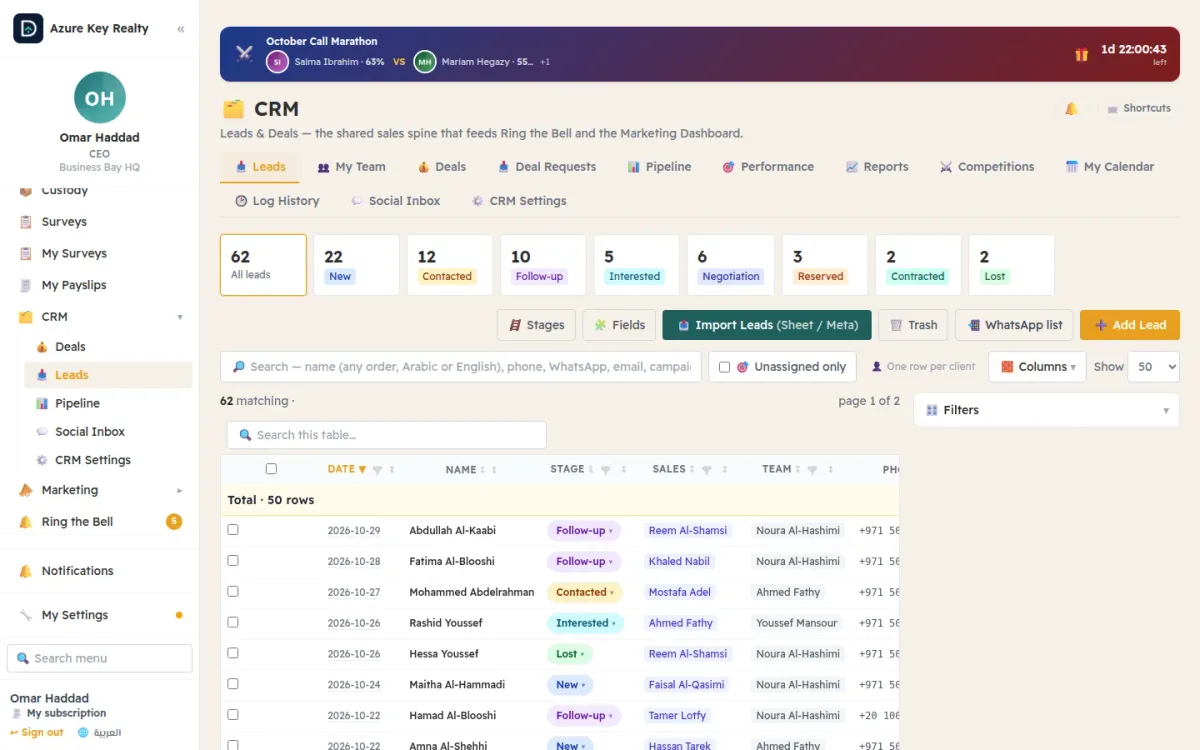
One point to be precise about: Dealora's Payroll page (Payroll is on the Enterprise plan) describes bonuses and deductions as lines that carry a month, a reason, a requester and an approver. It does not describe commission being calculated automatically from contracted deals. So treat the contracted deal as the evidence and the bonus line as the decision, and write the deal reference in the reason. Whatever system you evaluate, ask exactly which of those two steps it does for you.
The staff file underneath it all
Targets and pay both depend on knowing who someone reports to and whether they are still employed. The Employees module keeps branch, department, job title, direct manager, papers and bank details in one file, and supplies the reporting lines that the CRM and org chart use. When a manager is marked as Left, the portal asks for a replacement manager and moves the whole team under them, so targets and approvals do not point at someone who is gone.
Attendance and payroll for sales teams
For field-heavy teams, attendance is the input most often skipped and most often disputed. The Attendance and Leave module (Business plan and above) records check-in and check-out from the browser or the mobile app, with an optional branch geofence. It judges each day against the shift, weekends, Ramadan hours and company holidays, and official holidays are never counted as absence.
Leave and permission requests go to the direct manager, or to a different approver the administrator sets, so the approval is on record instead of in a chat. Deduction Rules form an escalating ladder: on the Nth late arrival, deduct days or send a warning. At month end, Close month snapshots every employee's totals and deduction and locks the month.
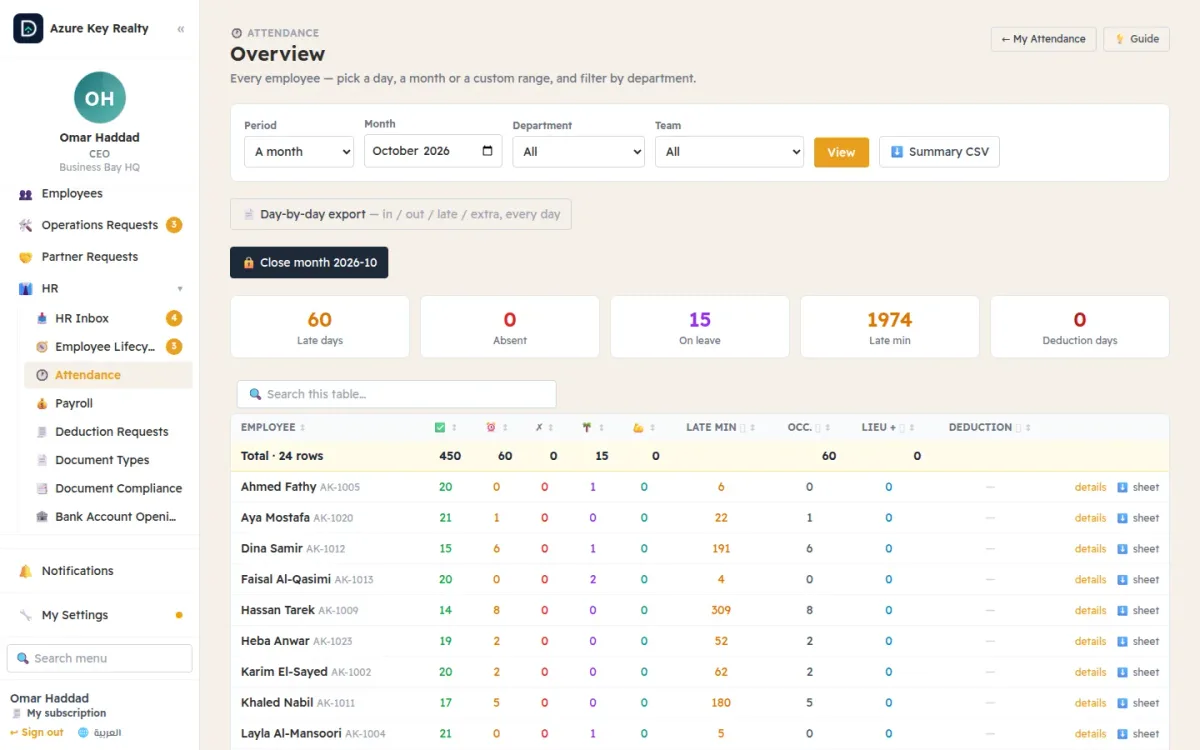
The lock is what matters for pay. The Payroll run reads the month's attendance, and its amber box warns when the month has not been closed in Attendance. When a manager believes one day should not count against someone, Payroll has Forgive the day, which stops that day feeding the deduction. Close attendance first and payroll never rests on a figure that can still change.
Sales commission and payroll: keep bonuses traceable
Commission is wage, not a favor, and the law treats it that way in some markets. Egypt's Labour Law 14 of 2025 defines commission or percentage as a variable part of the wage: a sum paid based on the worker's production, sales or collections. Under Article 108, a worker paid by production or commission whose work takes more than two weeks receives a weekly payment on account, earnings may never fall below the minimum wage, and withholding wages without legal basis is prohibited. For how commissions are structured per deal, see our guide to real estate broker commission in Egypt.
Deductions deserve the same discipline. In Egypt, the establishment's manager may impose a written warning or a deduction of up to three days' wages (Article 148). Deductions are calculated on the basic wage and may not exceed five days' basic wage for one violation or in one month (Articles 140 and 143). Keep a written reason and an approver for each one. Dealora's Payroll records bonuses and deductions with a month, reason, requester and approver, and each payslip line shows why it exists, for example 3 days × 333.33 or instalment 2 of 6.
The Egyptian private-sector minimum wage is EGP 7,000 a month since 1 March 2025, with a mandatory annual raise of at least 3% of the social insurance wage, floor EGP 250, as set by the National Wages Council. The council can change these figures, so check the current figure before you set a commission-only or low-base package.
Sales team targets and bonuses with a contest layer
Many brokerages add short contests on top of the monthly target. The Competitions module (Growth plan and above) scores entrants automatically from calls, meetings, EOIs, contracted deals and sales amount logged in the CRM, as percentages of each person's own target or a shared goal. The organiser declares the winner after the end date, and the result is kept permanently. Because the score comes from logged activity, a prize decision does not rest on screenshots.
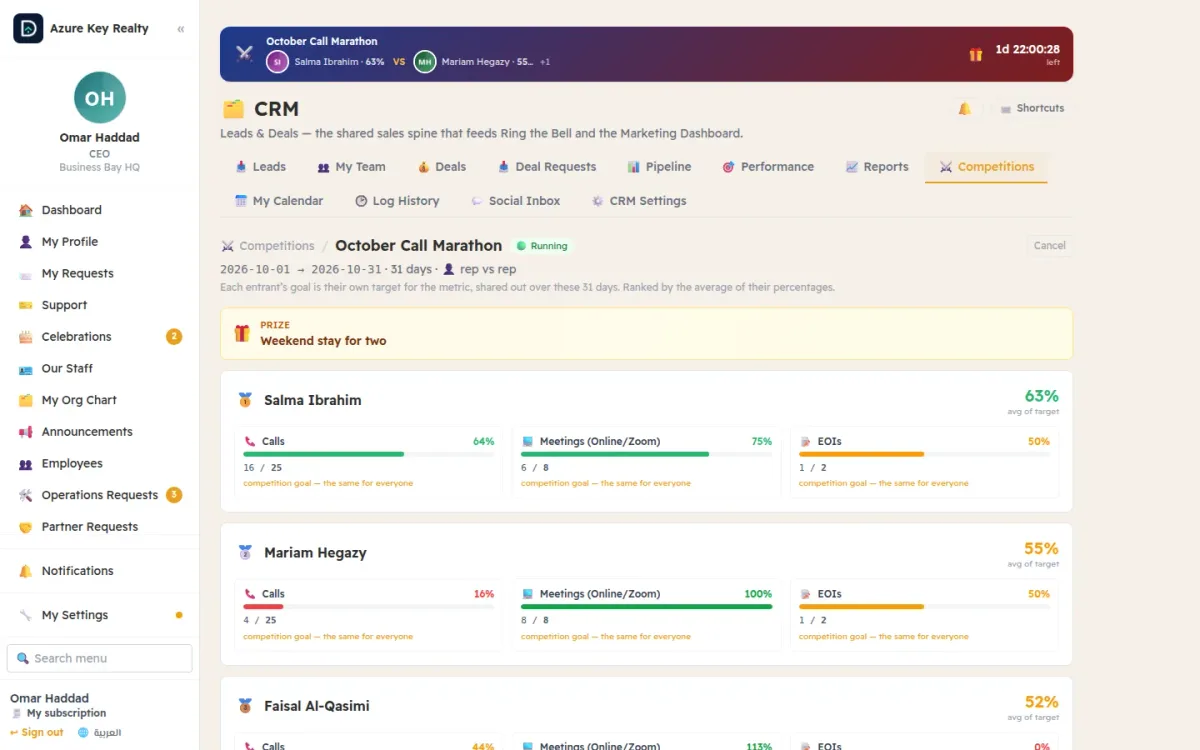
If a contest prize becomes a bonus, treat it like any other: raise it as a bonus line with the competition name as the reason, and let the approver sign it off. For the wider set of tools around targets and follow-up, see how to manage a real estate sales team.
A monthly workflow with owners
Use this order every month. The names of roles will differ in your company, but each step needs exactly one person who answers for it.
- Through the month, the sales manager and CRM Admin approve deal requests and keep every deal at its true stage, so Contracted means contracted.
- Through the month, line managers approve leave and permission requests in Attendance and request bonuses or deductions with a reason as events happen, not at month end.
- Last days of the month, the attendance officer closes any forgotten check-outs and runs Close month.
- Payroll opens the month and reads the amber box (empty sources) and the red box (people with no salary on file, who are skipped rather than paid zero).
- Payroll confirms the From and To dates and presses Generate drafts. Drafts are rebuilt each time, and lines corrected by hand are kept.
- Payroll and the sales manager review the draft lines: bonuses against the deal evidence, deductions against the attendance report. Corrections carry a note, and the original figure stays in the log.
- Payroll approves the drafts and publishes. Publishing locks each payslip, shows it to the employee and takes its advance instalments.
- The owner reads the result. A published month cannot be reopened, and later corrections appear as their own line on the next open payslip.
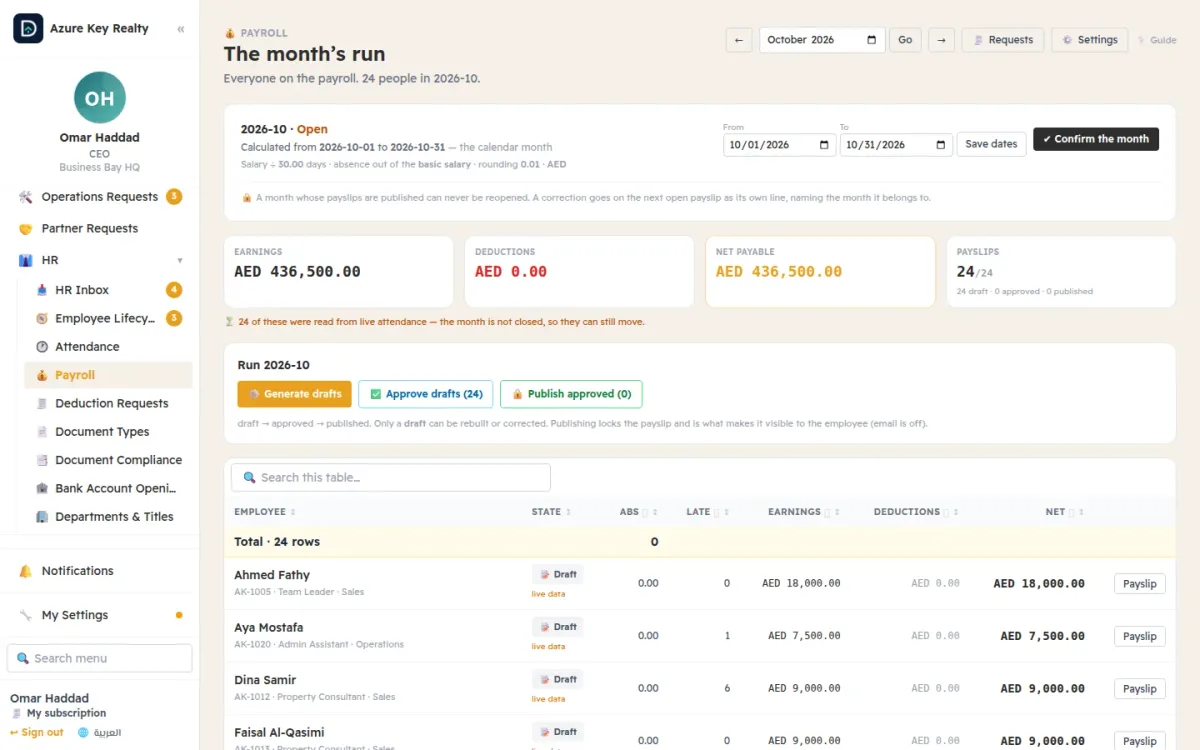
Two details help sales teams specifically. A salary change dated in the past on a published month becomes a back-pay line on the next open payslip, so a mid-month promotion is not lost. And net pay is never negative: an excess is carried to the next payslip or written off, depending on the settings. The full run is described on the Payroll page.
Checks before choosing one system for sales and HR
If you buy integrated sales and HR software, or stitch separate tools together, run these checks in a demo with your own examples, not the vendor's.
- One employee record. Does the CRM user, the attendance profile and the payroll file belong to the same person record, or are they matched by name?
- Reporting lines set once. Can a manager's team be changed in one place, and does the sales side follow?
- Target source. Where is each salesperson's target stored, and can a contest and a bonus read the same figure?
- Deal evidence. Can a manager open the approved deal behind a bonus request in one click?
- Locking. Can attendance and payroll months be closed, and what happens to a correction afterward?
- Explainable lines. Does every payslip line state its reason, so an employee's question is answered by the screen?
- Approvals on record. Are requester and approver stored for each bonus and deduction?
- Language and direction. Do payslips print in Arabic and English, in the right direction?
- Exports and imports. Can staff data go in and out of Excel with a preview before anything is written?
For a broader view of how these modules fit with sales and marketing, see our article on real estate ERP software. If you are weighing ERP against a CRM alone, Keys of Success explains the difference in ERP vs CRM and when a company needs one.
Where to start
Do not migrate everything at once. Start with the staff file and reporting lines, set targets in the CRM, then run one month of attendance with Close month before you run payroll on the system. Compare the first draft payslips against your spreadsheet for a month, and note every line where the two disagree: those are the places your manual process was leaking. Every new Dealora company starts with a free trial of 3 months from the sign-up page. The trial runs on the Starter plan, which covers the staff file and the CRM targets; Payroll is on Enterprise and Attendance & Leave on Business and above, so the payroll comparison needs one of those plans.
Sources
Frequently asked
How do you link sales targets to payroll?
Keep targets and contracted deals in the CRM, attendance in a monthly closed record, and bonuses and deductions as approved lines in the payroll run. Name one owner for each step and run them in order: deals confirmed, attendance closed, drafts generated, drafts approved, payslips published. Every payslip line should point back to a source.
Should sales commission be calculated inside payroll or outside it?
Whichever you choose, the commission must reach the payslip as a visible line with a month, a reason and an approver. In Dealora, bonuses and deductions are recorded lines carrying those details. The contracted deal in the CRM is the evidence behind the line, so check how any system you consider records that link.
Why does attendance matter for a sales team's pay?
Sales staff work from offices, site visits and the road, so lateness and absence rules need clear evidence. When attendance is closed for the month before payroll starts, deductions come from a locked record instead of memory. That removes most of the arguments about excused days and approved leave.
What should a brokerage check before choosing one system for sales and HR?
Check that the CRM, staff file, attendance and payroll share the same employee record, that reporting lines are set once, that a month can be closed and locked, that every pay line shows its reason, and that corrections after publishing appear as new lines instead of rewriting history.
Do pay laws in the UAE, Saudi Arabia and Egypt affect this setup?
Yes. The UAE requires previous-month wages by the first day of each month through approved channels, Saudi Arabia reports salaries on Mudad, and Egypt's Labour Law 14 of 2025 treats commission as part of the wage. A faster, cleaner month end makes these deadlines easier to meet. Confirm current details with your adviser.
Read next
- How to Scale a Real Estate Brokerage: Systems at 20, 50, 100 Reps A stage-by-stage map of the systems a brokerage needs at about 20, 50 and 100 salespeople: what breaks at each
- Software for a 20 Agent Brokerage: What to Require A requirements list for a brokerage of about 20 agents: what the software must do on day one, what can wait, h
- Real Estate Software Egypt: A 10-Point Buying Checklist A market-specific checklist for Egyptian brokerage owners: Arabic and English screens, WhatsApp and Instagram
- Real Estate Software Saudi Arabia: A 10-Point Buying Checklist A buying checklist for Saudi brokerage owners: Arabic and English screens, WhatsApp and Instagram leads, Meta