
Real Estate Software Egypt: A 10-Point Buying Checklist
By Dealora Published Reviewed by Ali Darwish 11 min read
A market-specific checklist for Egyptian brokerage owners: Arabic and English screens, WhatsApp and Instagram inbox, developer data, commission per deal, HR, pricing by team size and a 90-day trial plan.

Real estate software in Egypt should offer Arabic and English screens, WhatsApp, Facebook and Instagram conversations on the client record, developer and project data, deal tracking that supports commission, records you can hand to a regulator, and pricing that fits your team size. Test it for 90 days on real leads before signing.
Real estate software in Egypt has to do things a generic CRM does not: show Arabic and English side by side, keep WhatsApp, Instagram and Facebook conversations on the client record, hold developer and off-plan project data, and give registered brokers clean records for the regulator. Check those points first, then price and trial terms. Dealora, built by Keys of Success and sold in Egypt, Saudi Arabia and the United Arab Emirates, is one option, and the checklist below works for any vendor you shortlist.
What real estate software in Egypt should cover
Most comparison pages list vendors or repeat the same generic CRM features. An Egyptian brokerage has different pressure points: leads arrive from Facebook and Instagram forms, clients write on WhatsApp at night, developers change payment plans, and commissions depend on the developer and the deal. The table gives ten checks and what to look at on screen. The sections after it take them in turn, and the guide to ten features to look for in real estate management software covers the general features.
| Check | What to see on screen |
|---|---|
| 1. Arabic and English | Your own Arabic client names, notes and reports, in both languages |
| 2. Messaging inbox | WhatsApp, Instagram and Messenger chats on the client page |
| 3. Lead capture and distribution | One registration from three forms becomes one client, routed by rules |
| 4. Developer and project data | Developers, projects, phases and files, searchable by the salesperson |
| 5. Deals and commission data | Unit, developer, value, salesperson and approval status on each deal |
| 6. Records for the regulator | Every transaction recorded and exportable on your plan |
| 7. Personal data handling | Consent records, access control, breach process, data location |
| 8. HR and payroll | Attendance, leave, salaries, bonuses and deductions with editable rules |
| 9. Pricing model | Total cost at your headcount and at 50% more, add-ons included |
| 10. Trial and exit | A trial long enough for real deals, and a clear way to take your data out |
Arabic and English screens: what to test
A language switch in the corner is not proof. Type an Arabic client name, an Arabic note and an Arabic project name, then search for each. Open a form, a table and a report in right-to-left layout and check that nothing overlaps or truncates. Ask whether each user can pick their own language, so a manager can work in English while a salesperson works in Arabic on the same record.
Look at the documents too. Policies, announcements and HR letters often need both languages at once, and a tool that handles them side by side will usually handle your sales screens well. In Dealora, the Company Policy module (Business plan and above) shows each policy in English and Arabic side by side, with the acknowledgement status of every employee.
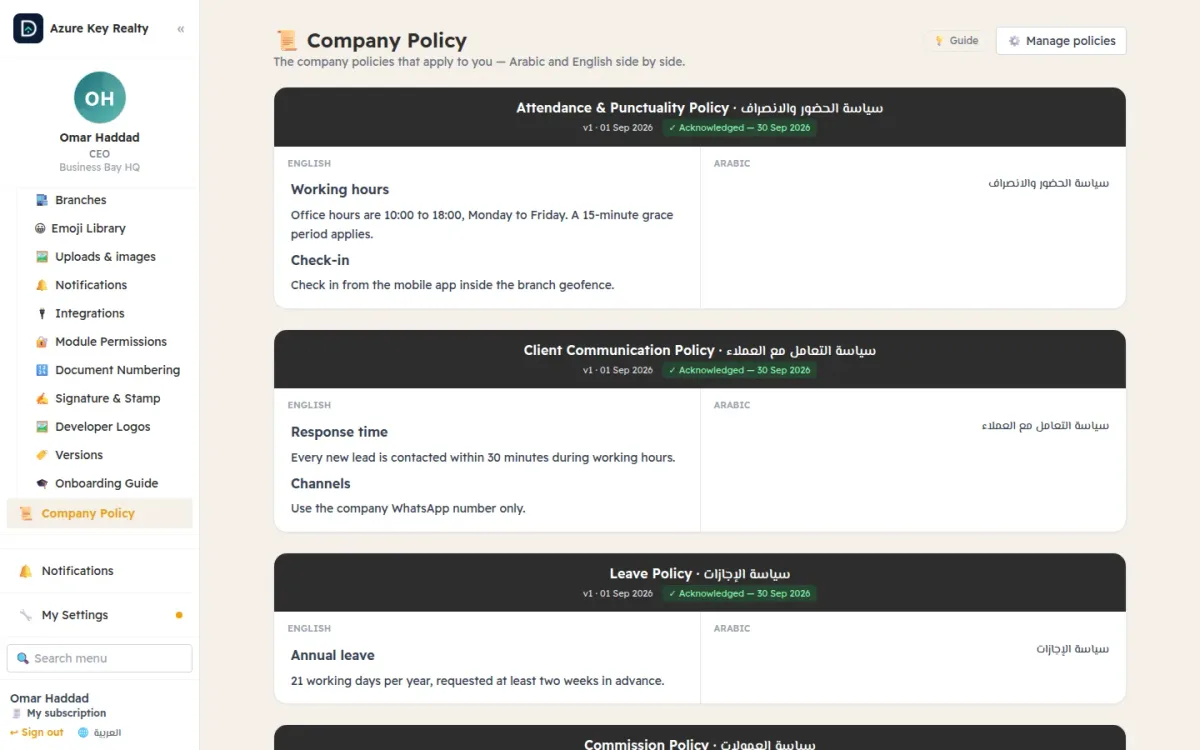
If Arabic is the main reason for your search, the Keys of Success guide to choosing the best Arabic CRM in Egypt goes deeper into what to check.
WhatsApp, Instagram and Facebook inside the CRM
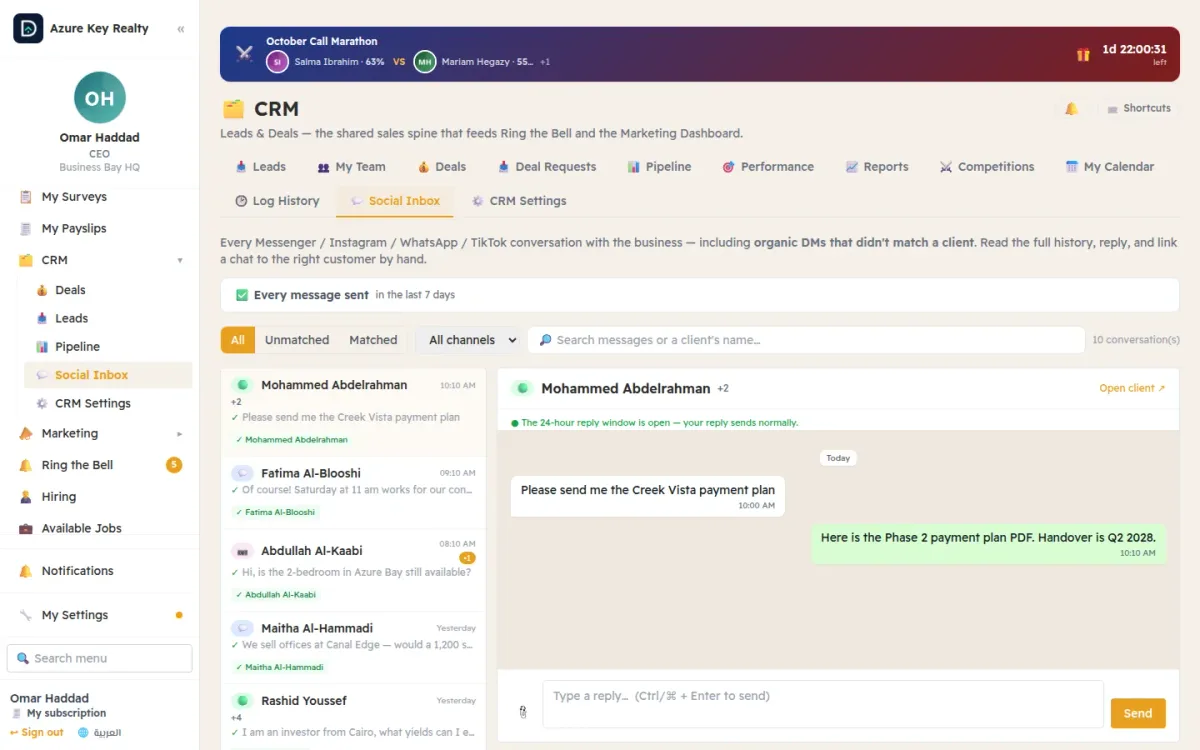
Clients write to a brokerage on WhatsApp, Instagram and Messenger, so the inbox deserves the same scrutiny as the lead list. The aim is simple: every conversation sits on the client record, and when a salesperson leaves, the history stays with the company. Test that unknown senders can be linked to an existing client, that unread messages are visible, and that managers can see failed sends and the reason.
The rules from Meta shape what any inbox can do. A free-form (non-template) reply is allowed only within 24 hours of the client's last message; after that only an approved template gets through. From 1 October 2026 Meta charges for service messages again, with a free tier of 1,000 service messages per month for each business phone number. Unused messages do not roll over. Inside the 72-hour window that opens when a client starts a chat from an ad or a Page button and the business replies, Meta does not charge for marketing, utility, authentication or service messages. These terms change from time to time, so ask the vendor which rules the product follows today.
Dealora's Social Inbox gathers Messenger, Instagram and WhatsApp conversations inside the CRM, shows whether the 24-hour window is open, and records a message sent from a salesperson's own phone once the window has closed. It is part of the Growth plan and above, and it works only with the company's own Meta connection: its Facebook page, Instagram and WhatsApp Business number.
Lead capture and distribution: one client, one owner
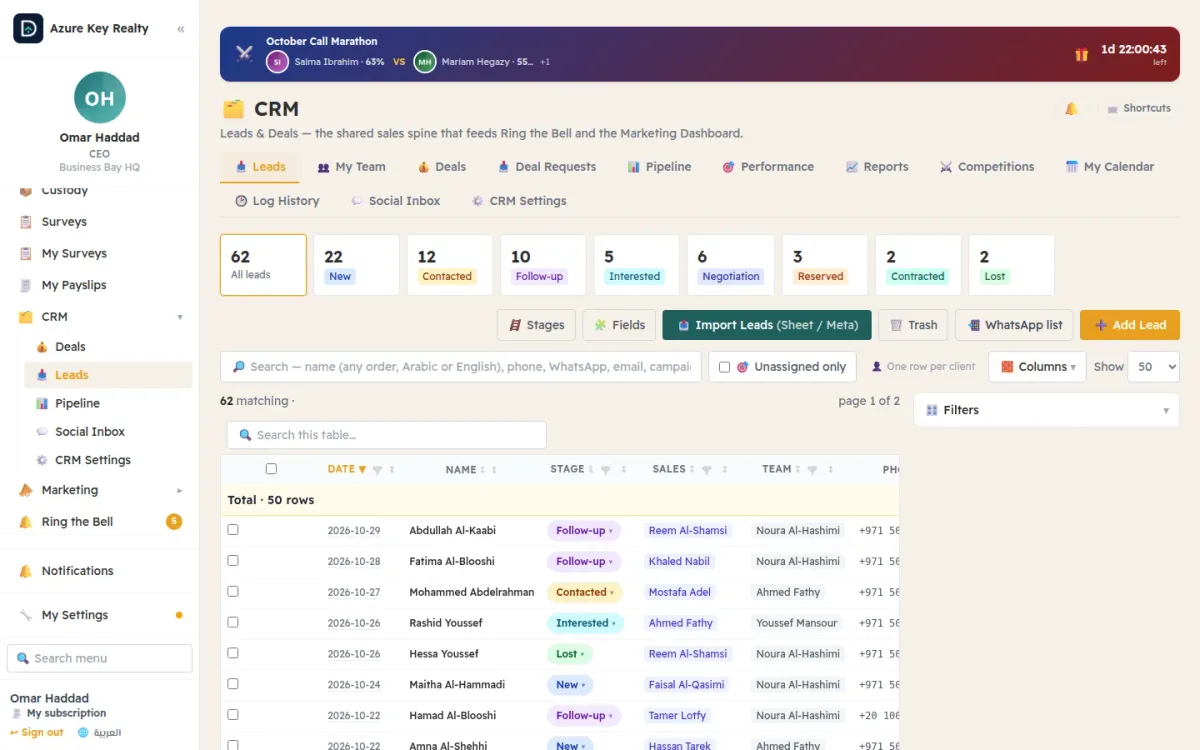
A campaign for a new compound can bring hundreds of registrations over a weekend, and the same buyer often fills in three forms. Test this directly: register one phone number three times from different sources and see whether the software shows one client or three. Then check who owns the client and how that was decided.
Good lead distribution follows rules you set, such as least loaded, round-robin or weighted, and it takes back leads that sit untouched. In Dealora's CRM, phone numbers and emails are matched to one client, pools route new leads to salespeople or teams, and a Pipeline SLA pulls a lead that stays idle too long, with a scan every 30 minutes. Whatever product you test, ask to see the manager's view of what each salesperson holds right now.
Developer and off-plan project data
Egyptian brokers sell mostly developer inventory, so the software should know developers and projects, not just contacts. Check that a salesperson can find a developer, open its projects and phases, and send a project file to a client without leaving the system. A list that shows developers with Arabic names and project counts saves real time at the desk.
Payment plans are the data that moves fastest. Egyptian developers sell on payment plans of 10 to 12 years, and in the first half of 2026 Cairo developers offered plans of up to 15 years and smaller units to keep ticket prices down. Ask how the product stores the current plan for each project and how quickly a manager can replace an outdated file for the whole team.
Off-plan rules are also in motion. As of November 2026 a law requiring escrow accounts for developers and draft rules requiring 30% construction completion before off-plan sales are both still drafts, not in force. You cannot predict the final text, so prefer software where project status and files are editable by your own team rather than fixed by the vendor.
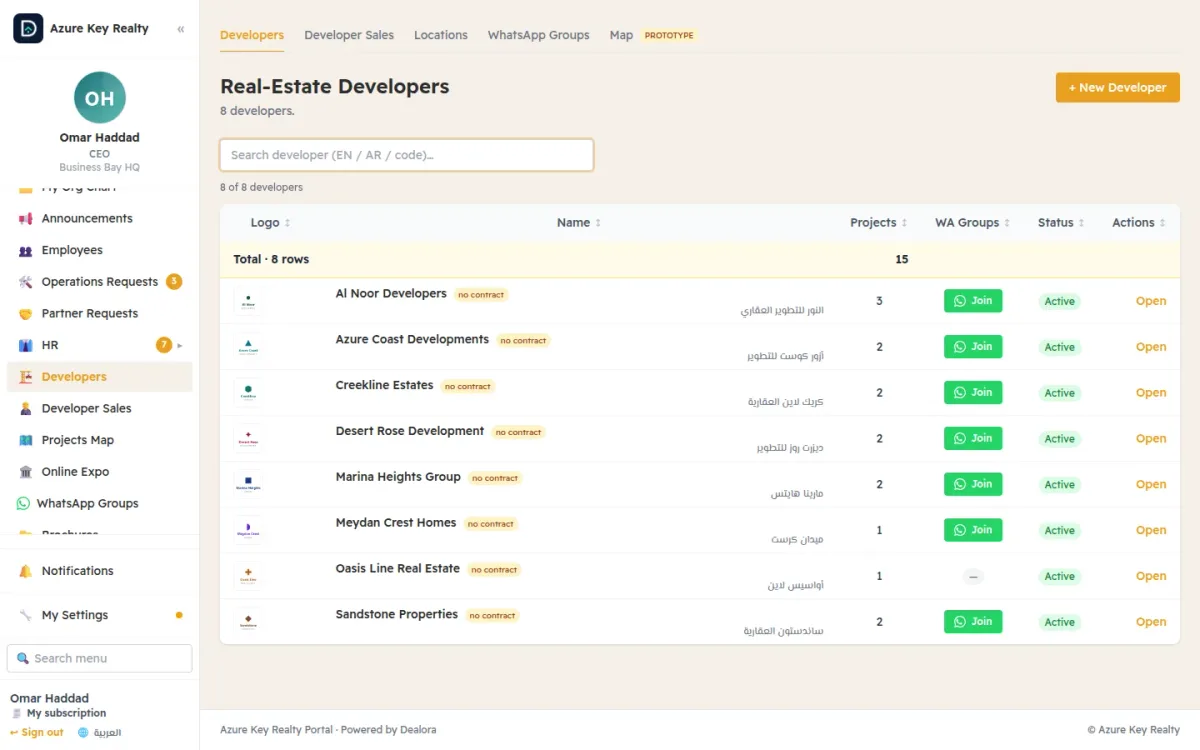
Dealora's Developers & Projects, Projects Map and Developer Sales index modules are on every plan, including Starter.
Commission tracking per deal
Commission rates differ by developer, project and agreement, so ask what the software records and how a manager confirms a deal before it counts. Take five closed deals from last quarter and enter them. Each deal record should carry the unit, developer, value, salesperson, stage and approval status, because every commission calculation starts from those fields. The article on broker commission in Egypt and how to track it per deal sets out the types you will meet.
In Dealora, a salesperson sends a deal request for one unit, the CRM Admin approves, holds or rejects it, and the deal moves from Deal to EOI to Contracted. A unit can sit on one live deal only, which stops two salespeople claiming the same sale.
Records for the regulator and personal data rules
Under Law 21 of 2022, individuals who broker or facilitate contracts for buying, selling or leasing real estate and land in Egypt must be registered in the Real Estate Brokers Registry kept by GOEIC. Amendments issued in January 2026 to the Executive Regulation made the register mandatory for practising and gave the Ministry of Investment and Foreign Trade, through GOEIC, full powers of monitoring and inspection. Registered brokers and marketers must record all transactions and sales contracts and provide them to GOEIC when asked.
Ministerial Decision 578 of 2025, published in the Official Gazette on 17 January 2026, defines four broker types and, in its Article 2, four registration categories (A to D) based on the total value of the contracts a broker handles. Details like these get revised, so confirm the current version with your legal adviser. For software, the practical test is whether every transaction and contract is recorded in one place and whether you can export it. Export is available from the Growth plan in Dealora, and the Starter plan has no data export, so ask every vendor the same question.
Personal data is the second front. Egypt's Personal Data Protection Law No. 151 of 2020 got its Executive Regulations in November 2025, and the one-year grace period that ran from 1 November 2025 ended at the start of November 2026. The regulator is the Personal Data Protection Center. For a brokerage that holds thousands of buyer phone numbers, four points matter:
- Controllers must keep a secure electronic register of consent records, data categories, processing scope, retention periods and security measures, open to inspection.
- Under Article 5, a personal data breach must be notified to the Center within 72 hours of becoming aware of it.
- Transferring, storing or processing personal data outside Egypt needs a permit from the Center, and Article 16 covers transfer permits.
- The permit categories include direct electronic marketing, which affects bulk WhatsApp and SMS campaigns.
Ask each vendor where your data is stored, how access is logged, and what help you get if you need to answer an inspection.
Local HR and payroll needs
A brokerage is a people business, and commissions, advances and late arrivals reach payroll every month. Check that attendance, leave and salary run in the same system as the sales data, so a manager sees the real earnings picture. Also check that the rules are settings you control. From 1 January 2026 the minimum social insurance contribution wage is EGP 2,700 and the maximum EGP 16,700 under Law 148 of 2019, and these limits are revised from time to time, so a figure fixed in the code is a risk.
In Dealora, Attendance & Leave and Employee Lifecycle are on the Business plan and above, and Payroll, with salaries, allowances, advances, bonuses, deductions and the monthly payslip run, is on the Enterprise plan. Smaller teams can start with Employees, which is on every plan, and add HR modules as they grow.
Per-user or flat pricing: how team size changes the answer
With per-user pricing, the bill follows headcount, which suits a team of five that stays at five. With a flat or tiered price, growth costs less per person, which suits a brokerage that adds salespeople each quarter. The cost model for per-user vs flat-rate CRM pricing shows the arithmetic.
Whatever the model, price three things: today's headcount, headcount 50% higher, and every add-on you will need, such as extra users, storage and the Meta connection setup. Dealora's plans have user limits: Individual up to 3 users, Starter up to 10, Growth up to 50, Business up to 150 and Enterprise with no limit. Past a limit you add users or move up a plan, and extra users are an add-on from Starter. Current prices are on the pricing page.
A 90-day trial plan that tests real work
Every new company gets three months free on Dealora's Starter plan, which holds Employees, CRM, Developers & Projects, Projects Map and Developer Sales index, without data export. Use the three months in this order, whatever product you are testing:
- Days 1-30, setup and one source. Import your client list, define stages and sources, create the distribution rules, and run one lead source through two or three salespeople. Check the duplicate test from earlier.
- Days 31-60, the full team. Bring everyone in, move real leads through every stage, enter developers and project files, and push a few deals to EOI or Contracted with approvals.
- Days 61-90, reports and comparison. Compare the system's numbers with your old spreadsheet: leads unanswered, time to first contact, deals by salesperson. Ask each salesperson what slowed them down.
The inbox and WhatsApp campaigns are on the Growth plan and payroll on Enterprise, all outside the Starter trial, so judge them from their pages and a talk with the Dealora team about the plan that fits you.
What to ask before signing
- Which plan includes data export, and in what format?
- What happens to my data and my users if I leave?
- Which modules need my own Meta connection, and who sets it up?
- What does adding a user, storage or a branch cost?
- Where is the data stored, and how do you support a regulator inspection or a breach notice?
- Can each user choose Arabic or English?
- Who helps with the import and the first month, and in which language?
The list of demo questions for brokerage owners goes further on what to ask in a demo. When your shortlist is down to two or three, talk to the Dealora team with your headcount, lead sources and the modules you need, and bring your five test deals.
Sources
Frequently asked
What features should real estate software in Egypt have?
At minimum: Arabic and English screens, one client record that merges duplicate registrations, rule-based lead distribution, WhatsApp, Instagram and Facebook conversations on the client page, developer and project data, deal stages with approvals, and reports per salesperson. HR and payroll matter once the team grows beyond a few people.
Is a per-user or a flat-rate price better for an Egyptian brokerage?
Per-user pricing is cheaper for a small team that stays small. A flat or tiered price is easier to budget when you add salespeople often, because headcount stops driving the bill. Model the cost at today's headcount and at 50% more, and include add-ons such as extra users and storage.
Do Egyptian real estate brokers have to keep records for the regulator?
Yes. Brokers registered under Law 21 of 2022 must record all transactions and sales contracts and provide them to GOEIC when it asks. Your software should keep a clean, searchable record of every deal and, on the plan you choose, let you export it.
How long should I trial a real estate CRM before buying?
Ninety days is enough to run real leads through every stage, including a few deals that reach a contract. Use the first month for setup and one lead source, the second for the full team, and the third for reports and a comparison with your old spreadsheet.
Can I answer clients on WhatsApp after 24 hours?
Only with an approved template. A free-form reply is allowed within 24 hours of the client's last message. After that window closes, a template message is the only kind that can be sent, and from 1 October 2026 service messages beyond a free monthly tier of 1,000 per number are charged.
Read next
- Real Estate Software UAE: A Buying Guide by Brokerage Size How a UAE brokerage should choose its software: match the tool to team size, then test Arabic and English use,
- Real Estate Software Saudi Arabia: A 10-Point Buying Checklist A buying checklist for Saudi brokerage owners: Arabic and English screens, WhatsApp and Instagram leads, Meta
- Real Estate Tech Stack: A Tool-by-Tool Audit for Brokerage Owners A brokerage software audit, tool by tool: the signs a spreadsheet, chat group or HR app can be replaced, what
- How to Test a CRM Free Trial: A 30-Day Plan for Brokerages A week-by-week 30-day plan for brokerage owners: import real leads, run the pipeline with real reps, check dev