
Off-Plan Sales Process: A Broker's Step-by-Step Walkthrough
By Dealora Published Updated Reviewed by Ali Darwish 8 min read
A broker-side walkthrough of an off-plan sale in Egypt and Dubai: what to collect at launch, how to qualify buyers, hold a unit and reach a signed reservation, and how to track it all in one pipeline.

The off-plan sales process for a broker has six steps: collect the developer's launch pack, verify the developer and project, qualify and shortlist buyers, run a viewing or sales-office meeting, hold a unit with a reservation form and deposit, then move to the contract. Track each buyer and unit in one pipeline.
The off-plan sales process, seen from the broker's chair, runs in six steps: collect the developer's launch pack, verify the developer and the project, qualify and shortlist buyers, run a viewing or sales-office meeting, hold a unit with a reservation form and deposit, and move to the contract. The paperwork and the party who registers the sale differ between Egypt and Dubai. Each step carries a check and a hand-off.
Step 1: Collect the launch pack before you sell anything
When a developer launches, the first job is to gather what a salesperson needs to answer any question without calling the developer. Ask for the same items every time, and do not start advertising until you have them.
- The current price list and unit availability, with the date it was issued.
- The payment plan: down payment, installment length, and any handover payment.
- The brochure, master plan, floor plans and the project's location details.
- The name of the developer's sales contact who confirms availability, and a second name for when the first is unreachable.
- Your commission terms for the project, in writing.
The trouble starts on the second price sheet. A developer sends an update on Monday, and by Wednesday two versions circulate in the team's chats. Keep one live brochure per project in a shared library such as Dealora Brochures (on the Growth plan and above), where a manager publishes each new PDF as a version and salespeople always download the latest. Older versions stay with the managers, and the download log shows who downloaded what and when.
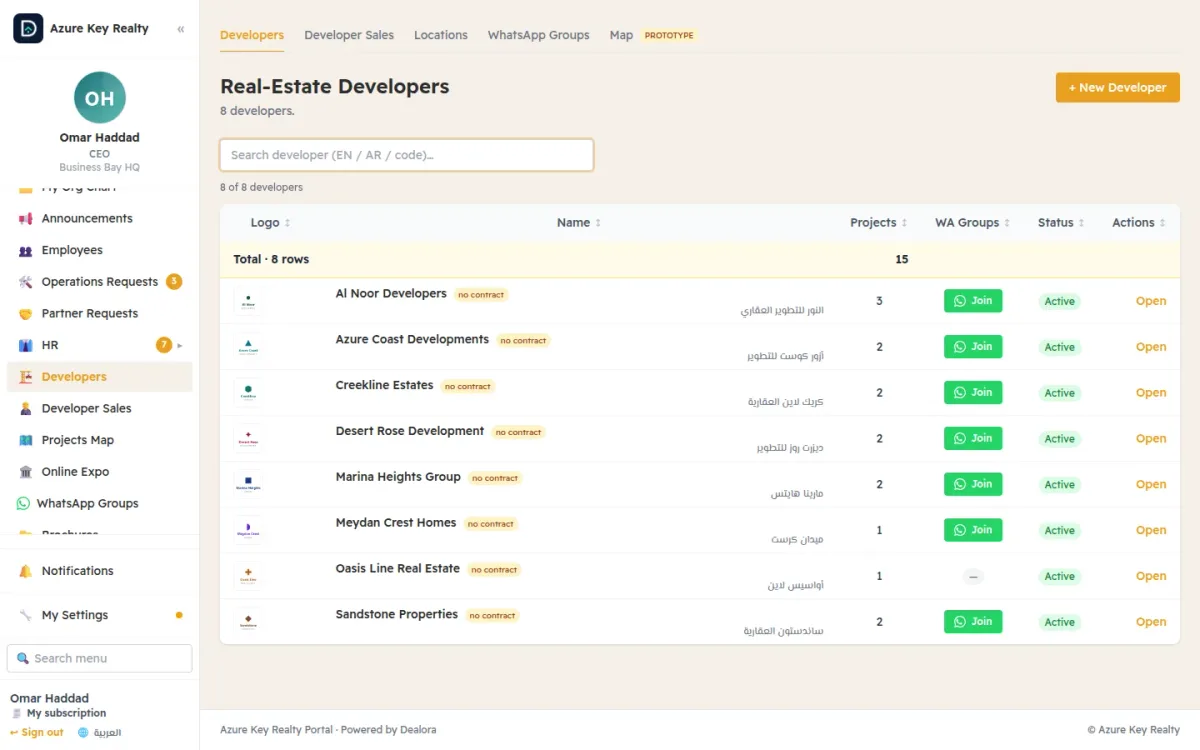
Store the developer's own record in one place too. The Developers and Projects module holds each developer's projects, phases, files, contracts and commission rates, so a salesperson asked for a phase's master plan does not have to ask three colleagues.
Step 2: Verify the developer and the project
A broker who sells an unverified project carries the reputation risk with the client. The checks differ by market, and a salesperson should know the rules at least in outline.
Egypt
Prime Minister's Decree No. 2184 of 2022, issued in June 2022, sets the rules for selling units in real estate development projects. A developer may not announce sales in a project before obtaining the ministerial decision that approves its general plan, and the detailed ministerial decision for the phase being announced. Each project or phase must have its own bank account, and before a phase is offered the developer deposits in it a share of the phase's construction cost that depends on the project's area: 20% for limited, 15% for small, 10% for medium, 5% for large and 3% for maximum-area projects. Ask the developer which approvals are in place before you share the launch with clients.
Dubai
Every off-plan project must be registered with DLD and linked to a RERA-approved escrow bank before sales begin, and all buyer payments go into the project's escrow account under Law No. 8 of 2007. Before anyone reserves, check the project in DLD's Project Status service or Dubai REST, confirm the project licence and the escrow IBAN, and check the agent's RERA broker card. Put these checks in a short list that the salesperson ticks before the first client call.
Step 3: Qualify and shortlist buyers
A launch can bring hundreds of registrations in a weekend, and the same person often registers on three forms. Merge them into one client record first, then qualify. Record the unit type, budget, preferred project and how the buyer plans to pay: a down payment from savings, installments from salary, or an investment purchase. The last distinction changes the pitch, and the comparison of property investors and end-user buyers shows how to tell the two apart and what each wants to hear.
Shortlist only buyers whose budget fits the available units and payment plan. Send each of them two or three matching units, not the whole price list. Who owns each lead should be settled by rule, not by whoever replies first in a group chat. The rules for lead distribution and reassignment cover how to pick owners and pull back leads that sit untouched.
Step 4: Run the viewing or the sales-office meeting
Off-plan buyers cannot walk through the unit, so the meeting has to replace that. Prepare the project's location, the unit's position in the plan, the delivery date as the developer states it, and the full payment schedule in one place. Never promise a delivery date or a return that is not in the developer's documents.
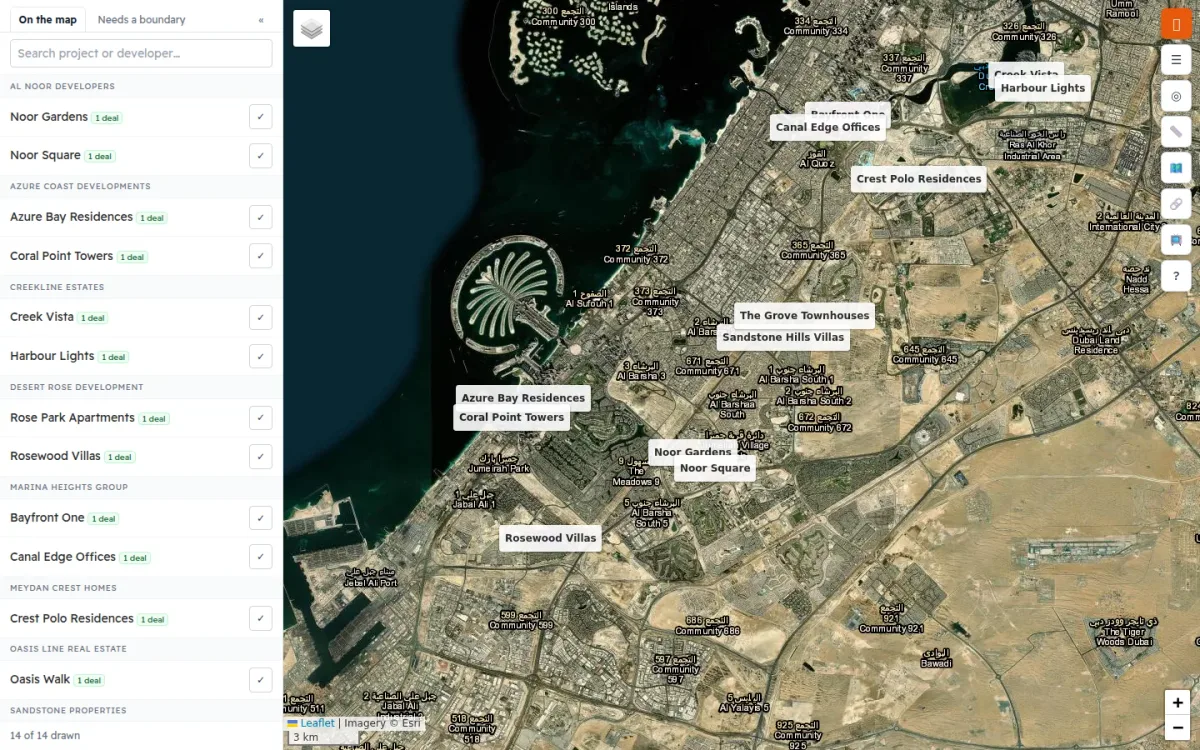
Location is the question every buyer asks first. A projects map lets the salesperson show where the compound sits and what lies around it. In Dealora's Projects Map, a project panel opens the description, files, phases and the developer's salespeople, Nearby lists what is within 5 km, and Present mode hides deals and internal data before the screen is turned to the client. A single project file can be sent to the client through a link that works for 14 days.
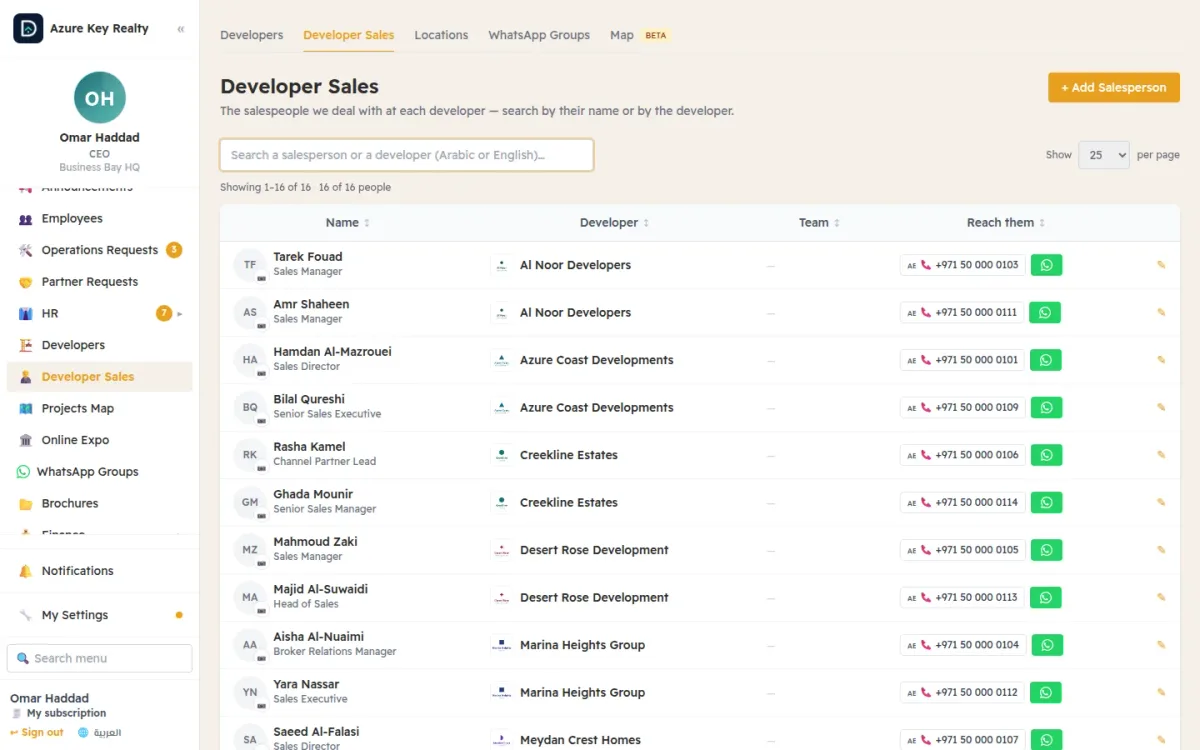
When the client asks for availability on the spot, the developer's sales contact is who you need. Keep those contacts in a shared list instead of personal phones. The Developer Sales index lists the salespeople at each developer with titles, numbers and call or WhatsApp buttons, and marks numbers that lack a country code.
Step 5: Hold the unit and handle the reservation
This is the step where two salespeople most often promise the same unit. Confirm availability with the developer first, then record the hold internally before the client pays anything.
In Egypt, a reservation form and a deposit hold the chosen unit while the contract is prepared. The booking amount is set by each developer and differs by project, a preliminary sale agreement with the developer follows, and the client should read the contract before any deposit is paid. In Dubai, the buyer signs the developer's booking form and pays a booking amount, which should go to the project escrow account. The form states the unit, total price, payment plan and down payment percentage, and the sale and purchase agreement (SPA) follows. The reservation form should also show the amount paid and the refund terms.
Payment plans vary by developer and project. In Egypt, the down payment and the installment period differ from one launch to the next, so confirm the exact terms in writing rather than quoting from memory.
Step 6: From signed reservation to registered contract
A signed reservation is not the end of the sale. Your role now is to keep the buyer moving to the contract and to know what the developer must do.
In Dubai, Law No. 13 of 2008 requires every off-plan sale to be entered in DLD's Interim Real Estate Register, or the disposal is considered void. The developer, not the buyer, registers the sale in the provisional register through the Oqood portal. The four steps on the portal are:
- Log in to the Oqood portal and choose provisional sale registration.
- Select the property, fill in the details, attach the documents and choose the payment method.
- Send the application online.
- The output is emailed to the purchaser.
The developer self-registration fee for a provisional sale on Oqood is AED 1,000, and DLD states that the contract must be registered in the provisional register within 90 days of signing. Ask the developer to confirm the current fee before you quote it to a buyer. Then ask the developer to confirm when the buyer's email arrives and chase it with the buyer if it does not.
In Egypt, the broker's task is to make sure the client has the preliminary sale agreement, understands the installment schedule and keeps copies of every receipt.
Track the off-plan sales process in one pipeline
When the steps live in chats and sheets, nobody can say which buyer is at which step, or which units are held. One CRM pipeline fixes that when each stage has an exit check and a time limit your team sets.
| Stage | Exit check | Hand-off |
|---|---|---|
| New registration | Duplicates merged, owner assigned | Marketing to sales |
| Qualified | Budget, unit type and payment method recorded | Salesperson to manager if budget is large |
| Meeting held | Meeting logged, matching units sent | Salesperson to developer contact |
| Unit held | Availability confirmed by developer, reservation form issued | Salesperson to collections or admin |
| Contract stage | Contract read by buyer, deposit receipt filed | Admin to developer |
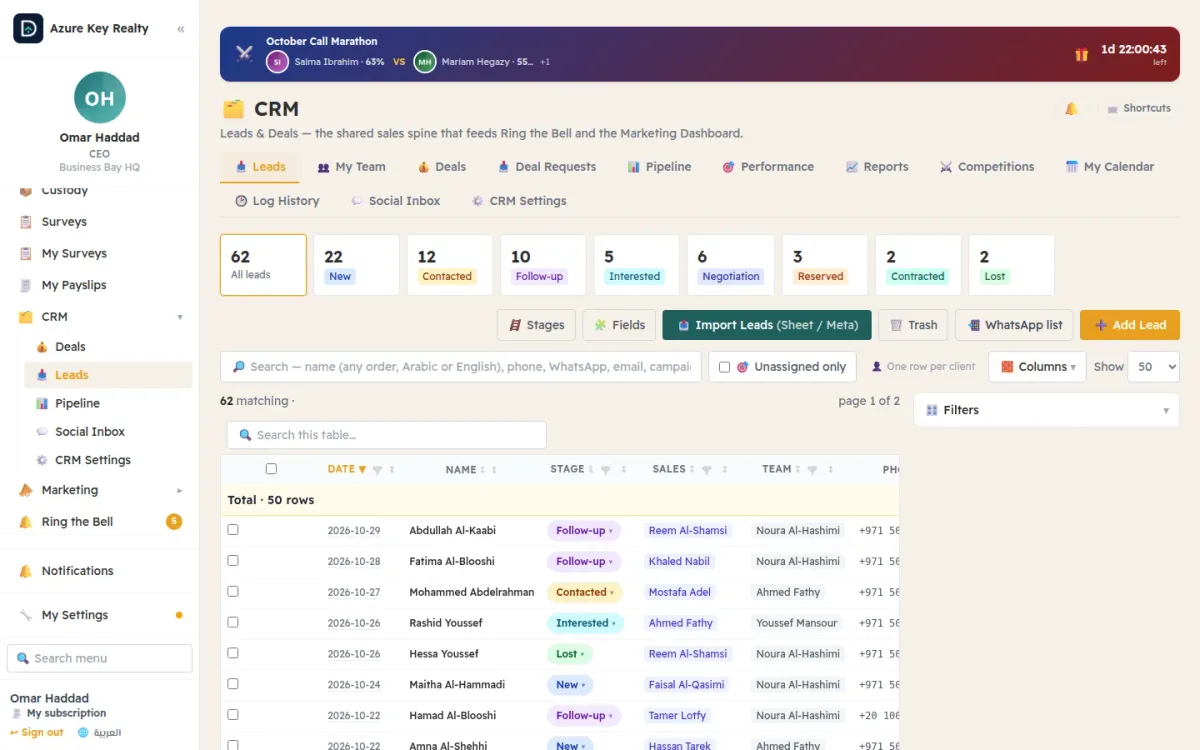
In Dealora's CRM, every phone number and email is matched to one client record, and the salesperson sends a deal request for one unit. The CRM Admin approves, holds or rejects it, and the deal moves from Deal to EOI to Contracted. A unit can sit on one live deal only, which stops the double promise. Pipeline SLA gives each stage a maximum idle time and pulls a lead that sits too long without a sales action. The guide to sales pipeline stages, exit rules and time limits shows how to set those limits.
Off-plan buyer follow-up after the reservation
Off-plan buyers wait months or years for handover, and the doubt comes early. Make follow-up part of the pipeline, not a favor. After the reservation, assign a date for the next contact and log it on the client's timeline. Typical reasons to call are an installment due date, a developer construction update, a new document to sign, or a registration confirmation. Use these touchpoints to ask for referrals only when the buyer has just received good news.
Keep a note of any promise made to the buyer and who made it. When a salesperson leaves, the client record and its history stay with the company, so the next person can pick up the buyer without asking them to start over.
A practical next step: pick your next launch, write the six steps into your pipeline stages with an exit check each, and set a time limit your team agrees on for every stage. Then run the launch through it and see which step loses the most buyers.
Sources
Frequently asked
What are the steps of an off-plan sale for a broker?
Collect the developer's launch pack, verify the developer and project, qualify and shortlist buyers, run a viewing or sales-office meeting, hold the unit with a reservation form and deposit, then follow the developer's contract. Log each step against the buyer and the unit so nothing depends on a chat thread.
Who registers an off-plan sale in Dubai, the buyer or the developer?
The developer. Units sold off-plan, or land plots not fully paid, are registered in the provisional register through the Oqood portal. The buyer receives the output by email. Law No. 13 of 2008 requires the entry, and a sale not entered is considered void.
What should I check before a client reserves an off-plan unit in Dubai?
Check the project in DLD's Project Status service or Dubai REST, confirm the project licence and the escrow IBAN, and check the agent's RERA broker card. The reservation form should show the unit, the amount paid and the refund terms, and the booking amount should go to the project escrow account.
How much is a booking deposit for off-plan property in Egypt?
There is no single figure: each developer sets the booking amount for its project, and a preliminary sale agreement with the developer follows. Confirm the amount in writing. The client should read the contract before paying any deposit, since the reservation form only holds the unit while it is prepared.
Why track off-plan buyers in a CRM instead of WhatsApp and sheets?
Launches bring many registrations at once, the same buyer often registers more than once, and units can be held for two clients by mistake. A CRM keeps one record per client, shows who owns each lead, and allows one live deal per unit, so managers see the real position.
Read next
- Selling Off-Plan Property in Dubai: Team Roles and Follow-Up Selling off-plan property in Dubai with several developer launches running at once needs clear roles, lead rul
- Real Estate Software Saudi Arabia: A 10-Point Buying Checklist A buying checklist for Saudi brokerage owners: Arabic and English screens, WhatsApp and Instagram leads, Meta
- How to Test a CRM Free Trial: A 30-Day Plan for Brokerages A week-by-week 30-day plan for brokerage owners: import real leads, run the pipeline with real reps, check dev
- Software for a 20 Agent Brokerage: What to Require A requirements list for a brokerage of about 20 agents: what the software must do on day one, what can wait, h