
Real Estate Software Saudi Arabia: A 10-Point Buying Checklist
By Dealora Published Reviewed by Ali Darwish 11 min read
A buying checklist for Saudi brokerage owners: Arabic and English screens, WhatsApp and Instagram leads, Meta tracking, PDPL questions for vendors, modules by company size and a 3-month trial plan.

Good real estate software for a Saudi brokerage works in Arabic and English, keeps WhatsApp and Instagram chats in the CRM, tracks Meta leads to closed deals, holds developer and project data, links targets to payroll, prices users clearly, and answers PDPL questions about data. Test it for 3 months on real leads.
The right real estate software for a Saudi brokerage is the one your team will actually use in Arabic and English, that keeps WhatsApp and Instagram conversations attached to the client, follows a Meta lead all the way to a signed deal, and can answer plain questions about personal data. Everything else is a feature list. These checks are built around how Saudi sales teams work day to day, and they end with a 3-month trial you can run on real leads.
Real estate software Saudi Arabia: what brokerages need first
A generic software list will tell you to look for a CRM, reporting and a mobile app. That is true anywhere. A brokerage in Riyadh, Jeddah or the Eastern Province has extra conditions: staff who switch between Arabic and English in the same hour, buyers who start on Instagram and finish on WhatsApp, developer projects that change by the week, and a data protection law that has been fully enforceable since September 2024.
Use the ten checks that follow as a scorecard. Give each vendor a score from 0 to 2 per check, and write down the evidence (a screen, a document, a written answer), not the promise. If you want a wider set of criteria to run alongside this one, the article on 10 features to look for in real estate management software covers the general ground.
Check 1: Arabic and English screens side by side
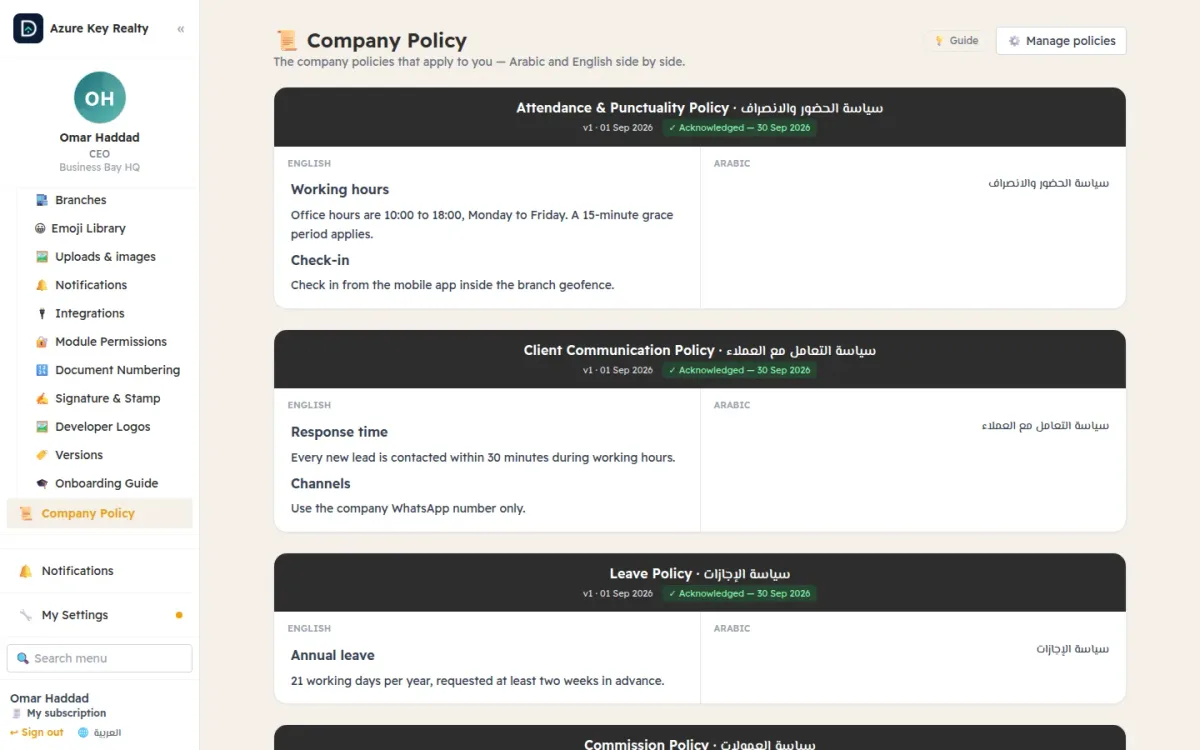
Ask to see the same screen in both languages, with real content in each. Look at right-to-left layout on tables and forms, Arabic names for developers and projects, and whether documents your staff must read (policies, letters, procedures) can exist in both languages at once. Many tools translate the menu and stop there.
The test that matters is a user test: give an Arabic-speaking sales consultant and an English-speaking manager the same task and watch whether either one gets stuck. Dealora runs in Arabic and English, and its Company Policy screen (on the Business plan and above), for example, shows the two languages side by side with each employee's acknowledgement status.
Check 2: WhatsApp and Instagram conversations inside the CRM
In many brokerages, the first conversation may happen on WhatsApp or Instagram. If those chats live on personal phones, the history leaves when a salesperson does, and a manager cannot see which messages went unanswered. Ask whether Messenger, Instagram and WhatsApp conversations land on the client record, and whether an unknown sender can be linked to a client with a few clicks.
Dealora's Social Inbox puts those three channels on one screen inside the CRM, and it is on the Growth plan and above. A salesperson replies to their own clients from the portal, inbox administrators see every conversation, and a panel lists failed sends with the reason and the fix.
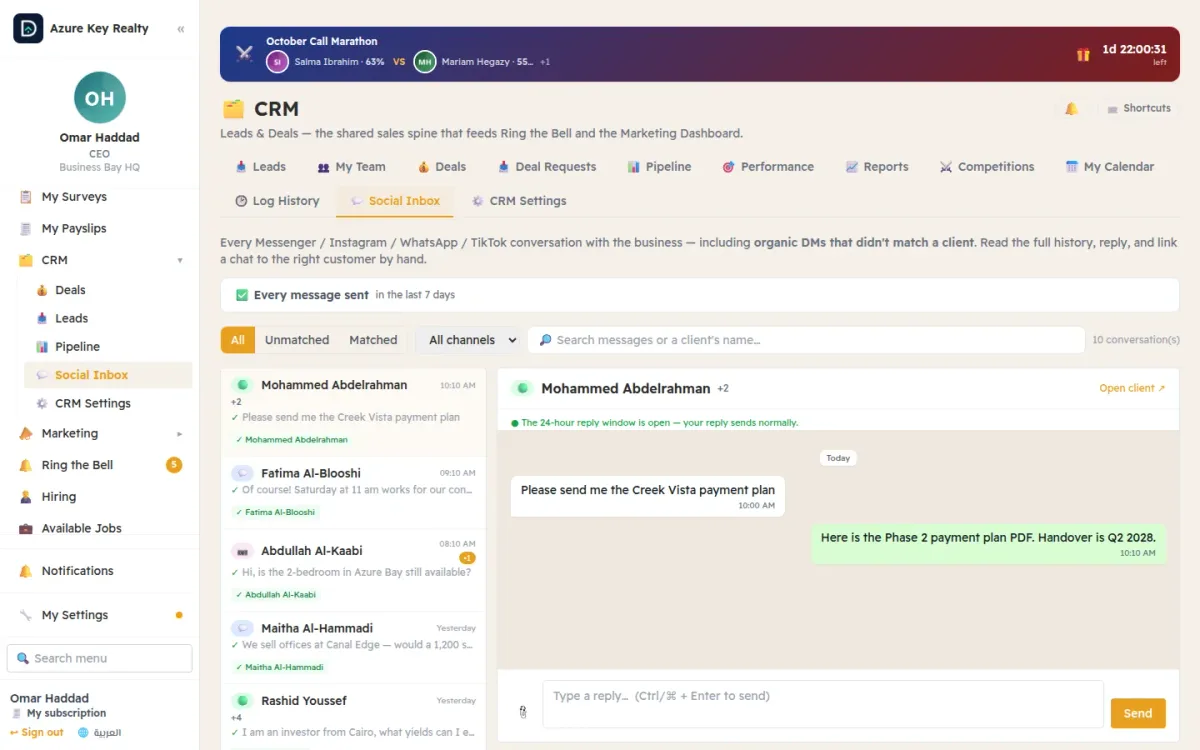
Ask every vendor about the 24-hour window too. Meta allows a free-form (non-template) reply only within 24 hours of the client's last message, and the window resets with each new client message. Once it closes, only a pre-approved template gets through. In Dealora, a line above the messages shows whether the window is open, and when it has closed the salesperson logs a message sent from their own phone so the client record stays complete.
What WhatsApp costs, and what stays free
Meta gives every WhatsApp business phone number 1,000 delivered service messages per month free. The allowance does not roll over and resets monthly, and messages inside the free entry point window are not charged. Since 1 October 2026, Meta charges for free-form service replies sent inside the 24-hour window once a number passes its 1,000 free messages. These terms are Meta's and can change, so ask the vendor whether its quote includes Meta's charges or leaves them to you, and check Meta's current pricing before you estimate volumes.
Check 3: Meta leads tracked to closed deals
Cost per lead is easy to read. Cost per closed deal is the number that decides whether a campaign was worth it, and it needs the lead to keep its source from the ad form through to the contract. Ask the vendor to show one lead from a Meta form to a closed deal on a single client record, and to show what happens when the same person registers twice.
In Dealora's CRM, every phone number and email is matched to one client, so a person who registered three times is one row with three requests behind it. Leads carry sources, tags and requirements such as unit type, budget and project. On the Growth plan and above, the Marketing Dashboard reads spend against leads and sales, with cost per lead and return on ad spend. Meta Ads is included on Enterprise and is an add-on from Growth.
Check 4: Developer and project data
A brokerage sells other people's inventory, so the software has to hold developers, projects, phases and files in a form a salesperson can use in front of a client. Look for a developers list, a projects map, brochures the team can send, and contacts at each developer. If these live in a separate spreadsheet, your team will keep the spreadsheet and ignore the CRM.
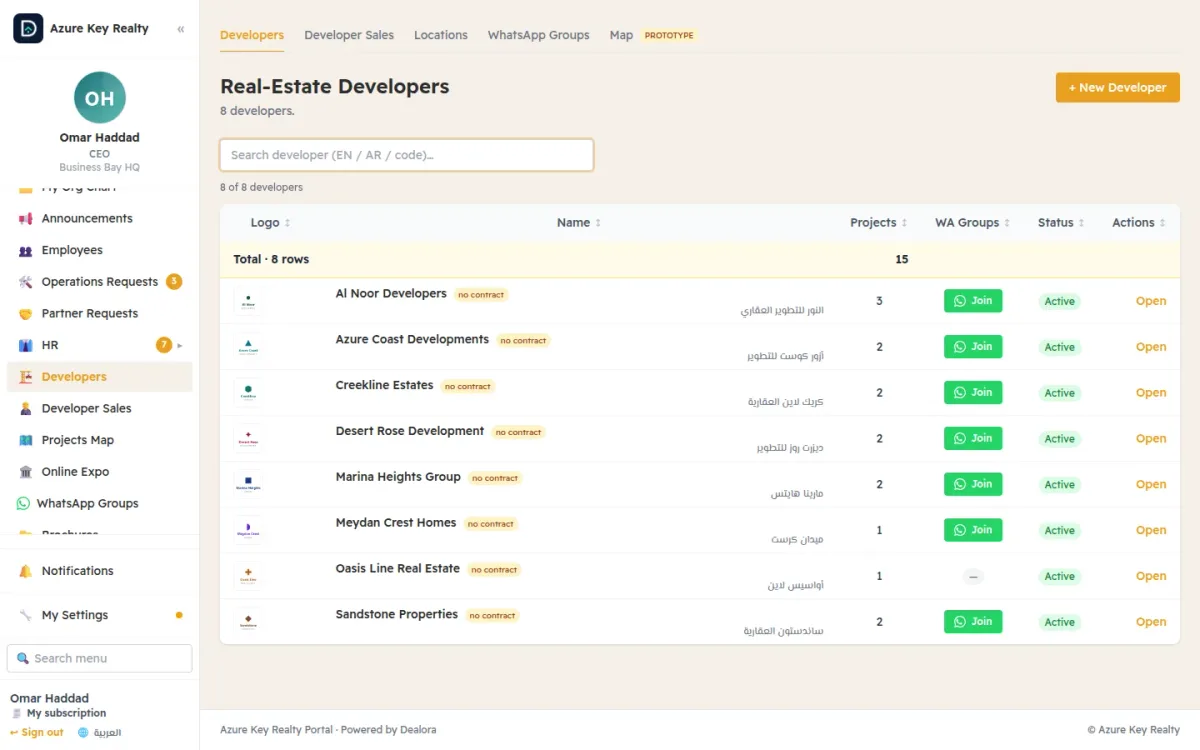
Dealora's Developers & Projects, Projects Map and Developer Sales index modules are on every plan, including the free trial. The developers list shows logos, Arabic names and project counts; the Developer WhatsApp Groups page is on the Growth plan and above.
Check 5: Sales targets tied to payroll
Commission disputes usually start with a number that was typed twice. Ask how a closed deal reaches the month-end salary run: does the figure move by itself, or does someone copy it from a report into a sheet? Also ask who can change a target, and whether changes are recorded.
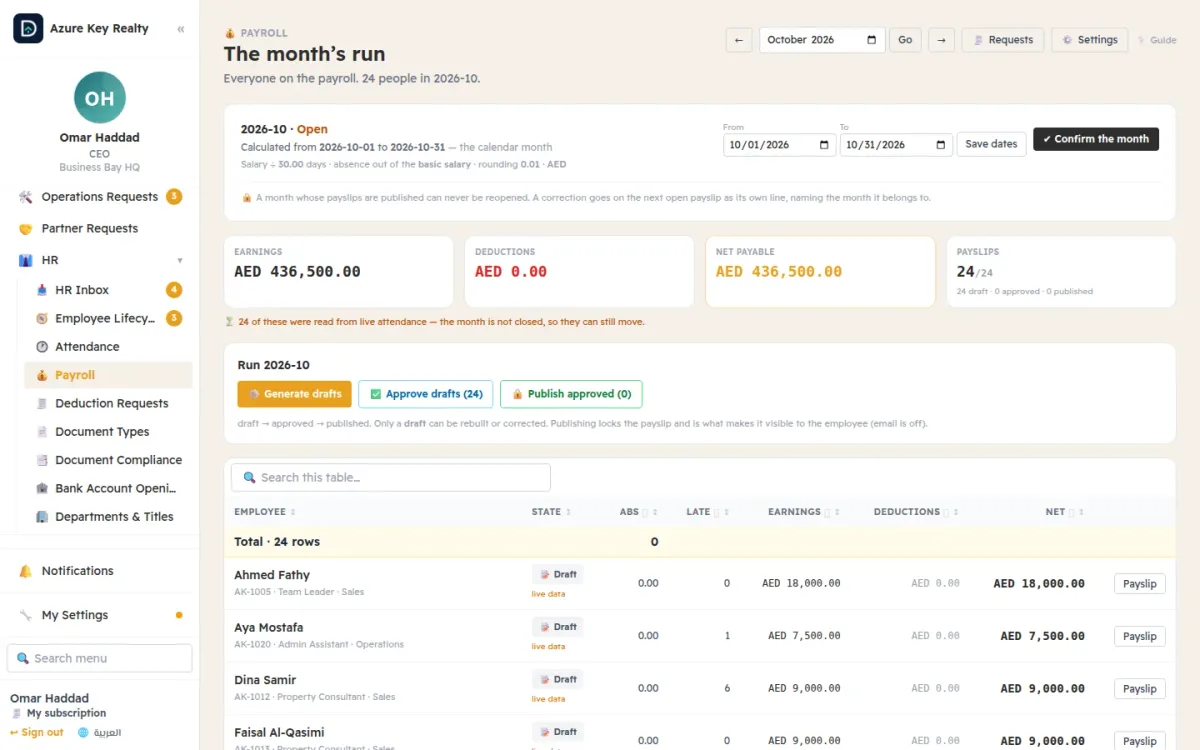
In Dealora, the CRM Admin sets targets in CRM Settings and reports count by salesperson and team. Payroll, which covers salaries, allowances, advances, bonuses, deductions and the monthly payslip run, is on the Enterprise plan. For the method itself, see how to link sales targets to payroll in the blog; the point for buying is to test the handover with one real month of data.
Check 6: Per-user or flat-rate cost
Count every person who needs a login: reps, team leaders, managers, the marketing coordinator, the inbox administrator and HR. Then ask what happens to the bill when you hire ten reps for a new launch. Per-user pricing rewards a stable team; a high user limit rewards a growing one. The article on per-user versus flat-rate CRM pricing gives a cost model you can fill in.
Dealora's plans set user limits instead: Starter up to 10, Growth up to 50, Business up to 150, Individual up to 3, and Enterprise with no limit. Extra users are an add-on from Starter. Starter and Individual have no data export, while Growth, Business and Enterprise do. The pricing page shows plan contents, user limits and add-ons, and the amounts come from the Dealora team.
Checks 7 to 10: data protection, storage and licensing questions
Saudi Arabia's Personal Data Protection Law applies to any processing of personal data of individuals in the Kingdom, by any means, and SDAIA is the regulator. Under the Implementing Regulation, using personal data for professional or commercial purposes is not personal or family use, so your clients and leads are covered. The law entered into force on 14 September 2023 and became fully enforceable on 14 September 2024. Put the questions that follow to the vendor, and check the answers against the law and SDAIA's published regulations, with your own lawyer, rather than assuming them from a sales page.
Check 7: Where is our data stored, and does it leave the Kingdom?
The law requires a controller to tell the person, when collecting data, whether it will be transferred abroad or disclosed to an entity outside the Kingdom, and who receives it. SDAIA's Regulation on Personal Data Transfer outside the Kingdom limits any transfer to the minimum necessary, and requires a risk assessment before transfers made under the appropriate-safeguards route or the exceptional cases. SDAIA issued this regulation in August 2024 and a Risk Assessment Guideline for transfers outside the Kingdom in February 2025. Ask the vendor in writing where servers are, which sub-processors touch the data, and what safeguards apply to any transfer.
Check 8: Can we meet data subject rights and breach duties?
Individuals have the right to access their data, receive it in a readable format, have it corrected or destroyed, and withdraw consent at any time. A controller must notify SDAIA within 72 hours of becoming aware of a breach that may harm personal data or the person's rights. Ask how you would find, export, correct and delete one client's data, and how the vendor tells you about an incident on its side so you can meet that deadline.
Check 9: Does the software help you collect only what you need?
Article 19 of the Implementing Regulation requires collecting and retaining only the minimum personal data needed for the purpose. If you buy or import leads from a third party, you must inform the person within 30 days at most, naming the categories of data and the source. Check that the system records where each lead came from, so that notice is possible.
Check 10: Can the software carry REGA advertising details?
REGA's Governance Regulation for Real Estate Marketing and Advertisements, issued in 2026, means each advertisement needs its own advertisement licence, except where the advertiser is licensed to market an entire project, such as authorised off-plan sales. Every advertisement must show the advertisement licence number, the advertiser's name, the advertiser's REGA licence number and contact details identical to those submitted with the licence application. Software does not replace the licence, but ask whether you can record the licence number against a campaign or source. Anyone can verify an advertisement on REGA's electronic services platform using the advertisement licence number, the brokerage contract number or the ownership document.
For a longer list of questions to put to any vendor in a meeting, use the real estate software demo questions checklist.
Which modules matter first, by company size
Do not buy the whole product range on day one. Start with what removes the biggest leak for your size, then add modules as the team grows. The table matches company size to the first modules and the plan where they begin. Check the user limit against every login, not only reps.
| Company size | Modules that matter first | Plan to check | Add when ready |
|---|---|---|---|
| Small team (up to 10 users) | CRM with one record per client, Employees, Developers & Projects, Projects Map, Developer Sales index | Starter (no data export) | Social Inbox on Growth |
| 20-50 reps | CRM with lead pools and stage time limits, Social Inbox, Marketing Dashboard, WhatsApp Campaign, Task Management | Growth (up to 50 users, with export) | Meta Ads as an add-on from Growth |
| Large brokerage (50 to 150 users, or more) | Everything above, plus Attendance & Leave, Employee Lifecycle, Document Compliance, Company Policy | Business (up to 150 users) or Enterprise (no limit) | Payroll and Meta Ads on Enterprise |
Teams between 10 and 20 users sit in the gap: Starter's limit is 10, so check whether Growth is the plan you will be on within a year. At the large end, the CRM's rules matter more than any extra module. Pools pick the owner by strategy (least loaded, weighted, FIFO or round-robin), and a stage time limit pulls a lead that sits idle and re-distributes it, with a scan every 30 minutes.
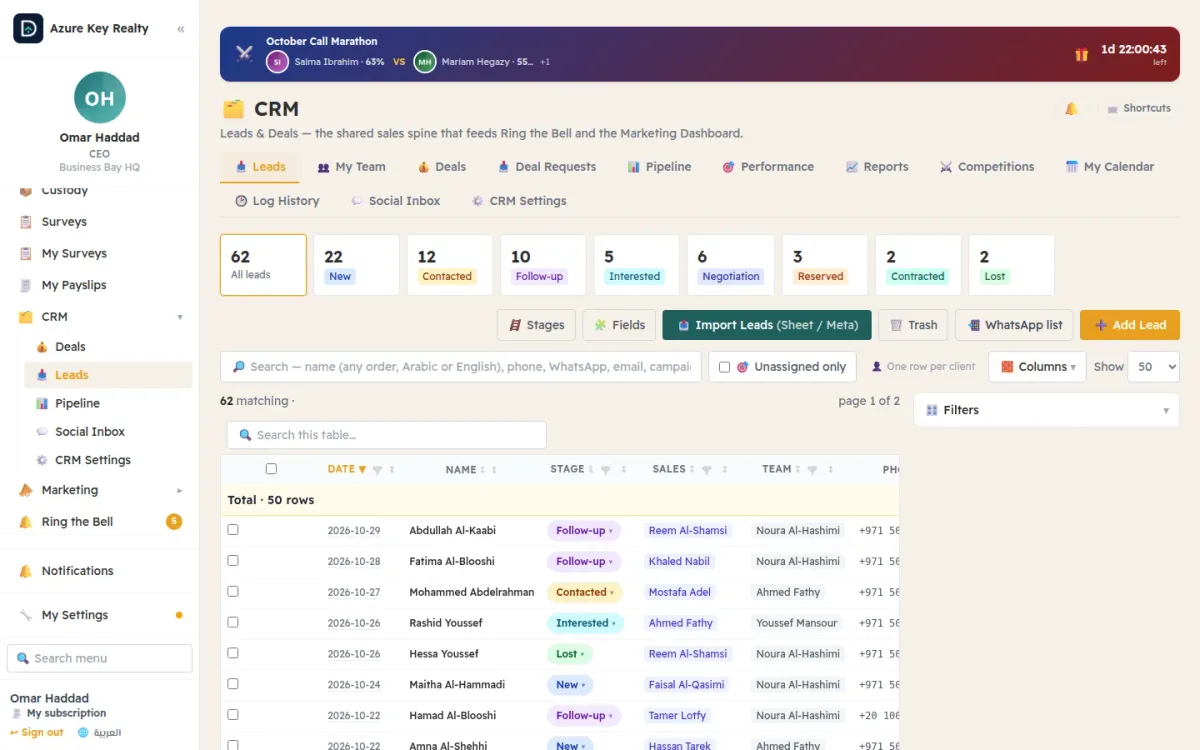
A 3-month trial plan on real leads
A demo shows what a vendor wants you to see. A trial on your own leads shows what your team will live with. Every new Dealora company gets 3 months free on the Starter plan. That trial holds Employees, CRM, Developers & Projects, Projects Map and Developer Sales index, with no data export. Social Inbox, Marketing Dashboard and Payroll are on higher plans, so judge them from the vendor's answers and the plan page, not from the trial.
Month 1: set up and load real data
- Add your team in Employees, with departments and job titles, and give each person only the access they need.
- Import a real list of leads and let the CRM merge duplicates. Count how many rows became one client.
- Set stages, sources and one pool for one team. Write down your reply-time rule before anyone starts.
Month 2: run live work
- Send all new leads for one project through the CRM only, with no parallel sheet.
- Have salespeople log calls, meetings and site visits on the client page and send deal requests from there.
- Use the developers list and the projects map in real client conversations, and note every gap in the project data.
Month 3: measure and decide
- Check the numbers you set at the start: leads untouched after your reply deadline, duplicates found, hours a manager spent distributing leads, and whether the report matches what the sales director believes.
- Ask each salesperson whether they would go back to their old way, and why.
- Send the vendor your written PDPL and storage questions, and compare the answers with SDAIA's published regulations. Ask about export on the plan you would actually buy.
If you want a second scorecard to compare against, Keys of Success, the company behind Dealora, publishes its own real estate CRM comparison with 8 checks before you buy. When you are ready, open a free 3-month Starter account and load one real project, or write to the team through the contact page with your questions on plans, storage and data protection.
Sources
Frequently asked
What should real estate software in Saudi Arabia include?
At minimum: Arabic and English screens, one client record per buyer, WhatsApp and Instagram conversations linked to that record, lead tracking from Meta ads to closed deals, developer and project data, sales reports per salesperson, and clear answers on data protection and storage. Payroll links matter once the team grows.
Does the Saudi PDPL apply to a brokerage's CRM?
Yes. The Implementing Regulation says using personal data for professional or commercial purposes is not personal or family use, so client and lead data held by a brokerage falls under the law. SDAIA is the regulator. Have a Saudi lawyer confirm how it applies to your exact setup.
Can I send WhatsApp replies from the CRM for free?
Meta gives each business phone number 1,000 free delivered service messages a month. Since 1 October 2026, free-form replies inside the 24-hour window are charged once a number passes that allowance. Meta sets the rules and can change them, so check its current pricing before you plan volumes.
Is per-user or flat-rate pricing better for a brokerage?
It depends on how many people need a login. Per-user pricing suits a stable small team; a flat rate or high user limit suits a team that adds reps, managers and admins often. Count every login, including managers, marketers and HR, before comparing quotes.
How long should I trial real estate software?
Three months is enough to run a full cycle: setup, live leads, and a review against numbers you set at the start. Dealora gives every new company 3 months free on the Starter plan, which holds the CRM, Employees, Developers & Projects, Projects Map and Developer Sales index.
Do I need a REGA licence number inside the software?
REGA requires each real estate advertisement to carry its advertisement licence number, the advertiser's name, REGA licence number and contact details. Software does not replace the licence, but ask the vendor whether you can record the advertisement licence number against the listing or lead source.
Read next
- How to Test a CRM Free Trial: A 30-Day Plan for Brokerages A week-by-week 30-day plan for brokerage owners: import real leads, run the pipeline with real reps, check dev
- Software for a 20 Agent Brokerage: What to Require A requirements list for a brokerage of about 20 agents: what the software must do on day one, what can wait, h
- How to Scale a Real Estate Brokerage: Systems at 20, 50, 100 Reps A stage-by-stage map of the systems a brokerage needs at about 20, 50 and 100 salespeople: what breaks at each
- AI Chat Agent for a Real Estate Brokerage: Test, Trust, Go Live One AI agent can answer property customers on Instagram, Messenger, WhatsApp and TikTok, but only if you give