
Speed to Lead Real Estate: A Reply Standard You Can Enforce
By Dealora Published Updated Reviewed by Ali Darwish 12 min read
"Reply fast" is not a standard. Here is a first-reply target for each lead source, rules for after hours, a reassignment deadline and a way to measure median response time per salesperson.

Speed to lead in real estate is the time between a lead arriving and a salesperson's first real reply. Set a written target per source (for example 5 minutes for ad forms and WhatsApp during working hours), name one owner per lead, reassign when the deadline passes, and measure the median per salesperson.
A speed to lead standard that real estate teams can enforce is not "reply fast". It is a written first-reply target for each lead source, one named owner for every lead, a deadline after which the lead moves to someone else, and a weekly number that shows who is meeting the target. A workable starting point is about 5 minutes for ad forms and WhatsApp messages during working hours, with slightly longer targets for portal inquiries and Instagram messages. Each of these pieces can be set in a way that a manager can check.
What does the research say about lead response time?
The oldest numbers still quoted come from Harvard Business Review in 2011, and they are American. An audit of 2,241 US companies, each sent a web-generated test lead, found that 37% responded within an hour, 16% within one to 24 hours, 24% took more than 24 hours, and 23% never responded. A separate study of 1.25 million sales leads at 29 B2C and 13 B2B companies found that firms that tried to contact a lead within an hour were nearly seven times as likely to qualify it as firms that waited one hour longer, and more than 60 times as likely as firms that waited 24 hours or more. Qualifying meant a meaningful conversation with a key decision maker.
Treat those figures as direction, not as a promise for Cairo, Riyadh or Dubai. They are 15 years old and not real estate specific. A closer, but small, check is a 2024 secret-shopper test by Mike DelPrete: more than 100 secret shops, online inquiries and open-house visits, at more than 25 US brokerages, all made during weekday business hours. It found 47% of online property inquiries ignored, a median reply of 39 minutes and an average of 8 hours 17 minutes.
The useful lesson is in why companies were slow. HBR named three causes: leads pulled from the CRM once a day instead of continuously, salespeople busy generating their own leads instead of reacting to interest that already exists, and distribution rules built around geography and "fairness". Each of those is a process problem, and a clear rule can fix each one.
Which speed to lead target fits each real estate lead source?
One target for everything is too blunt. A lead from an ad form gave you a phone number and expects a call. A person who writes on Instagram expects a short message back. These starting points are for working hours. They are our recommendations, not industry rules, so run them for a month, look at your own median, and then tighten them.
| Lead source | First-reply target (working hours) | What counts as the first reply |
|---|---|---|
| Ad form (Meta or other) | 5 minutes | A call attempt, followed by a WhatsApp message if there is no answer |
| WhatsApp message | 5 minutes | A typed reply from the owner that answers the question asked |
| Portal inquiry | 10 minutes | A call attempt or a message that names the property they asked about |
| Instagram message | 15 minutes | A typed reply from the owner, moving to WhatsApp or a call once the person agrees |
Write the target next to the definition of "first reply". An automatic receipt, a read tick or a reply from the page admin who is not the owner should not stop the clock. Only a person who owns the lead, doing something the client can see, does.
Why ad forms get the tightest target
An ad form is the lead with the least context: the person tapped a button and may not remember the project name an hour later. If your team downloads form leads by hand, you are adding delay before anyone even sees them. Meta lead ad submissions do not arrive as an alert by themselves. They sit in Meta's Leads Center and can be downloaded as a CSV from Ads Manager, and instant-form data is available for only 90 days after submission, so older leads cannot be downloaded at all. The fix is to get form leads into the CRM automatically. Dealora's CRM takes ad-form leads in as client records and shows new leads on screen by themselves. For tracing those leads on to closed deals, see how to track leads from Meta ads to closed deals.
What are the rules for after-hours leads?
Leads do not stop at six in the evening, and a standard that ignores nights and weekends will be broken every day. Decide explicitly what the clock does outside working hours, and write it down.
- Pause the clock outside working hours. A lead arriving at 11 pm is "received" at 11 pm but its target starts when the day opens, for example 30 minutes after the first shift begins.
- Name a first-in-the-morning order. Overnight leads are called in order of arrival, before the salesperson touches anything else. Ad-form and WhatsApp leads come first, since they are the most likely to have gone cold.
- Use an on-call rota for weekends and Fridays. One person per shift owns the unclaimed leads for a few hours, rather than everyone assuming someone else will look.
- Keep the 24-hour messaging windows in mind. An evening message can still get a free-form reply next morning, but only if that reply lands before the window closes. The limits of each platform are set out in the messaging windows section.
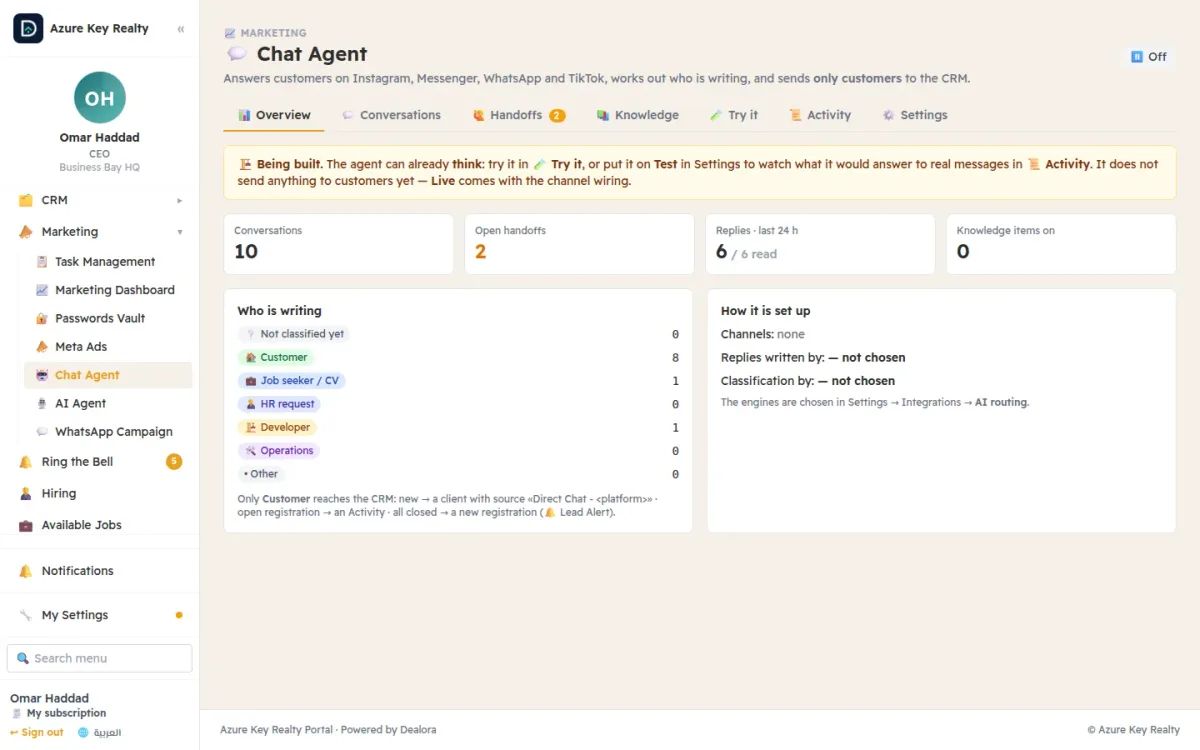
If you use an AI agent for the quiet hours, be clear about what it does. Dealora's Chat Agent (Growth plan and above) drafts replies only from the company's own Knowledge, hands unknown questions to a person, and sends only real customers to the CRM. It works only with the AI Sales Agent add-on. Its replies do not replace the owner's first reply in your measurement. They keep the buyer warm until the owner can speak. Details are on the Chat Agent page.
Who owns a new lead, and how does it get to them?
A lead with no owner has no response time, because nobody is late. Every new lead needs one named salesperson at the moment it arrives, chosen by a rule and not by a message in a group chat. HBR's third cause of slow replies, distribution by geography and "fairness", shows up when the rule is about who deserves a lead instead of who can answer it now.
In Dealora, pools link tags to salespeople or teams, and the matching pool picks the owner by its strategy: least loaded, weighted, FIFO or round-robin. A Leads Bank lets a salesperson press one button and receive unassigned leads, within ceilings per press, per day and per month. Pairing the two gives you a sensible split: fresh paid leads go through a pool, so someone owns them at once, while leftovers wait in the bank for people with capacity. The full set of rules is covered in real estate lead distribution: rules, time limits and reassignment.
One more rule prevents the classic duplicate: when the same buyer registers three times, the CRM matches the phone number or email to one client record. Otherwise three salespeople each reply, or each assume another one will, and the buyer notices.
What should the reassignment deadline be?
The reassignment deadline is the point where a lead that has not had a sales action moves to someone else without a manager having to notice. It protects the buyer, and it also protects the salesperson who is on leave, in a viewing, or simply buried under forty open leads.
Set it in two layers. The first is the first-reply target from the table: a missed target is flagged to the team leader. The second is a hard limit, longer than the target, after which the lead is pulled. For a fresh lead, choose a limit measured in hours inside working time, not days, and pick a number your team can meet on a normal day. Reduce it once the median improves.
In Dealora this is the Pipeline SLA: each stage gets a maximum idle time, and a lead that sits too long without a sales action is pulled and re-distributed. The scan runs every 30 minutes, with quiet hours at night so nobody loses a lead in the middle of the night. Pipeline Rules can also require a logged action before a lead moves forward. How to set stage limits is described in the real estate sales pipeline guide with exit rules and time limits.
What should a good first reply say?
A fast reply that says nothing wastes the speed. The first message has one job: to get a real answer from the buyer. A good one is short, personal and ends in a single easy question.
- Name the source. "You asked about the two-bedroom units in the project you saw on Instagram" shows this is not a mass message.
- Introduce yourself in one line. Your name, your company, and that you are the person who will deal with them.
- Answer what they asked. If they asked for a price range and you have it, give it. If you do not, say when you will.
- Ask one question. Budget, unit type or the purpose of the purchase. Not five at once.
- Offer the next step. A call at a time they choose, or a brochure sent right away.
Never promise a price, a payment plan or a delivery date you have not confirmed. If the question is outside what you know, say that you are checking and when you will come back, then do it. For the questions that turn a first reply into a qualified lead, the Keys of Success article on real estate lead qualification questions gives eight to ask before a viewing.
Which messaging windows limit your reply time?
Targets of 5 to 15 minutes sit well inside the platform limits, but the limits decide what you can send when the target is missed, so the team should know them.
After a user messages a business's professional account, the app has 24 hours to respond. When a human agent replies and needs more time, the response can be tagged so it goes out beyond the window. That tag allows a human-typed reply up to 7 days after the user's message, and it is not for automation.
On the WhatsApp Business Platform, free-form replies need no template approval but are allowed only within 24 hours of the customer's last message or call. Each new customer message resets the 24 hours. Once the window closes, a business can send only approved message templates, and the customer must have opted in, until the customer writes again.
Two details vary and should be checked in your Meta account. A customer arriving through an ad that clicks to WhatsApp can open a free entry-point window when the business replies within the customer service window. Meta's pricing page says that window may remain open for up to 7 days. Charging also changes: from October 1, 2026, Meta charges for free-form service replies after a free tier of 1,000 service messages per business number per month, and for utility templates sent inside the window. Confirm current terms before you build a budget around either.
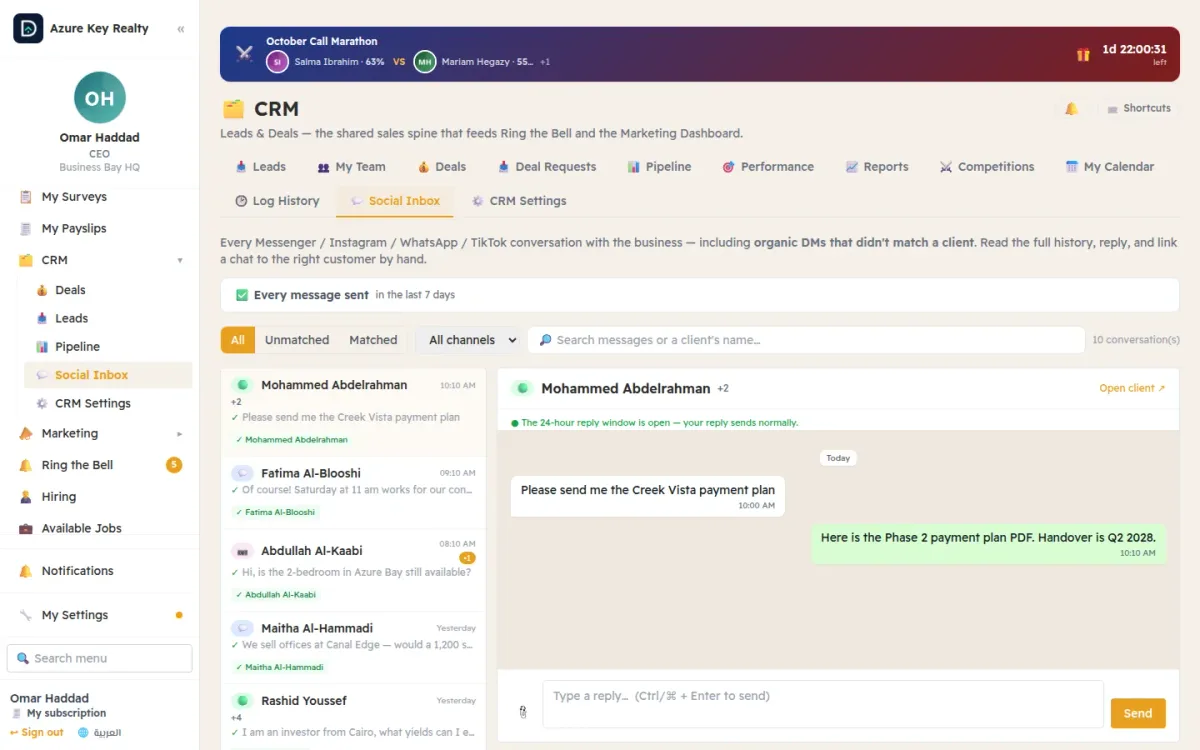
Dealora's Social Inbox (Growth plan and above) shows a line above each conversation that says whether the 24-hour window is open. When it has closed, the button becomes Log sent: the salesperson messages the client from their own phone, types what was sent, and the CRM records it on the client. Nothing goes out from the portal in that case, but the record stays complete, which matters for measuring. See the Social Inbox page for the channel filters and the failed-sends panel.
How do you measure median first-response time per salesperson?
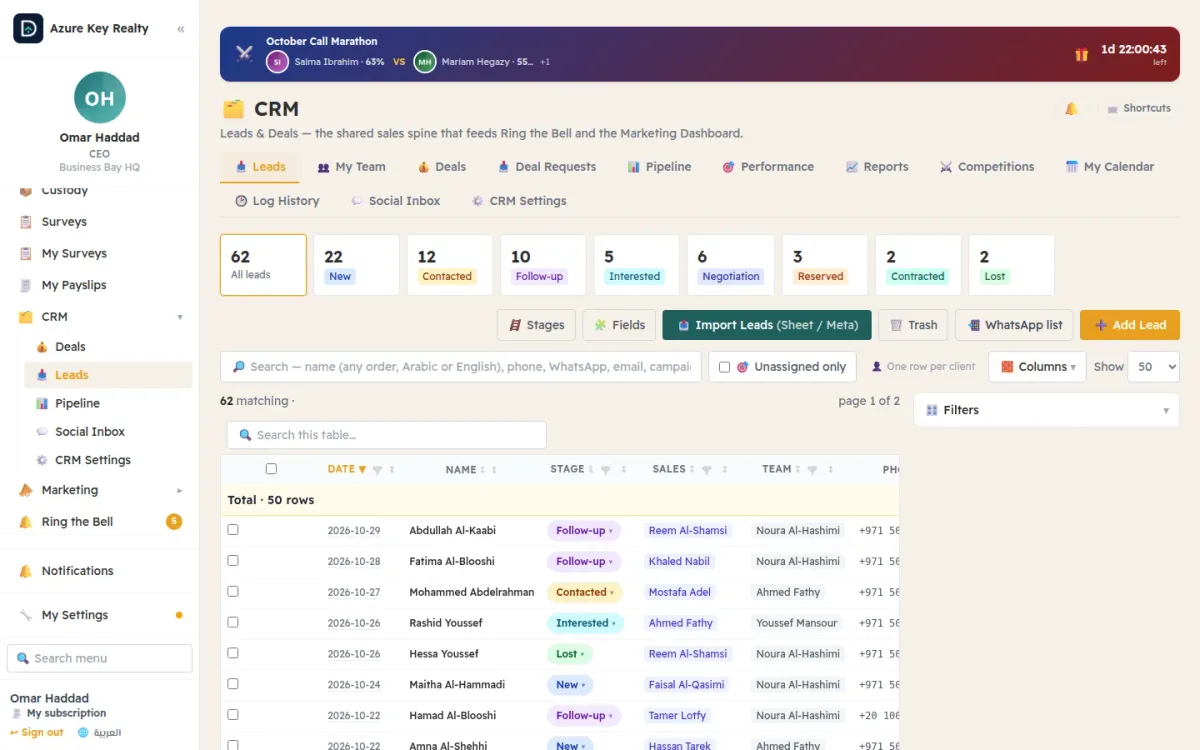
You need three things on every lead: the time it arrived, the owner, and the time of the owner's first logged action. Subtract the first from the third and you have first response time for that lead. The client page in Dealora's CRM keeps a Sales Activity timeline of calls, WhatsApp, meetings and site visits, and the CRM reports per salesperson and team, so those pieces are in one place. Which metric the report shows depends on your setup; the definition that follows is the one to hold constant.
- Start the clock when the lead arrives, or when working hours open for after-hours leads.
- Stop the clock at the first logged call attempt or typed reply from the owner. Automatic messages do not count.
- Use the median per salesperson, per source, per month. A handful of overnight leads can drag an average up while the typical reply is fine.
- Add the share inside target. "82% of ad-form leads answered within 5 minutes" is easier to act on than a single number.
- Count reassignments. A salesperson whose leads are repeatedly pulled has a capacity or discipline problem that the median alone can hide.
Compare salespeople only when each has enough leads to make the median meaningful. A person with six leads in a month tells you little. Review the figures weekly in the team meeting, look at the slowest source first, and ask what blocked the reply. Usually the answer is a system issue: a missing notification, a lead that never reached the owner, or an owner with too many open leads.
Speed only pays if the reply leads somewhere, so connect the metric to outcomes. Compare first-response time with how many leads become viewings and deals, as described in real estate leads in 7 steps. Over a few months you will see where your own threshold lies, which is worth more than any borrowed benchmark.
What to do this week
Pick one lead source, usually the ad form, and write its first-reply target and the definition of a first reply on one page. Check that every lead from that source lands in the CRM with an owner within a minute or two of arriving. Then pull last month's arrival and first-action times, work out the median per salesperson, and share it with the team. You will have a baseline before you change anything, and a clear case for the reassignment deadline. New companies on Dealora start with a free trial from the sign-up page, if you want to set these rules up in a live CRM. The trial runs on the Starter plan, which includes the CRM; Social Inbox and Chat Agent come with Growth and above.
Sources
Frequently asked
How fast should a real estate agent respond to a new lead?
There is no single legal or universal number, so set your own written target per source. A workable starting point is about 5 minutes for ad forms and WhatsApp messages during working hours, and 10 to 15 minutes for portal inquiries and Instagram messages. Measure the median for a month, then tighten it.
What is speed to lead in real estate?
Speed to lead is the time between a buyer or tenant showing interest, through a form, a message or a portal inquiry, and the first real reply from the salesperson who owns that lead. An automatic receipt does not count. The reply has to come from a person and move the conversation forward.
Should I measure average or median first response time?
Use the median. A few leads that arrive at night and wait until morning inflate the average and hide how the team behaves on a normal lead. The median shows the typical wait. Track the share of leads answered inside the target as a second number.
How long do I have to reply on WhatsApp and Instagram?
On WhatsApp Business Platform, free-form replies are allowed within 24 hours of the customer's last message, and each new message resets the clock. After that, only approved templates go out. On Instagram, the app has 24 hours, and a human agent tag can extend a typed reply to 7 days.
What should I do when a salesperson does not reply in time?
Reassign the lead automatically at a fixed deadline, not when a manager happens to notice. Decide the idle time per stage, move the lead to the next owner, and record the miss against the first owner. In Dealora, Pipeline SLA pulls idle leads and redistributes them.
Read next
- AI Chat Agent for a Real Estate Brokerage: Test, Trust, Go Live One AI agent can answer property customers on Instagram, Messenger, WhatsApp and TikTok, but only if you give
- Software for a 20 Agent Brokerage: What to Require A requirements list for a brokerage of about 20 agents: what the software must do on day one, what can wait, h
- PropSpace Alternative for UAE Brokerages: Cost Model and Tests A decision guide for UAE brokerage owners leaving per-user pricing: a yearly cost model at your own headcount,
- Real Estate Software Saudi Arabia: A 10-Point Buying Checklist A buying checklist for Saudi brokerage owners: Arabic and English screens, WhatsApp and Instagram leads, Meta