
PropSpace Alternative for UAE Brokerages: Cost Model and Tests
By Dealora Published Reviewed by Ali Darwish 10 min read
A decision guide for UAE brokerage owners leaving per-user pricing: a yearly cost model at your own headcount, six tests for any replacement CRM, and a migration trial on one small team.

A good PropSpace alternative for a UAE brokerage is the one with the lowest total yearly cost at your own headcount, including hiring peaks, and that passes six tests: data export and import, lead sources, WhatsApp and Meta handling, Arabic and English screens, extra-user cost, and personal-data handling. Prove it on a small team first.
The right PropSpace alternative for a UAE brokerage is not the tool with the lowest price per seat. It is the one with the lowest total yearly cost at your own headcount, including the months when you hire heavily, and one that passes six practical tests before you move a single client record. A yearly cost model and a migration trial on a small team settle it.
When a PropSpace alternative is worth pricing
Owners usually start looking when the bill stops matching the way the company grows. A brokerage in Dubai or Abu Dhabi does not hire evenly. It adds agents before a big launch season, after a developer event, or when a new team leader arrives with a group of followers. Under per-user pricing, each of those moments raises the invoice, and agents who leave do not always free a seat on time.
Price is only one trigger. Others are a lack of control over lead distribution, no way to export your own client data, weak Arabic screens for part of the team, or WhatsApp conversations that live on personal phones. Any of them is enough to run a comparison. The comparison itself should be the same whatever tool you leave, so it starts with arithmetic you can do on one page.
How to model the yearly cost at your own headcount
The theory of seat-based and company-level pricing is covered in our cost model for per-user vs flat-rate CRM pricing. For a switch decision you need the applied version: your numbers, twelve months, peaks included.
Step 1: count user-months, not heads
List every month of the year with the number of people who need a login: agents, team leaders, the sales manager, admin staff and anyone in marketing who reads leads. Add the twelve numbers. The total is your user-months. A team of 20 for eight months and 32 for four months is 160 + 128 = 288 user-months, not 20 x 12 or 32 x 12.
Then check what your current contract actually bills. Some contracts bill monthly on active seats. Others bill annually on the highest seat count, which in this example would be 32 x 12 = 384 user-months. The difference is the first number to bring to a renewal talk.
Step 2: price both models on the same table
The figures below are placeholders to show the method, not market prices. Replace them with your quotes.
| Line | Per-user tool | Company-level plan |
|---|---|---|
| Users in the base months | 20 users x 8 months = 160 user-months | Covered by the plan if within its user limit |
| Users in the peak months | 32 users x 4 months = 128 user-months | Extra users only above the plan limit |
| Yearly subscription | Price per user per month x 288 | Plan fee x 12 + extra users |
| Add-ons you need | Storage, integrations, onboarding | Storage, Meta connection setup, website connection |
| VAT | 5% on top | 5% on top |
| Total yearly cost | Add the rows | Add the rows |
Step 3: find your break-even price
Divide the yearly cost of the company-level plan (with extra users, add-ons and VAT) by your user-months. The result is the per-user monthly price at which the two options cost the same. If your current per-user price is above it, the switch saves money at your headcount. If it is below, the saving has to come from somewhere else, such as control, export or bilingual screens.
Run the table three times: at your current headcount, at the headcount you plan for next year, and at the peak you hit in your busiest quarter. A model that only works at today's headcount is not a decision.
Costs that sit outside the subscription line
The standard rate of VAT in the UAE is 5%, the same in every emirate. A software subscription from a VAT-registered supplier is normally quoted before it, so add 5% to every quote and compare like with like.
Then list what else changes the total:
- Extra users. Ask what a user costs beyond the plan limit and whether it is billed monthly or yearly.
- Storage. Brochures, contracts and recordings add up; ask what happens when you pass the allowance.
- Connections. Setting up the company's own Meta connection, or linking the company website to the CRM, may be an add-on rather than part of the plan.
- Usage charges. AI calling and WhatsApp messaging are usually charged by use, on top of the subscription.
- Exit cost. If you cannot export your data, leaving later costs you the data itself.
For a wider view of what each size of brokerage needs, see our buying guide to real estate software in the UAE by brokerage size.
What to test in any replacement CRM for UAE brokerages
Price decides whether a switch is worth considering. These tests decide whether it is safe. Run all six with real records, not with the sample data a vendor loads for you.
1. Data export and import
Ask for an export of your current data in an open format before you do anything else, and keep it. Then import a real sample into the new tool and check what survives: phone numbers in international format, duplicate matching, notes, sources, owners and stage history. Also ask whether the new plan lets you export later. Export availability can depend on the plan, so confirm it for the plan you would actually buy.
Client and lead data exported or imported is personal data. Federal Decree-Law No. 45 of 2021 on the Protection of Personal Data has been in force since 2 January 2022, so decide who may export, where the files are kept, and delete test files when the trial ends.
2. Lead sources
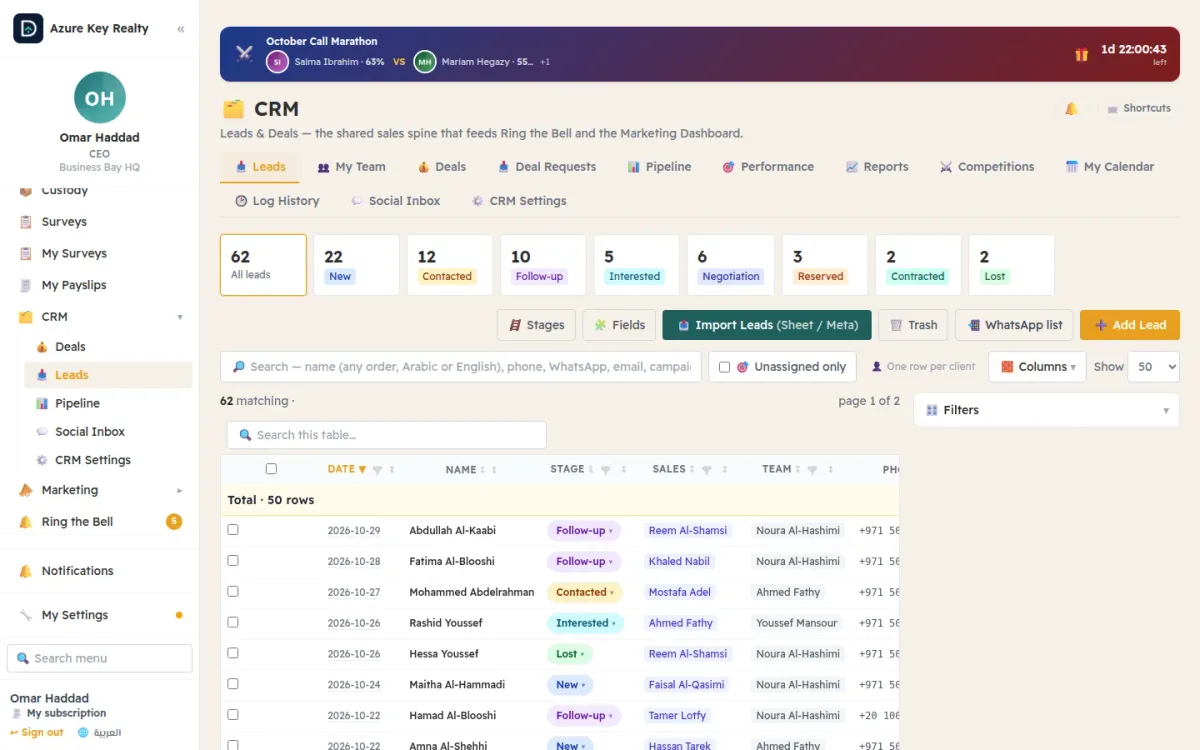
List every place a lead comes from: portal enquiries, Meta lead forms, your website, WhatsApp, walk-ins, referrals and imported lists. For each, check in the CRM's lead list that the lead arrives as one client record, that the source is kept, and that a person who registers twice is matched to the same record. Then check how leads are distributed: by pool, by round-robin, by workload or by hand.
3. WhatsApp and Meta handling
Ask exactly how the tool handles WhatsApp. Free-form messages can only be sent inside an open 24-hour customer service window, which opens and resets with each message from the client, so reaching out first takes an approved template.
Pricing also changed. Since 1 October 2026 Meta charges again for service messages, with a free tier of 1,000 service messages per month on each business phone number. The allowance does not roll over and is not a shared pool, so a company with three numbers gets 1,000 on each. Utility messages sent inside the window are also charged from that date. Messages inside the free entry point window, opened by a Click to WhatsApp ad or a Facebook Page call-to-action button, stay free for delivery if the client writes from an Android or iOS device and the business replies within 24 hours. These terms can change, so confirm them before you sign.
Ask the vendor which of these costs pass through to you, and whether the connection uses your company's own Meta assets: its Facebook page, Instagram account and WhatsApp Business number.
4. Arabic and English screens
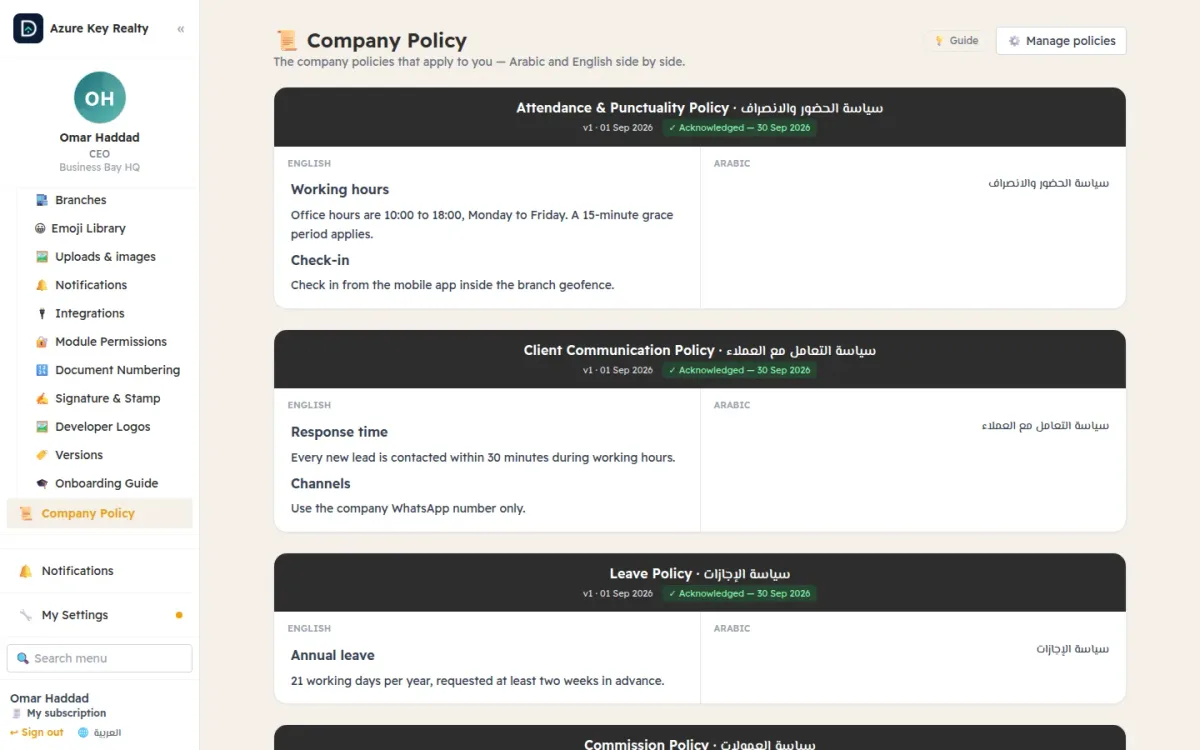
Open the tool in both languages and look at the screens your whole team uses, not only the login page. Check right-to-left layout, Arabic names in lists and search, and whether forms and notifications switch language with the user. A mixed team of English-speaking and Arabic-speaking agents needs both to work equally. In Dealora, for example, the Company Policy module (Business plan and above) shows each policy in English and Arabic side by side, with each employee's acknowledgement status.
5. What extra users cost on the plan
Write down the plan's user limit, the price of an additional user, and what happens when someone leaves: can you remove the seat the same month? A fixed limit is manageable if extra users are an add-on. It is a problem only when the only way past it is a different contract.
6. Who sees what
Check roles. An agent should see only their own leads, a team leader should see the team, and only an admin should be able to reassign or export. This matters most when an agent resigns: you must be able to pull their clients back the same day.
For a broader checklist, the Keys of Success article Real Estate CRM Comparison: 8 Checks Before You Buy adds more points to score.
Where Dealora fits
Dealora is a cloud platform for real estate brokerages, sold in Egypt, Saudi Arabia and the United Arab Emirates, in Arabic and English. Pricing is by company plan, not a fee per login, and the plans are:
- Starter: up to 10 users, no data export.
- Growth: up to 50 users, with data export.
- Business: up to 150 users, with data export.
- Enterprise: no user limit, with data export.
Individual is a separate plan for a solo broker or a team of up to 3 users, with no data export. It is not a step above Enterprise, so it sits outside this list. Plan details and the add-ons are on the Dealora pricing page.
The user limit does not force a plan change. Extra users are an add-on from Starter, so you can compare two routes at your peak headcount: add users to your current plan, or move up a plan. The other add-ons from Starter include extra storage, branches in other countries, Meta connection setup, a company website connected to the CRM, and White Label.
The Dealora CRM merges every registration into one client record, distributes leads by pools, a Leads Bank or manual assignment, pulls idle leads back by stage time limits, and tracks deals from EOI to Contracted with approvals. Social Inbox and WhatsApp Campaign are on Growth and above, and both need the company's own Meta connection: its Facebook page, Instagram and WhatsApp Business number.
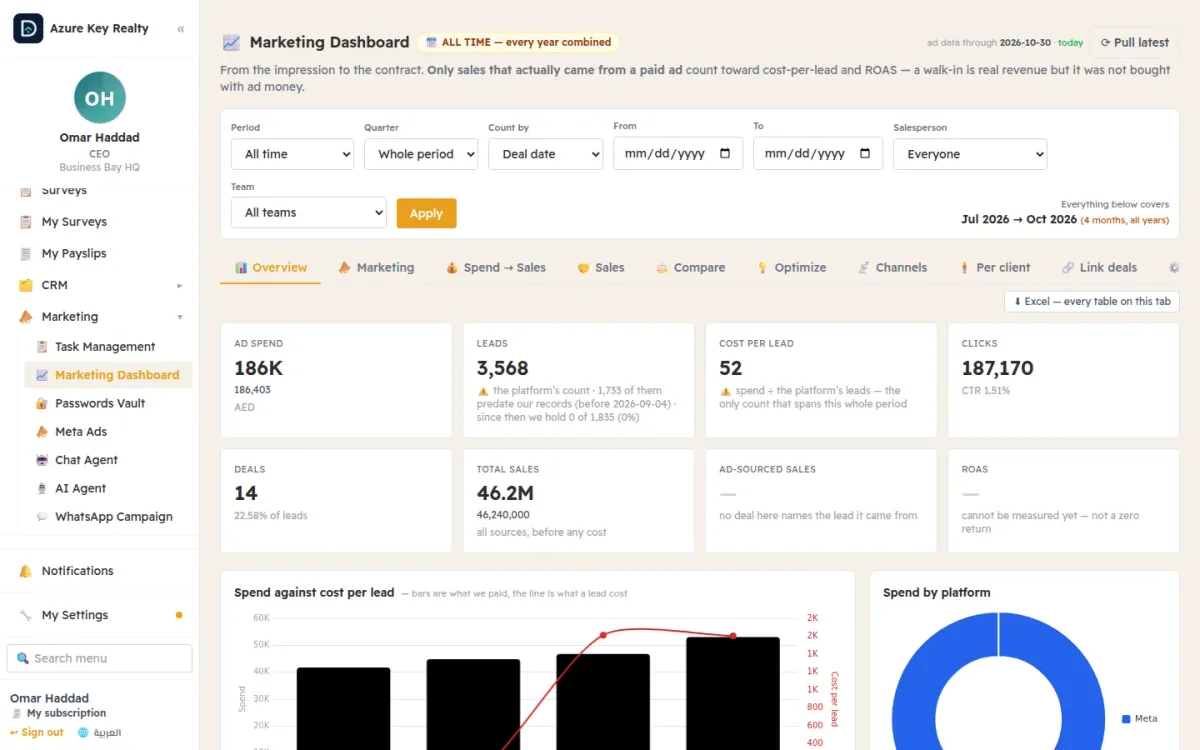
Marketing Dashboard, also on Growth and above, follows spend to leads to sales and shows cost per lead and return on ad spend, which helps when you compare what each lead source really costs you.
Every new company gets a 90-day free trial on the Starter plan, which holds Employees, CRM, Developers & Projects, Projects Map and the Developer Sales index. Starter has no data export, so you test import and the daily workflow in the trial. Export is judged from the Growth plan page and in a talk with the Dealora team about which plan fits your headcount. If you are comparing several tools, the same thinking appears in our notes on an AssetsMena alternative.
A step-by-step migration test on a small team
Do not move the whole company at once. Pick five to eight people from one team, with a team leader, and run the new CRM beside the old one for a defined period. The trial gives you 90 days, which is enough for this.
- Export your current data first. Take a full export from the old tool and store it safely. Remove anything you do not need to migrate, such as dead contacts and test records.
- Create the account and set the structure. Open the company account, add the pilot team as employees, and set stages, sources and the distribution rule you want to use.
- Import a clean sample. Load a few hundred real clients owned by the pilot team. Check phone numbers, duplicates, sources and owners against the old tool, row by row.
- Connect one live lead source. Choose the source that brings most volume, send it to the new CRM, and compare what arrives in each system for a week.
- Run real work for two to four weeks. The pilot team logs calls, follow-ups, viewings and deal requests only in the new CRM. The team leader checks idle leads and reassignment daily.
- Review against fixed measures. Compare reply time, leads left untouched, duplicates, and the minutes agents spend on admin. Ask the agents what slowed them down, in their own language.
- Redo the cost model with real numbers. Update your user-months, add-ons and VAT, and recalculate the break-even price. Then decide: move the next team, stay, or ask for different terms.
The same table that opened this decision also closes it: if the new plan is cheaper at your headcount and passed all six tests, move team by team, keeping the old tool read-only until the last team is across.
To start the test with your own records, create a free Dealora account and import the pilot team's clients.
Sources
Frequently asked
How do I compare per-user and flat-rate CRM pricing for a UAE brokerage?
Count user-months, not heads. Multiply each month's active users by the months they are billed, add them up for the year, then multiply by the per-user price. Compare that with the company plan's yearly fee plus any extra users. Include the months when hiring peaks, because that is where per-user bills grow.
Is VAT added to a CRM subscription in the UAE?
The standard UAE VAT rate is 5%, the same in every emirate. A subscription billed by a VAT-registered supplier is normally quoted before that 5%, so add it to every quote you compare. Check each quote states clearly whether the figure includes VAT.
What should I test before switching real estate CRM in Dubai?
Test six things: exporting and importing client data, every lead source you use, WhatsApp and Meta handling, Arabic and English screens, what extra users cost on the plan, and how personal data is handled. Run them on a small team with real records before moving the whole company.
Can I try Dealora before moving my team?
Yes. Every new company gets a 90-day free trial on the Starter plan, which includes Employees, CRM, Developers & Projects, Projects Map and the Developer Sales index. Starter has no data export, so judge export on the Growth plan page and in a talk with the Dealora team.
What happens when my team grows past a plan's user limit on Dealora?
Starter allows up to 10 users, Growth up to 50, Business up to 150, and Enterprise has no user limit. Past a plan's limit you add users as an add-on, available from Starter, or move up a plan. Compare both routes at your peak headcount.
Does the WhatsApp free allowance affect the CRM I choose?
It can. Since 1 October 2026 Meta gives each business phone number 1,000 free service messages a month and charges for more. The allowance is per number, not shared. Check how a CRM connects your numbers, because Meta's pricing can change and the connection must be your company's own.
Read next
- Software for a 20 Agent Brokerage: What to Require A requirements list for a brokerage of about 20 agents: what the software must do on day one, what can wait, h
- AI Chat Agent for a Real Estate Brokerage: Test, Trust, Go Live One AI agent can answer property customers on Instagram, Messenger, WhatsApp and TikTok, but only if you give
- Real Estate Software Saudi Arabia: A 10-Point Buying Checklist A buying checklist for Saudi brokerage owners: Arabic and English screens, WhatsApp and Instagram leads, Meta
- Aqar+ Alternative: 7 Checks for Egyptian Brokerages of 20-150 Reps A practical way for Egyptian brokerages with 20 to 150 salespeople to judge any Aqar+ alternative: a seven-che