
Real Estate Lead Distribution: Rules, Time Limits, Reassignment
By Dealora Published Updated Reviewed by Ali Darwish 9 min read
Who gets each lead once it arrives? Compare round robin, project, source and workload rules, then set a first-call time limit and a reassignment rule for leads nobody touches.

Good real estate lead distribution means every new lead reaches one named agent within minutes, by a rule written down in advance. Pick one main rule (round robin, project, source or workload), set a first-call time limit, take back leads nobody touches, and merge duplicates into one client before assigning.
Real estate lead distribution is the set of rules that decides which agent receives each new lead, how fast that agent must call, and what happens if they do not. The strongest setup is plain: one main assignment rule, a written first-call time limit, an automatic take-back for untouched leads, and one client record per person. The steps before this one, getting leads in and qualifying them, are covered in our seven-step guide to real estate leads. This article deals with the moment after a lead lands, when it belongs to nobody yet.
Why the assignment step loses so many leads
A lead that sits unassigned does not stay warm. In a 2011 Harvard Business Review audit of 2,241 US companies that were sent a web-generated lead, 37% responded within an hour and 16% within one to 24 hours. Another 24% took more than 24 hours, and 23% never responded at all. Among the companies that did respond within 30 days, the average response time was 42 hours.
Speed also changes the outcome. The same research, drawing on 1.25 million sales leads received by US companies, found that firms that contacted a potential customer within an hour of the query were nearly seven times as likely to qualify the lead as firms that waited longer.
The authors of that research named two causes of slow response that brokerages recognize at once. Leads were fetched from the CRM database once a day rather than continuously, and distribution rules based on geography and "fairness" delayed the handover to an agent. A sales manager who splits a weekend's registrations by hand on Sunday morning is running exactly that process.
Five real estate lead distribution rules compared
There is no single best rule. Each one solves a different problem and creates a different risk, so choose the one that matches how your brokerage actually sells.
| Rule | Best for | Main risk |
|---|---|---|
| Round robin | Teams of similar skill selling the same inventory | Leads land on agents who are absent or overloaded |
| By project | Brokerages with specialists per developer or compound | One popular project floods one or two people |
| By source | Separating ad campaigns, portals, referrals and walk-ins | Agents fight for the sources that convert best |
| By workload | Uneven teams, part-timers, new hires | Slow agents with few leads keep receiving more |
| By performance | Rewarding top closers with the best leads | Weaker agents never improve; the top few burn out |
Round robin
Round robin lead distribution sends each new lead to the next person in a fixed order. It is the easiest rule to explain and the hardest to argue with, which is why many sales managers start here. It breaks when the order ignores reality: a consultant on leave still gets their turn unless someone removes them.
By project and by source
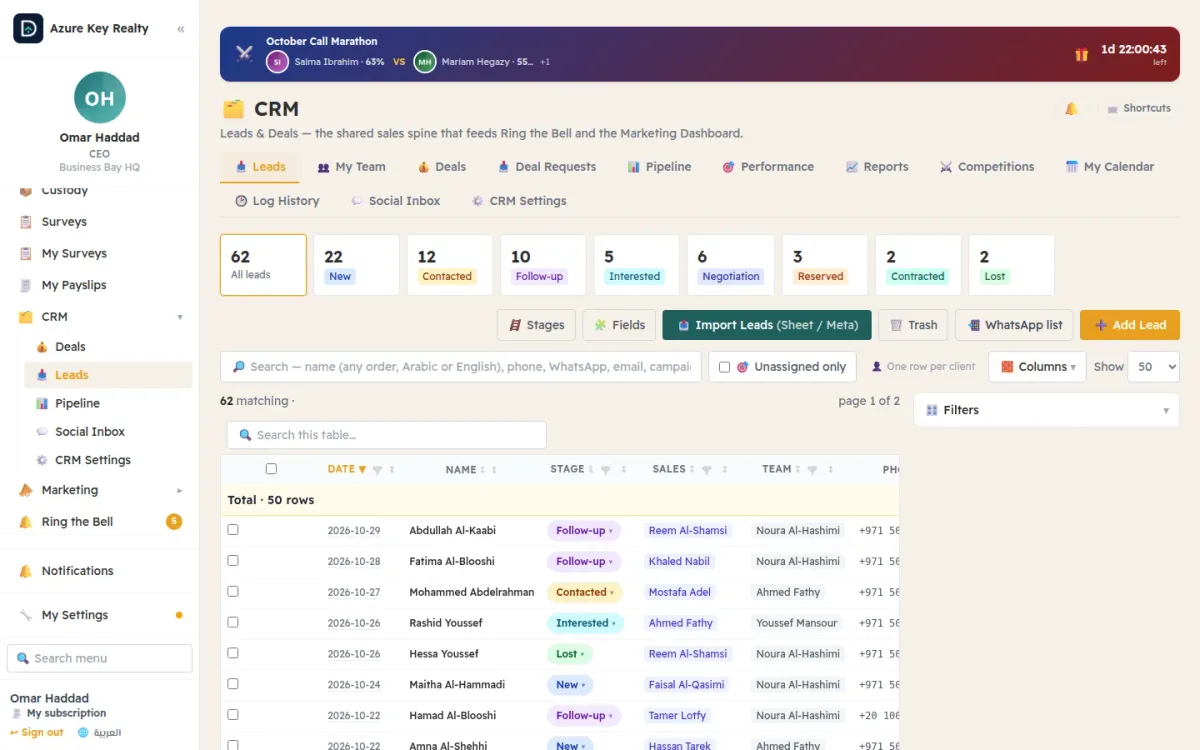
Project-based routing puts the buyer in front of the agent who knows that compound, its payment plans and its developer. Source-based routing keeps a team on one channel, so you can later judge that channel fairly. In Dealora CRM, pools link tags to salespeople or whole teams, so if you tag leads by project or source, the matching pool picks the owner. Requirements such as unit type, budget and project are mostly filled from the ad form answers, which gives you something to tag on.
By workload and by performance
Workload rules protect response time because the person with the fewest open leads receives the next one. Dealora's pool strategies include least loaded, weighted, FIFO and round-robin. Weighted is the one to look at when some agents should take a bigger share than others. Performance-based routing is a management decision rather than a setting: if you favor your best closers, review it every month, or the same three names will collect every good lead.
How to distribute leads to real estate agents: a practical mix
Layered rules often work well: start with the narrowest rule that applies, then fall back to a general one. A workable order looks like this.
- Route by project where you have specialists, so a buyer asking about a specific compound reaches the right person.
- Route by source for campaigns you want to measure separately.
- Within each group, use least loaded or round robin so nobody waits for a turn.
- Keep a fallback pool for everything that matches no rule, so no lead is left without an owner.
A Leads Bank adds a pull model on top. A salesperson presses one button and receives unassigned leads, within ceilings per press, per day and per month. It suits agents with spare capacity and keeps the leaders from deciding who is busy.
Fair lead allocation in a brokerage is easier to defend when the principle is written down: equal chance at fresh leads, equal duty to act on them. A rule that gives equal turns but tolerates leads left untouched is fair only in appearance.
Set a time limit for the first call
Lead response time in real estate needs a number, or it is a wish. Write one limit for working hours and one for leads that arrive at night, and put both in the sales policy every agent signs.
- Working hours: a first call attempt within a fixed number of minutes. Pick a figure your agents can meet on a busy day, then hold to it.
- Nights and weekends: the first call by mid-morning of the next working day. Remember that the working week differs between Egypt and the Gulf countries, so define "working day" in the policy rather than assuming it.
- What counts: a logged call attempt or message, not an intention. If it is not on the client record, it did not happen.
Messaging channels add a second clock. When a client writes to the business on WhatsApp, a 24-hour customer service window opens, and it resets to 24 hours each time the client writes again. Inside the window the business can send free-form replies; outside it, the business can reach the client only with approved message templates, which Meta charges per message. A slow first reply can therefore cost you the open window. Since 1 October 2026 Meta also charges for service replies inside the window after the first 1,000 per business number each month. In Dealora's Social Inbox (Growth plan and above), a line above the messages shows whether the window is open, and on WhatsApp the salesperson holding the client's earliest open registration answers the conversation. That is a routing rule hiding inside the inbox, and it is worth knowing before you design your own.
Reassign a lead nobody touches
A time limit without a consequence is a suggestion. Add a reassignment rule with three parts: a maximum idle time per stage, an automatic action when it passes, and a record of why the lead moved.
Dealora's Pipeline SLA does this by giving each stage a maximum idle time. A lead that sits too long without a sales action is pulled and re-distributed, with a scan every 30 minutes and quiet hours at night. Because the scan runs every 30 minutes, a limit shorter than that will not be enforced to the minute, so set limits that make sense against the scan. Pipeline Rules can also require a logged action before a lead moves forward. For the stage structure itself, see our guide to real estate sales pipeline stages, exit rules and time limits.
Keep one exception in the policy: an agent with a booked meeting or a live negotiation can hold the lead, but the appointment must be logged. Without that, every agent will claim to be "in discussion".
Handle duplicates before you assign
The same buyer often registers on three forms, sometimes with a different name each time. If routing treats each registration as a new lead, three agents call the same person and the buyer concludes the brokerage is disorganized.
The fix sits before assignment. Match by phone number and email, merge into one client, and send the new request to whoever already owns that client. Dealora CRM works this way: every phone number and email is matched to the same client, so a person who registered three times is one row with three requests behind it. Then add a short rule for conflicts: the owner of the earliest live registration keeps the client unless a manager decides otherwise.
Agents who hold leads without acting
Hoarding is usually not laziness. An agent with forty leads protects them because leads are income, or avoids calling because the call might fail. Either way the lead is wasted.
Use these controls together:
- Cap the number of open leads in the first stage for each agent, and let the Leads Bank ceilings enforce it for pull-based leads.
- Review idle leads in a weekly team meeting, by name, not by percentage.
- Let team leaders move all the clients of one salesperson to another, and pull back clients still held by people who left. In Dealora this sits in My Team.
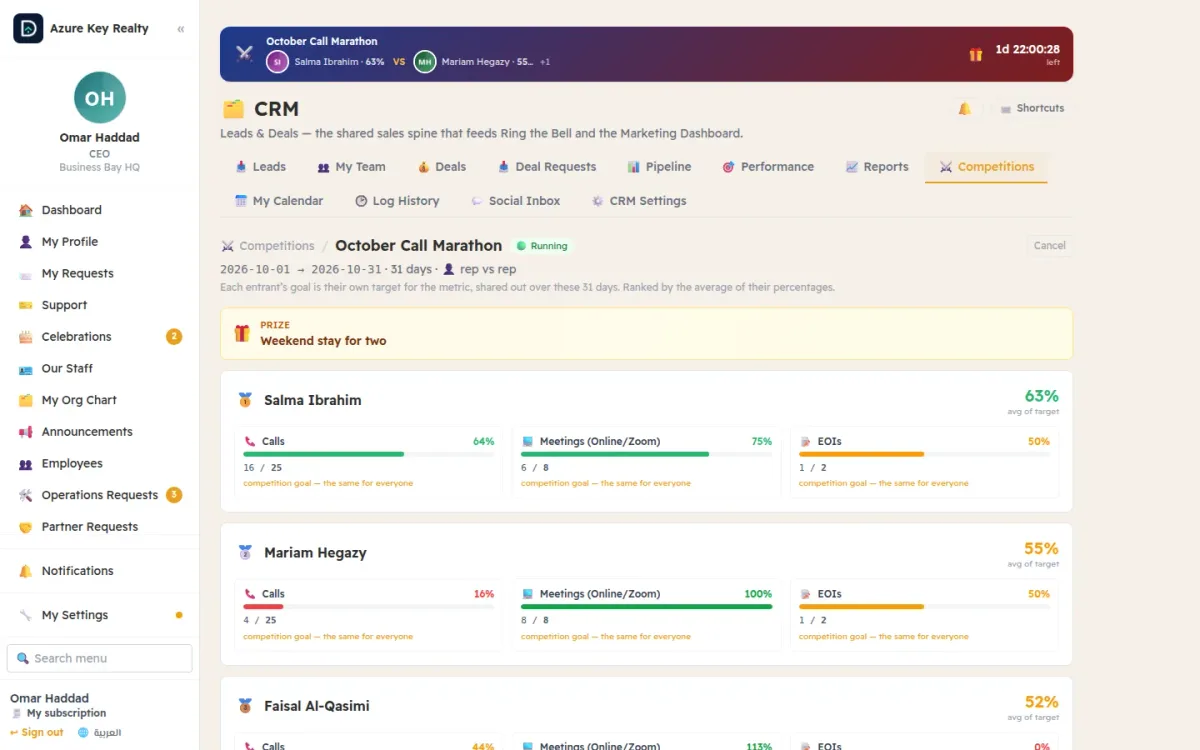
- Reward activity as well as closings. Calls and meetings logged are the early signal, and a sales competition (Growth plan and above) with a target and a deadline can make them visible.
More daily follow-up routines are in our list of tools for managing a real estate sales team.
Check the result in your CRM reports and Marketing Dashboard
Once rules are running, judge them by three things: where the lead came from, who owns it, and what stage it reached. Dealora's CRM reports per salesperson and team, and its reports count clients, not registrations, so duplicates do not inflate anyone's numbers. The lead list shows each lead's date, stage, salesperson and team, which is enough for a weekly check.
Ask the same questions every week:
- Is any source reaching only one or two agents? If so, the rule is concentrating leads.
- Does any agent hold many leads in the first stage? That is a hoarding signal.
- Which owners move leads to the next stage fastest? Compare like with like, by source and project.
- How many leads were pulled and re-distributed? A high number points to a limit that is too strict or an agent who needs support.
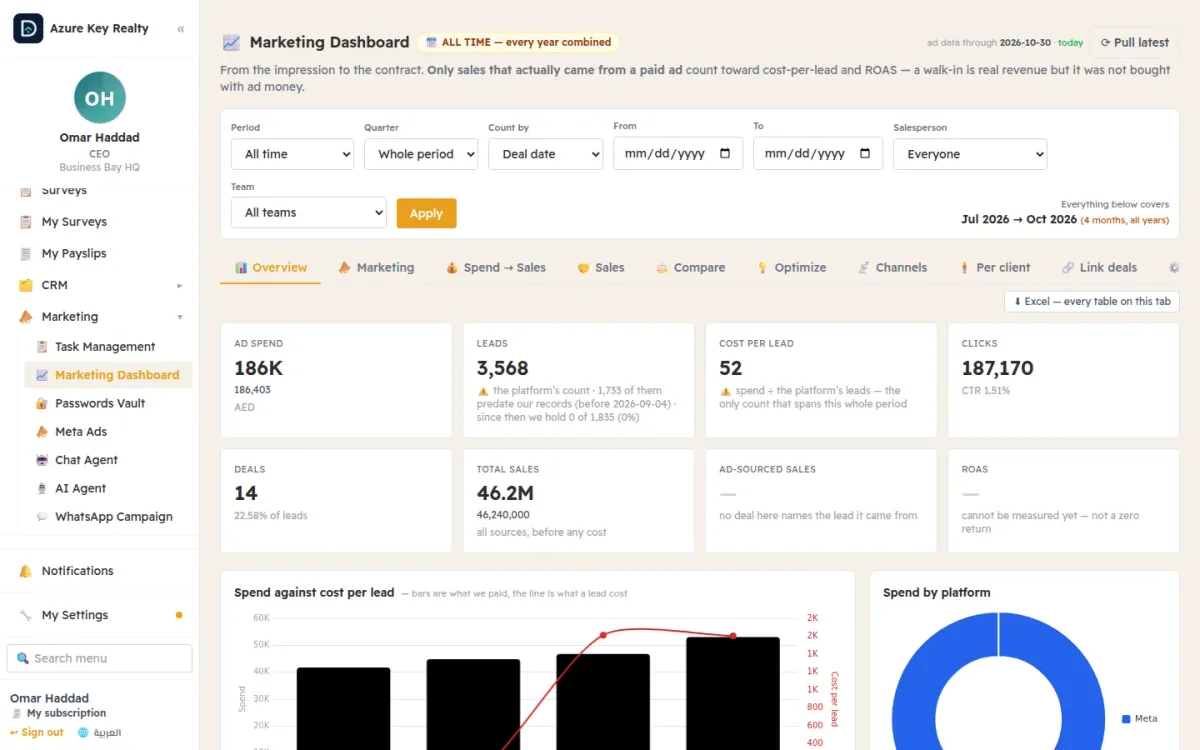
For the money side, the Marketing Dashboard in Dealora (Growth plan and above) follows spend to leads to sales, with cost per lead and return on ad spend. Put it next to the CRM reports and a weak source becomes easier to read: it may simply have been routed to the slowest agents.
To follow a lead from the ad to the closed deal, use the steps in how to track leads from Meta ads to closed deals. If you are still comparing systems, the Keys of Success checklist for comparing real estate CRMs lists what to test before you commit.
Put the rules in place this week
Write the policy on one page: the main rule, the fallback pool, the first-call limit for day and night, the idle limit per stage, and the duplicate rule. Then set it up in your CRM and run it for two weeks before changing anything. Every new Dealora company starts with a free 3-month trial on the Starter plan, which includes the CRM, so you can test pools and idle limits on real leads from the sign-up page before you decide.
Sources
Frequently asked
What is the fairest way to assign leads to sales agents?
Fair allocation means every agent gets an equal chance at fresh leads and the same duty to act on them. Round robin gives equal turns, least loaded gives equal workload, and both are easy to explain. Pair either one with a first-call time limit and a take-back rule, or fairness only means equal turns at ignoring leads.
Is round robin lead distribution good for real estate?
It works well when agents are similar in skill and cover the same projects, because it is simple and nobody can argue with it. It works badly when projects need specialists or when some agents are absent, since leads keep landing on people who cannot call. Use it as a default, with project rules above it.
How fast should an agent call a new real estate lead?
As fast as the team can sustain, and always inside a limit you write down. A 2011 Harvard Business Review study of 1.25 million US sales leads found that firms contacting a lead within an hour were nearly seven times as likely to qualify it as firms that waited longer. Pick a number your agents can meet on a busy day, and set a separate one for leads that arrive at night.
What should happen to a lead the agent never contacts?
It should leave that agent automatically and go to someone else, with the reason recorded. Set a maximum idle time for each stage, and have the system or a manager move any lead that passes it. In Dealora CRM, Pipeline SLA pulls the lead and redistributes it, scanning every 30 minutes.
How do you stop duplicate leads going to different agents?
Match every incoming lead to an existing client by phone number and email before assigning an owner, and send repeat registrations to the agent who already holds the client. Dealora CRM matches phone numbers and emails to the same client, so one person who registers three times is one record with three requests.
Read next
- How to Scale a Real Estate Brokerage: Systems at 20, 50, 100 Reps A stage-by-stage map of the systems a brokerage needs at about 20, 50 and 100 salespeople: what breaks at each
- Real Estate Sales Dashboard: 3 Views Every Manager Needs One screen, three views: agent, team and project or developer. Which number goes where, who reads it, and whic
- Lead Source Report for Real Estate: Build One to Closed Deals A lead source report should end at signed contracts, not enquiry counts. Fix the source list, require a source
- AssetsMena Alternative: A 3-Check Decision Checklist A decision checklist for brokerage owners comparing an AssetsMena alternative: test ad spend to closed deals,