
Real Estate ERP Software: Sales, HR and Marketing in One Place
By Dealora team Published Updated Reviewed by Ali Darwish 6 min read
What real estate ERP software covers, how it differs from a CRM, the signs your property company needs one, and how to roll it out step by step without slowing down your sales team.
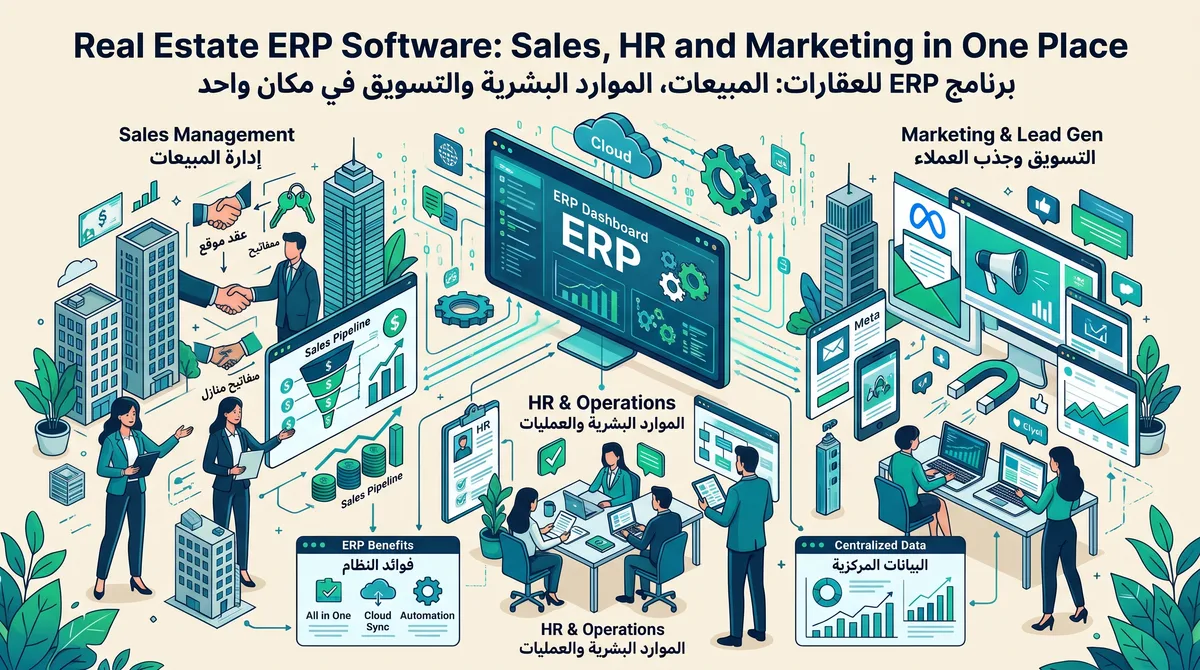
Real estate ERP software runs a property company's sales, marketing, HR and developer data in one system. It suits brokers, sales companies and developers once the team and paperwork outgrow a CRM alone. Each module works on the same data, so one record serves sales, marketing and management.
Real estate ERP software is one system that runs a property company's sales, marketing, HR and developer data together, instead of separate spreadsheets, phones and apps. A real estate ERP suits brokers, sales companies and developers once the team, the projects and the paperwork have grown beyond what a CRM alone can hold.
What a real estate ERP covers
A general ERP is usually built around accounting, stock and purchasing. A property company works differently. Its stock is projects and units owned by developers, its revenue depends on deals and commissions, and its biggest cost is a sales team that changes often. A real estate ERP follows that shape.
In practice it brings together the parts a brokerage in New Cairo or a sales company in Riyadh already runs, usually in different places:
- Sales: leads, clients, deals, the pipeline, sources and reports.
- Developers and projects: each developer's projects, phases and files, plus where each project sits on a map.
- Marketing: messages from social media, campaigns, and the link between ad spend and sales.
- People: hiring, attendance and leave, HR requests, documents and, at the top level, payroll.
- Company records: policies, custody items, company SIM cards and shared passwords.
ERP or CRM: what changes for a property company
Many companies start with a CRM, and that is the right first step. The question is when the CRM stops being enough. The table shows the difference in daily terms.
| Area | CRM only | Real estate ERP |
|---|---|---|
| Leads and deals | Yes, the core of the system | Yes, connected to the rest of the company |
| Social and WhatsApp messages | Often outside, on phones | Inside the client record |
| Marketing results | Lead counts by source | Spend, leads and sales in one view |
| Hiring and attendance | Separate tools or paper | Part of the same system and login |
| Employee documents and custody | Folders and spreadsheets | Tracked per employee |
| Payroll | Separate tool or spreadsheet | Available at the top plan |
A broker with five salespeople rarely needs the full set. A company with several branches, a hiring pipeline and monthly launches usually does.
Brokers, sales companies and developers use it differently
A broker or small office
A broker in Sheikh Zayed with a handful of salespeople mostly needs order in sales: one list of clients, current files for every project, and a clear view of who follows up with whom. The ERP side matters less at this size.
A growing sales company
A sales company with teams in New Cairo and the New Administrative Capital lives on social media leads and monthly hiring. It needs messages inside the client record, marketing results it can trust, and a clean way to bring new salespeople in and out.
A developer's sales arm
A developer selling its own projects, often with an in-house team and outside brokers, needs project files and phases kept current, a view of the salespeople working on each project, and HR records for a large staff.
Signs your company needs real estate ERP software
- HR keeps attendance in one spreadsheet and leave requests arrive on WhatsApp.
- New salespeople are hired every month, and CVs sit in a shared inbox.
- Managers cannot see marketing spend and sales on the same screen.
- Brochures and payment plans on salespeople's phones are out of date.
- Employee documents expire and nobody notices until they are needed.
- Company laptops, phones and SIM cards are tracked from memory.
Two or three of these signs are normal for a growing company. Five or six mean time is being lost every week.
Each of these signs costs hours that nobody records. Try Dealora free for 90 days on Starter, move your sales data first, and see how much of the spreadsheet work disappears.
How to choose the right real estate ERP plan
Dealora is an AI-powered real-estate ERP for brokers, sales companies and developers. Each company works on its own subdomain, in Arabic and English, and grows into the ERP plan by plan rather than buying everything on day one.
| Plan | Users | What it adds |
|---|---|---|
| Starter | Up to 10 | Employees, CRM, Developers & Projects, Projects Map, Developer Sales index |
| Growth | Up to 50 | Social Inbox, WhatsApp Campaigns, Developer WhatsApp Groups, Brochures library, Sales Competitions, Ring the Bell, Marketing Dashboard, Task Management, org chart and announcements |
| Business | Up to 150 | ATS hiring and a public Careers page, Attendance & Leave with mobile check-in, HR requests, employee lifecycle, policies, document compliance, custody, SIM cards, surveys, company profile and a Passwords Vault |
| Enterprise | Unlimited | Payroll, bank account opening, Ring the Bell production, Meta Ads and Online Expo (the last two are also add-ons from Growth) |
If you are still choosing your first system, our guide to real estate management software lists the features to check first, and the guide to a real estate CRM in Egypt covers the sales core.
How to roll out an ERP without stopping sales
- Start with sales data. Import clients and open deals first, because that is where money is at stake.
- Add developers and projects. Load the projects you actively sell, with current files and phases.
- Set roles and permissions. Decide what a salesperson, a team leader and a manager can see.
- Move one HR process at a time. Attendance first, then leave and requests, then documents.
- Train by role, not by module. A salesperson needs a short session on their own screens.
- Retire the old spreadsheets. Set a date after which nothing is updated outside the system.
A company in Sheikh Zayed that moves everything in one weekend usually spends the next month fixing it. Moving in stages takes longer on paper and less time in reality.
Who a real estate ERP is for
- A good fit: sales companies and developers with several teams, regular hiring and monthly launches.
- A good fit: growing brokerages that want sales and HR on one login.
- Not needed yet: a broker with a few salespeople and no HR work, for whom the Starter CRM is enough for now.
Mistakes to avoid
- Choosing a general ERP and then rebuilding real-estate sales inside it.
- Importing years of dead leads without cleaning sources and duplicates.
- Keeping HR on paper while sales moves to the system, so managers check two places.
- Skipping permissions, so every salesperson sees every client.
When to move to Business or Enterprise
Starter and Growth cover sales and marketing. The step to Business makes sense when HR work starts to slow the company: monthly hiring, attendance across branches, requests and documents. Business adds ATS hiring with a public Careers page, Attendance & Leave with mobile check-in, HR requests, and Document Compliance for employee paperwork, for up to 150 users.
Enterprise suits a company that wants payroll inside the same system with no user limit, and it includes Meta Ads and Online Expo, which are also available as add-ons from Growth. Companies with branches in other countries can open them on any plan with the Branches in other countries add-on, each branch with its own currency, time zone and language. The Dealora FAQ answers common questions about moving between plans.
Review what each plan includes on the Dealora pricing page, and pick the level that matches the size of your company today, with room to grow.
Frequently asked
What is a real estate ERP system?
It is software that connects the main parts of a property company in one place: leads and deals, developers and projects, marketing results, and HR work such as hiring and attendance. Unlike a general ERP built around stock and purchasing, it follows how brokers and developers actually earn: through projects, deals and commissions.
What is the difference between ERP and CRM for real estate?
A CRM manages clients, leads and deals. An ERP includes that and adds the rest of the company: marketing data, hiring, attendance, documents and, at the top level, payroll. Small brokerages often need only a CRM at first, then move to an ERP as they hire and open branches.
Is there free real estate ERP software?
Some general tools have free tiers, but they rarely cover real-estate sales, developers and projects. Dealora offers a 90-day free trial on the Starter plan, which includes the CRM, Developers & Projects, the Projects Map and the Developer Sales index, so you can test it with real data before paying.
Does Dealora include HR and payroll?
HR modules start with the Business plan: hiring with a public Careers page, attendance and leave with mobile check-in, HR requests, the employee lifecycle and document compliance. Payroll is part of the Enterprise plan. See the pricing page for what each plan includes.
Does Dealora work in Arabic?
Yes. Every Dealora company works in Arabic and English on its own subdomain, such as yourcompany.dealora-portal.com. Teams in Egypt and the Gulf can use the language they prefer, and the same system serves Arabic-speaking and English-speaking staff.
Read next
- How to Test a CRM Free Trial: A 30-Day Plan for Brokerages A week-by-week 30-day plan for brokerage owners: import real leads, run the pipeline with real reps, check dev
- Software for a 20 Agent Brokerage: What to Require A requirements list for a brokerage of about 20 agents: what the software must do on day one, what can wait, h
- How to Scale a Real Estate Brokerage: Systems at 20, 50, 100 Reps A stage-by-stage map of the systems a brokerage needs at about 20, 50 and 100 salespeople: what breaks at each
- PropSpace Alternative for UAE Brokerages: Cost Model and Tests A decision guide for UAE brokerage owners leaving per-user pricing: a yearly cost model at your own headcount,