
Real Estate Client Database: How to Build One in Your CRM
By Dealora Published Updated Reviewed by Ali Darwish 11 min read
Client contacts scattered across phones, WhatsApp chats and sheets cost brokerages deals. Here is how to build one real estate client database: fields, duplicate rules, access and handover.
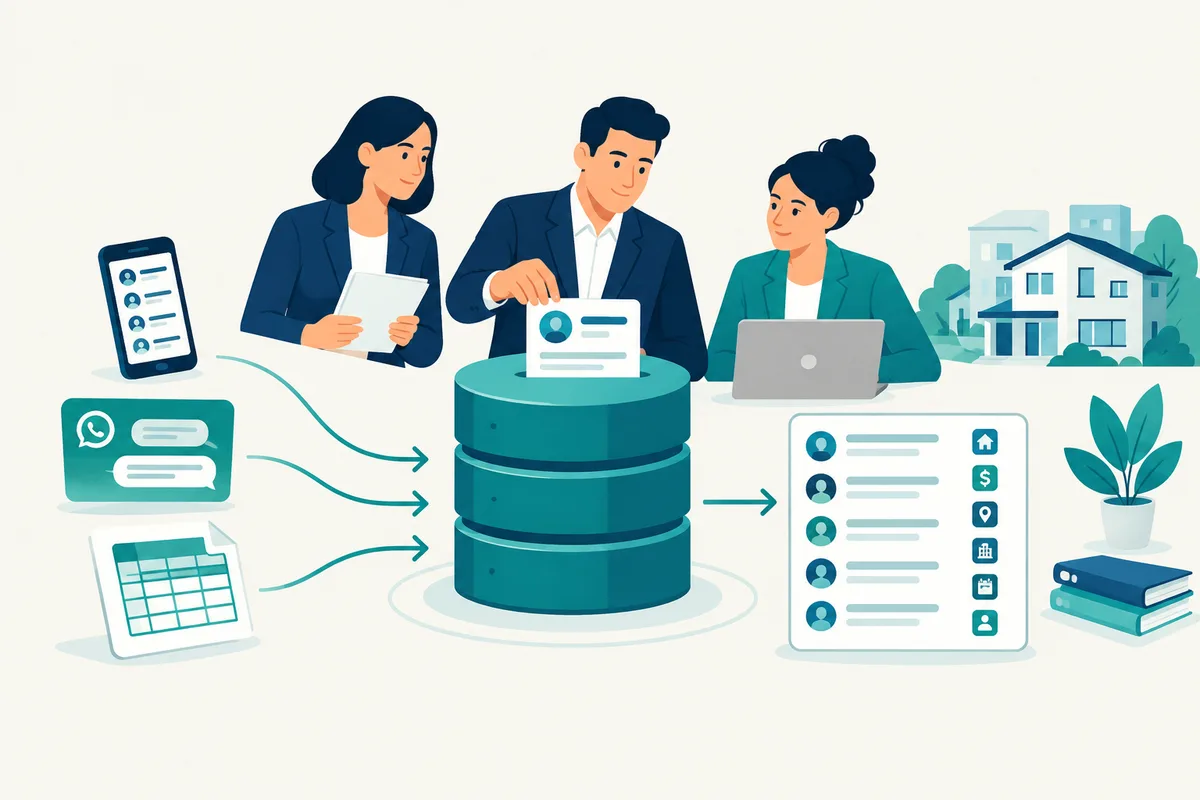
A real estate client database is one shared record per buyer, kept in a CRM instead of phones and sheets. Each record holds contact details, source, budget, unit type, area, stage and owner. Match duplicates by phone and email, limit who edits, log every call, and reassign clients when a salesperson leaves.
A real estate client database is one shared record for every buyer, seller or investor your brokerage talks to, kept in a CRM rather than in personal phones, WhatsApp chats and spreadsheets. Each record answers six questions: who is this person, where did they come from, what do they want, how much can they spend, which stage are they at, and who owns them. If your team cannot answer those six for any client in under a minute, the database does not exist yet, and the steps below are how to build it.
Why phones, chats and sheets fail as a real estate client database
A salesperson saves a buyer's number under a first name, continues the conversation on WhatsApp and promises a call on Thursday. The manager sees none of it. The same buyer fills in an ad form on Saturday and lands with a colleague, who starts from zero.
Spreadsheets fix the visibility problem for a week. Then three people edit three copies, columns drift, and the sheet records who a client was, not what happened with them. The real cost appears when a consultant resigns: their clients, their promises and their chat history leave on their phone.
A CRM changes the unit of work from the salesperson's memory to the client record. If you have not chosen a system yet, the step-by-step real estate CRM setup for brokers in Egypt and the Gulf covers selection and configuration. This article deals with the next question: what goes into the records, and who looks after them.
The fields worth recording for every client
Resist the urge to build a form with thirty boxes. Salespeople fill in what is quick and skip what is not, and an empty field is worse than no field because it looks like an answer. Six fields carry most of the value for a client database for real estate brokers.
| Field | Why it matters | How it works in Dealora CRM |
|---|---|---|
| Source | Shows which ad, form or channel produced the buyer, so spend can be judged by results. | Each client carries sources. A repeat registration adds a source to the same client. |
| Budget | Stops salespeople from pitching units the buyer cannot afford. | Held as a requirement on the client, mostly filled from the ad form answers. |
| Unit type | Apartment, villa or commercial: the first filter on any shortlist. | A requirement on the client. Click a requirement to see everyone who wants the same thing. |
| Project or area | Lets you match a new launch to the buyers already waiting for it. | Project is a requirement. For area, use a tag if your setup has no area requirement. |
| Stage | Tells everyone how far the buyer has moved. | Stages are set by the CRM Admin in CRM Settings. |
| Owner | One accountable salesperson per client. | Assigned by pools, the Leads Bank or manually. |
Beyond these six, the client page keeps contacts, conversations and a Sales Activity timeline of calls, WhatsApp, meetings and site visits. That timeline is what turns a contact list into real estate client records: it shows what was said, not only who said it.
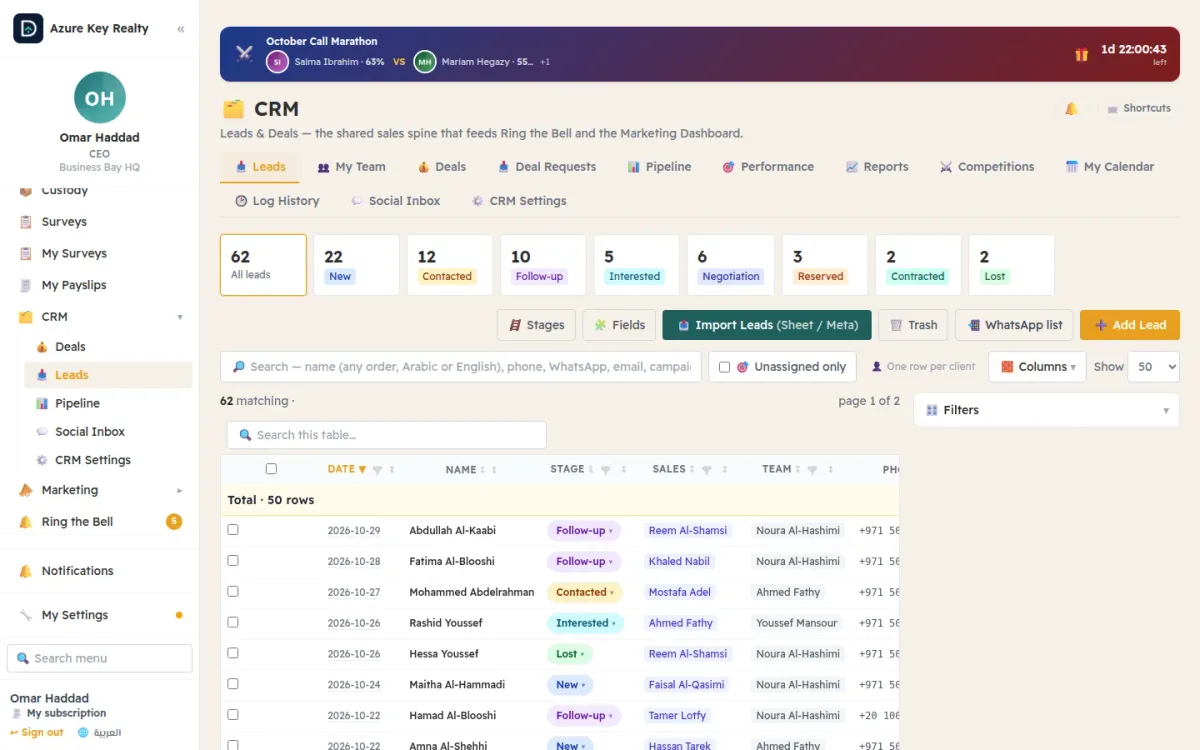
Tags deserve a rule of their own. In Dealora, pools link tags to salespeople or teams, so a tag is not only a label, it can decide who receives a lead. Keep the tag list short and agreed, such as one tag per project or campaign, rather than letting everyone invent their own.
Naming and duplicate rules for a real estate contact database
Duplicates are the most common way a real estate contact database rots. The fix is mostly agreement, backed by a system that matches automatically.
Let the phone number and email be the identity
Dealora CRM matches every phone number and email to the same client. A buyer who registers three times on three forms becomes one row with three requests behind it, instead of three leads with three salespeople. When you evaluate any system, test exactly this: register the same number twice and see what happens.
Write the name the same way every time
Agree on a simple convention and put it in one line in your sales handbook:
- Full name as the client gave it, first name then family name, no job titles or nicknames in the name field.
- Arabic or English, but not both mixed in one name.
- Phone numbers with the country code, no spaces or dashes.
- Notes about the person go in the activity timeline, not in the name, so a search for the name still works.
Check before you create
Before typing a new client by hand, search the phone number first. It takes five seconds and prevents the argument over who found the buyer. For a wider look at what happens once a lead exists, the article on real estate lead distribution rules, time limits and reassignment shows how owners are chosen.
Who may see and edit client records
Access is a management decision before it is a software setting. Write down who should do what, then configure the system to match.
In Dealora CRM the roles split naturally. Salespeople work their own leads, log activity and book appointments. Team leaders and managers use My Team to see what each person holds. The CRM Admin sets stages, sources, pools, targets and notifications, and approves deals. The owner reads reports that count clients, not registrations.
A few rules that hold up in practice:
- A salesperson edits the clients they own and nobody else's. If they need a colleague's client, they ask the manager to reassign it.
- Only the CRM Admin changes stages, sources and pools. A source list that every salesperson can extend becomes unreadable within a month.
- Managers see their whole team, but reassignment goes through them, not through side agreements on WhatsApp.
- Conversations follow the same logic. In the Social Inbox for Messenger, Instagram and WhatsApp (Growth plan and above), a salesperson sees the conversations of their own clients, while the inbox administrator sees every conversation the business receives.
Moving contacts out of phones and sheets
Do the migration in a fixed order, and do not import everything blindly. A dirty list imported into a clean system gives you a dirty system.
- Collect. Ask every salesperson to export or list the clients they are actively working. Ignore contacts with no activity in a long time unless they match a current project.
- Clean. Merge duplicates in the sheet first: same phone number, same person. Standardize phone formats.
- Map. Match each column to a field: name, phone, email, source, budget, unit type, project, stage, owner. Anything that does not fit goes into a note.
- Import. Dealora CRM accepts leads from imports as well as ad forms, the website and manual entry. Import one team first and check ten records by hand.
- Close the old door. After a set date, a client who is not in the CRM does not count for targets or commission. This single rule does more than any training session.
Chats need a separate step. Unknown senders on Messenger, Instagram or WhatsApp should be linked to a client record. In the Social Inbox, a conversation that matches no client is marked as not linked, and Link to a client searches by name, phone or email. After linking, the conversation shows on the client's page.
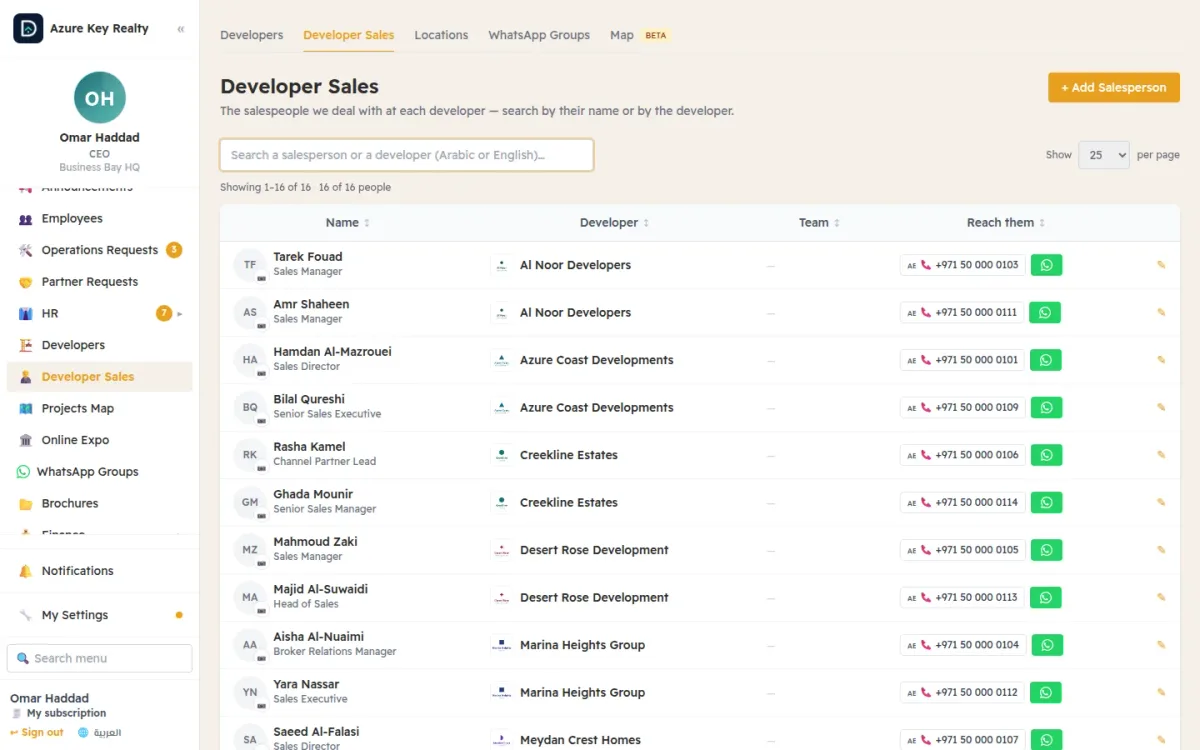
One more separation helps while you clean. Pull developer and partner contacts out of the buyer list, so your buyer database stays a list of clients. Dealora keeps developer salespeople in the Developer Sales index, with call and WhatsApp buttons for each contact.
Keeping records current after every call
A database is only as good as its last update. Make the rule small enough to follow: after every call, meeting or site visit, the salesperson logs one line and moves the stage if it changed. Two minutes, immediately, before the next call.
What to log in that line:
- What was agreed and the next step with a date.
- Any change in budget, unit type or project, updated in the requirement itself, not only in the note.
- The reason if the client goes cold, in a few words.
The system can enforce part of this. Pipeline Rules in Dealora CRM can require a logged action before a lead moves forward, and Pipeline SLA gives each stage a maximum idle time. A lead that sits too long without a sales action is pulled and re-distributed. For the stages themselves and their exit rules, see the guide to the real estate sales pipeline in 7 stages.
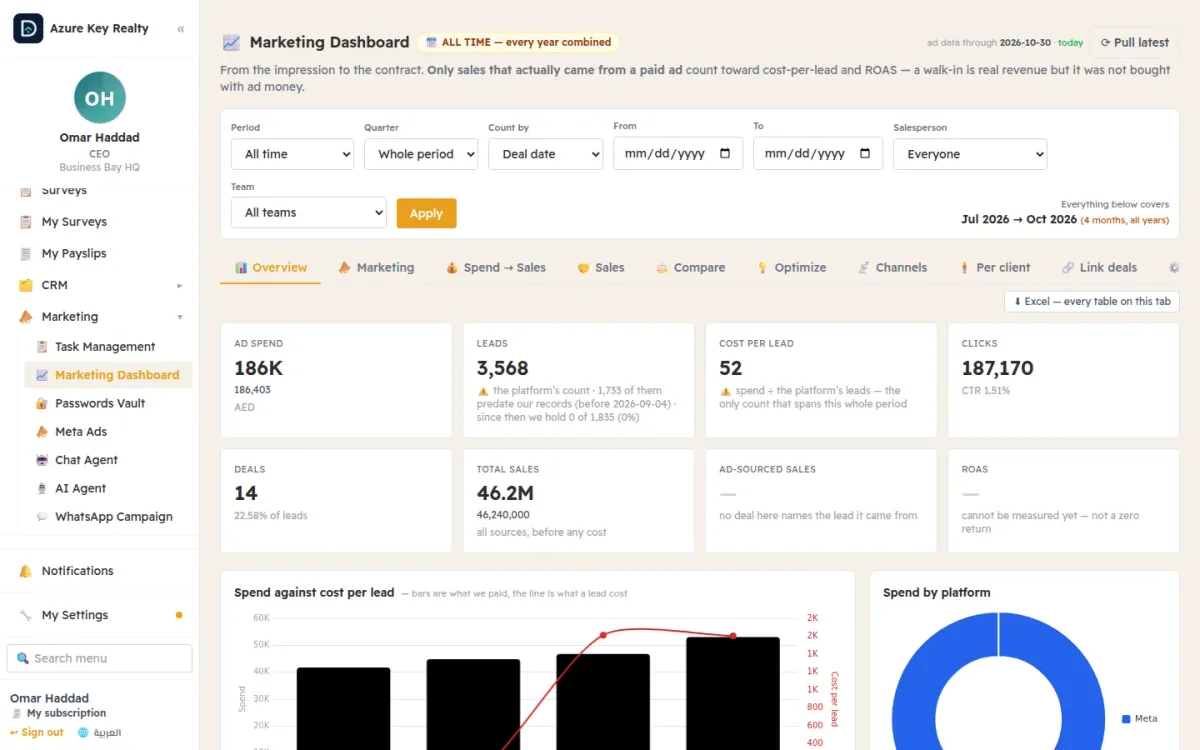
Clean source data pays off here. When every client carries a source, the Marketing Dashboard (Growth plan and above) can follow spend to leads to sales, with cost per lead and return on ad spend, so you see which campaigns bring buyers who actually sign.
WhatsApp has its own timing. A WhatsApp customer service window lasts 24 hours after the customer's last message and resets with each new one. Inside it free-form replies are allowed, outside it only approved templates. In the Social Inbox a line above the messages shows whether the window is open. When it has closed, the salesperson messages the client from their own phone and uses Log sent, so the client record stays complete even though nothing went out from the portal.
What to do when a salesperson leaves
This is the moment a client database proves its worth. If the records live in the CRM, a resignation is an administrative task. If they live on a phone, it is a loss.
Before the last day
The manager opens My Team, sees every client the leaver holds, and reviews them by stage. Live deals and clients near a site visit are handed over in person, with a short conversation. The rest can be redistributed.
On the last day
Dealora CRM lets managers move all clients of one salesperson to another in one action. Mark the person as Left in the staff file. In Dealora Employees, when a manager is marked as Left, the portal asks for a replacement manager and moves the whole team under them, so reporting lines never point at an empty chair.
After they have gone
Check again a week later. My Team can pull back clients still held by people who left, which catches anything missed on the day. Because calls, WhatsApp, meetings and visits sit on each client page, the new owner starts with the history, not with a cold introduction.
Privacy: consent, retention and breach rules for client data
A client database holds personal data, and the three main markets for Dealora's readers each regulate it. The rules below are a summary, not legal advice, and details change, so confirm your position with a local lawyer.
- Egypt. The Personal Data Protection Law is Law No. 151 of 2020. Personal data may not be collected without the person's prior consent after they are told the purpose, except where the law permits. Its Executive Regulations were issued on 1 November 2025 (Ministerial Decision No. 816 of 2025). Controllers must set a retention period tied to the purpose and erase data once the purpose is fulfilled, unless a legal obligation requires keeping it. People can access, correct, object to processing and withdraw consent. A breach must be reported to the Personal Data Protection Center within 72 hours of becoming aware, and affected people informed within three days of that notice. Controllers and processors need a licence or permit from the Center, and transferring client data outside Egypt, for example to a cloud CRM hosted abroad, needs a separate cross-border transfer permit. The one-year compliance period that began with the Executive Regulations ended on 1 November 2026, so these obligations now apply in full.
- United Arab Emirates. Federal Decree-Law No. 45 of 2021 came into effect on 2 January 2022. It prohibits processing personal data without the owner's consent, except in cases the law lists, and lets people ask for inaccurate data to be corrected and for processing to be restricted or stopped. It does not apply in the financial free zones DIFC and ADGM, which keep their own data protection laws. The regulator is the UAE Data Office.
- Saudi Arabia. The Personal Data Protection Law applies to any processing of personal data of individuals in the Kingdom by any means, and SDAIA is the regulator. It entered into force on 14 September 2023. Consent can be withdrawn at any time, except in cases the law sets out, and a person may ask for data that is no longer needed to be destroyed. Controllers must notify SDAIA within 72 hours of becoming aware of a breach that may harm personal data or the person's rights, through the National Data Governance Platform.
In daily practice this means three habits: record where and when a client gave consent, delete records you no longer have a reason to hold, and keep access limited to the people who need it. The role rules above already do most of the last one.
Start with one team and one week
Pick one sales team, agree the six fields and the naming line, import their active clients and run the log-after-every-call rule for a week. Then compare what the manager can see with what they could see before. Dealora's CRM is built for exactly this client record, and every new company starts with a free trial of 3 months from the sign-up page; plans and add-ons are on the pricing page. If you want to compare options first, Keys of Success, the team behind Dealora, publishes a real estate CRM comparison with 8 checks before you buy.
Sources
Frequently asked
What is a real estate client database?
It is a single, shared set of client records for a brokerage. Each record holds the person's contacts, where they came from, what they want to buy, their budget, their stage in the sales process and the salesperson who owns them. It replaces numbers saved on personal phones, WhatsApp chats and separate spreadsheets.
Which fields should every client record have?
At minimum: name, phone and email, source, budget, unit type, project or area of interest, current stage and owner. Add a tag or note for anything specific, such as payment preference. Keep the list short, because fields that salespeople find tedious end up empty.
How do I stop duplicate clients in the database?
Use phone number and email as the identity of a client and make the system match on them, so a repeat registration attaches to the existing record. In Dealora CRM a person who registers three times is one client with three requests behind it. Agree one phone format for manual entry.
What happens to client records when a salesperson leaves?
The records stay with the company. A manager moves the leaver's clients to another salesperson, or pulls back any still held by someone who left, and the history of calls and conversations stays on each client page. Mark the employee as Left in the staff file so reporting lines stay correct.
Is it legal to keep client data in a CRM in Egypt, the UAE or Saudi Arabia?
Yes, but each country regulates it. Consent, a defined purpose, retention limits, the right to correct or erase data and breach notification all matter. Egypt has Law 151 of 2020, the UAE has Decree-Law 45 of 2021 and Saudi Arabia has its own PDPL. In Egypt, a licence from the Personal Data Protection Center is required, and hosting client data outside Egypt needs a separate cross-border transfer permit. Confirm your obligations with a local lawyer.
Read next
- Software for a 20 Agent Brokerage: What to Require A requirements list for a brokerage of about 20 agents: what the software must do on day one, what can wait, h
- AI Chat Agent for a Real Estate Brokerage: Test, Trust, Go Live One AI agent can answer property customers on Instagram, Messenger, WhatsApp and TikTok, but only if you give
- PropSpace Alternative for UAE Brokerages: Cost Model and Tests A decision guide for UAE brokerage owners leaving per-user pricing: a yearly cost model at your own headcount,
- Real Estate Software Saudi Arabia: A 10-Point Buying Checklist A buying checklist for Saudi brokerage owners: Arabic and English screens, WhatsApp and Instagram leads, Meta