
Real Estate Sales Pipeline: 7 Stages, Exit Rules and Time Limits
By Dealora Published Updated Reviewed by Ali Darwish 11 min read
A practical stage model for brokerages: seven deal stages, each with an exit rule, a follow-up time limit and the signs of a stuck deal, plus a weekly review routine.
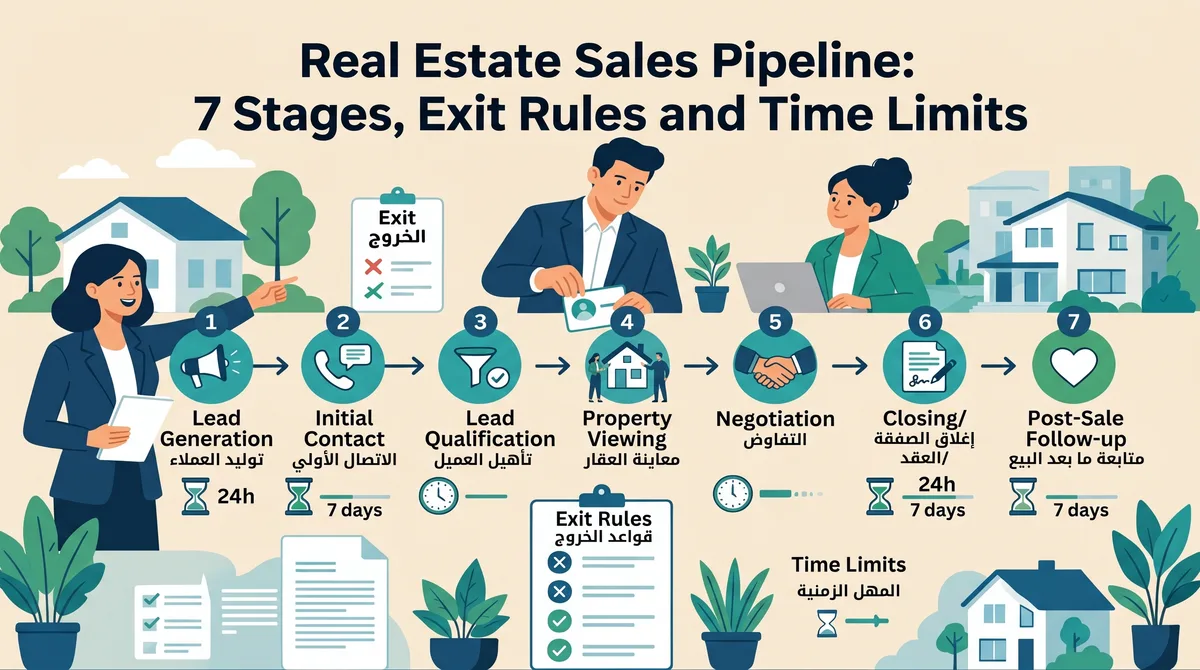
A real estate sales pipeline is the ordered list of stages a deal passes through, from first inquiry to handover and commission. For each stage, write an exit rule (what must be true to move on), a follow-up time limit, and the signs of a stuck deal. Then review the pipeline weekly.
A real estate sales pipeline is the ordered set of stages every deal passes through, from the first inquiry to handover and commission. A pipeline works better when each stage has three written rules: an exit rule, a time limit for the next follow-up, and the signs that tell a manager the deal is stuck.
Why the stages matter more than the software
A stage name helps only when everyone reads it the same way. If "in negotiation" can mean a single WhatsApp reply to one consultant and an offer already sent to the owner to another, the pipeline cannot be read. Totals look healthy, forecasts miss, and the manager finds out a deal died only when the client signs with someone else. Clear deal stages in real estate fix this by turning opinions into facts that can be checked.
If you have not yet set up clients, leads and deals in a CRM, start with the step-by-step real estate CRM setup. What follows assumes that groundwork exists and moves to the next question: how to define the stages.
How to build a sales pipeline in real estate: three rules per stage
Before naming stages, decide what each one has to contain. Every stage needs the same three things.
- Exit rule. One recorded fact that allows the deal to move forward. "The client seems interested" is not a fact. "Budget, unit type and payment method are filled in" is.
- Follow-up time limit. The longest a deal may sit in the stage without a logged action by the salesperson. The limits below are starting points. Tighten or relax them after a month of real data.
- Stuck signs. The visible symptoms that a deal has stopped moving, so a manager can spot it in a list without opening every record.
Keep the number of stages between six and nine. Add a stage only if its exit rule and time limit differ from the stage before it.
The seven real estate pipeline stages
The model fits both resale and off-plan business. Where the two differ, the text says so.
1. Inquiry
A person has registered through an ad form, the website, a message or a walk-in. The only job at this stage is to reach them.
- Exit rule: a two-way conversation has taken place and is logged, either a call that connected or a reply from the client.
- Time limit: first contact within 15 minutes in office hours, and first thing the next morning for leads that arrive at night.
- Stuck signs: no activity logged, several attempts with no answer, or a lead that reached the salesperson days after it arrived.
Speed matters most here. If the first contact happens over WhatsApp, remember that a business can send free-form (non-template) replies only inside the 24-hour customer service window that opens with the client's last message; after it closes, only an approved message template can restart the conversation, and templates are charged per message. Since 1 October 2026 Meta also charges for service replies after the first 1,000 per business number each month. Messenger and Instagram limit standard replies to a 24-hour window too, with a separate 7-day window for replies by a human agent. The Social Inbox (Growth plan and above) shows whether that window is still open on each conversation. For the work that comes before this stage, see real estate leads in 7 steps.
2. Qualification
The salesperson learns whether the client can and will buy, and what exactly they want.
- Exit rule: budget, unit type, preferred area or project, payment method, timeline and who makes the decision are all recorded on the client.
- Time limit: complete within two days of first contact, with a follow-up call or message every two days until then.
- Stuck signs: requirement fields still empty, a client who dodges the budget question, or a buyer who is only collecting price lists.
A client who fails qualification is not a failure of the pipeline. Move them out early, to the lost-lead destinations described later, so the live stages show only people who can buy.
3. Viewing or developer meeting
Resale clients see the unit. Off-plan clients meet the developer's sales team, visit the sales gallery or join a video meeting.
- Exit rule: the viewing or meeting took place and the client's feedback is logged, including what they liked, what they rejected and what they want to see next.
- Time limit: book within three days of qualification, and follow up the same day the viewing ends.
- Stuck signs: two postponements in a row, a viewing with no feedback logged, or a client who keeps asking to see "one more option" without narrowing down.
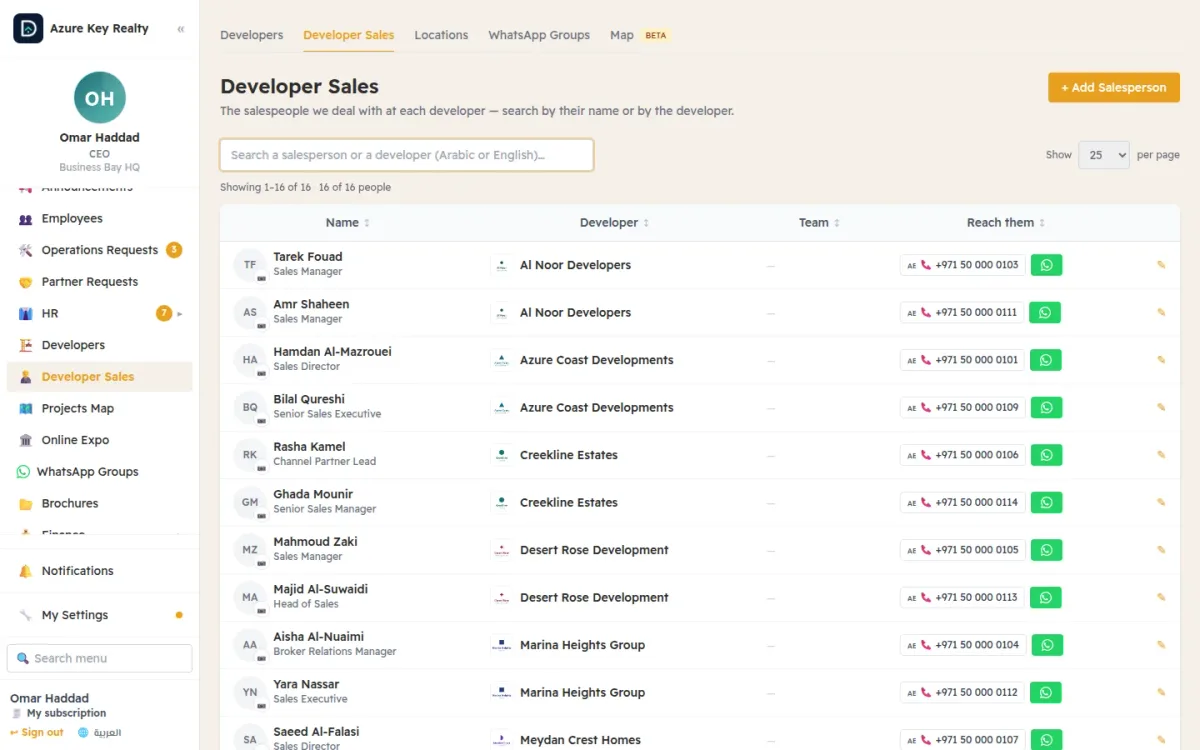
For developer meetings, having the right contact at hand saves days. The Developer Sales index lists the salespeople at each developer with their numbers.
4. Offer
The client states a price and terms, and the offer reaches the owner or the developer.
- Exit rule: a written offer was sent and a response, accepted, countered or declined, is recorded.
- Time limit: chase the owner or developer within 24 hours, and agree on a response date with the client when the offer goes out.
- Stuck signs: no counter after three days, an owner who will not name a bottom price, or a client whose offer keeps changing.
In a Dubai resale, an accepted offer is written into Contract F (often called Form F), the Dubai Land Department's standard sale agreement between seller and buyer, which the broker creates in the DLD broker system.
5. Reservation
The unit is held for this client against a deposit. On off-plan projects this is the EOI or booking form.
- Exit rule: the deposit is received, the unit is reserved in the client's name and the reservation paperwork is on file.
- Time limit: check weekly, and daily in the last three days before the developer's or owner's reservation deadline.
- Stuck signs: a deposit promised but not transferred, identity documents missing, or a client who stops answering after reserving.
The size of a booking deposit varies by developer. In Dubai off-plan sales the developer sets it, either as a share of the price or as a fixed EOI amount at major launches. Always record the actual amount on the deal rather than assuming.
6. Contract
The reservation turns into a signed agreement.
- Exit rule: the contract is signed by all parties and a copy is stored with the deal.
- Time limit: weekly follow-up on outstanding documents and payments, with a named person responsible for each missing item.
- Stuck signs: repeated contract draft changes, a signing date that keeps slipping, or a down payment that arrives in pieces.
The paperwork depends on the market. A Dubai off-plan sale moves from the reservation to the Sale and Purchase Agreement (SPA), and the developer registers the signed SPA with the Dubai Land Department through the Oqood portal within 90 days. In Saudi Arabia the brokerage contract must be in writing, with a copy deposited with REGA, for the broker to enforce a commission claim, and the broker must be REGA licensed. In Egypt, check that the brokerage meets the current registration rules for real estate brokers before any commission is agreed.
7. Handover and commission
The deal is not finished at signature. The brokerage still has to see the handover through and collect what it earned.
- Exit rule: handover is complete and the commission is collected and recorded against the deal.
- Time limit: review monthly for every contracted deal still awaiting handover or commission.
- Stuck signs: a commission invoice with no payment date, a handover date nobody owns, or a disagreement about who pays the commission.
On a completed Dubai off-plan unit, the provisional (Oqood) registration is later followed by a title deed in the buyer's name once the remaining conditions are met. Commission terms vary. In Egypt the rate is agreed between the parties and differs by deal and by developer. In Saudi Arabia the rate is 2.5% unless the parties agree otherwise in writing. Whatever the rate, agree it in writing before the reservation. The guide to broker commission in Egypt shows how to track it per deal.
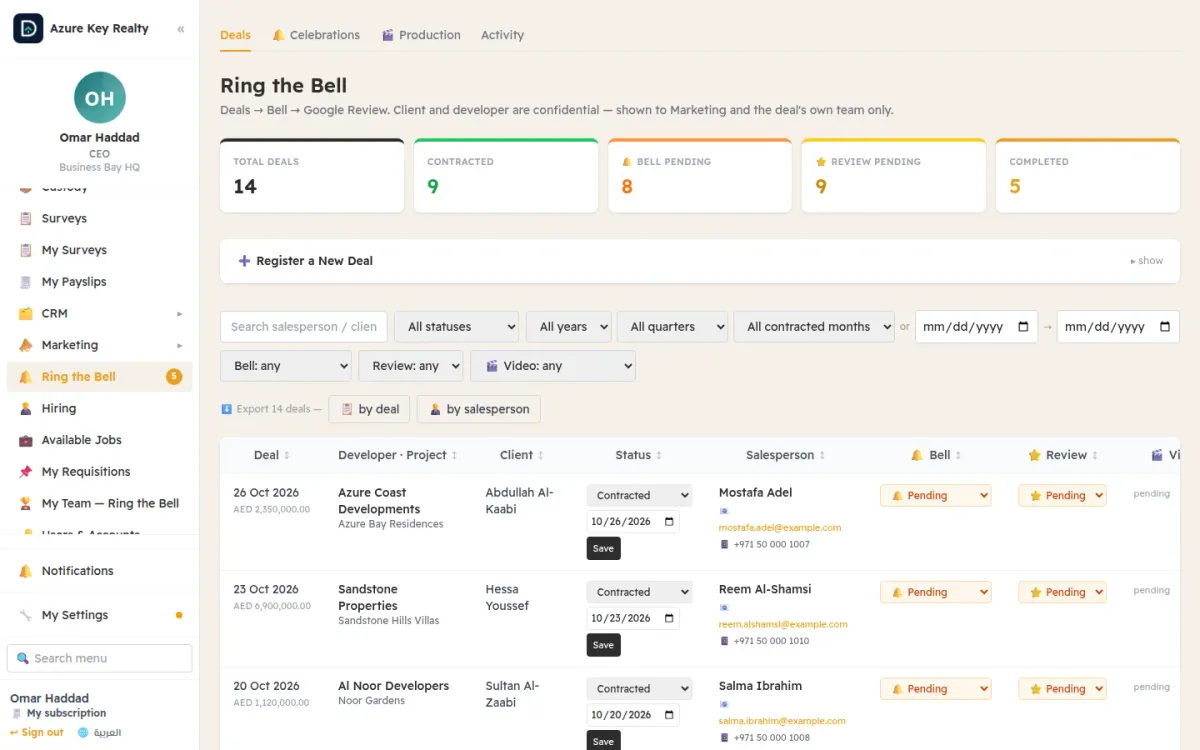
A contracted deal is also the moment to mark the win. Ring the Bell (Growth plan and above) handles the deal celebration and the Google review request, and its team boards list contracted deals per salesperson.
All stages on one page
| Stage | Exit rule | Follow-up limit | Stuck sign |
|---|---|---|---|
| Inquiry | Two-way conversation logged | 15 minutes in office hours | No logged activity |
| Qualification | Budget, unit, payment method, timeline recorded | 2 days | Empty requirements |
| Viewing or developer meeting | Held, feedback logged | Book in 3 days | Two postponements |
| Offer | Written offer answered | 24 hours to chase | No counter after 3 days |
| Reservation | Deposit received, unit held | Weekly, then daily near deadline | Deposit promised, not paid |
| Contract | Signed copy on file | Weekly | Signing date keeps slipping |
| Handover and commission | Handed over, commission recorded | Monthly | No commission payment date |
Setting up the stages in Dealora CRM
A stage model is only useful if the system enforces it. In Dealora, the CRM Admin sets stages, sources, pools, targets and notifications in CRM Settings, and the time limits and exit rules become daily behavior in one of two automation modes: Classic, which uses Pipeline SLA and Pipeline Rules, or Workflow boards. Workflow replaces SLA and Rules when it is switched on; the two modes never run together.
- Pipeline SLA gives each stage a maximum idle time. A lead that sits too long without a sales action is pulled and redistributed, with a scan every 30 minutes and quiet hours at night.
- Pipeline Rules can require a logged action before a lead moves forward. This is where your exit rules live.
- Workflow boards let you draw what happens at each stage.
Once a client is qualified, the salesperson sends a deal request for one unit. The CRM Admin approves, holds or rejects it, and the deal moves from Deal to EOI to Contracted. A unit can sit on one live deal only, which prevents two salespeople promising the same apartment. Offer, reservation and contract line up with those three states. The states described on the CRM page end at Contracted, so decide in advance where handover and commission follow-up will be recorded, for example in the client's Sales Activity timeline.
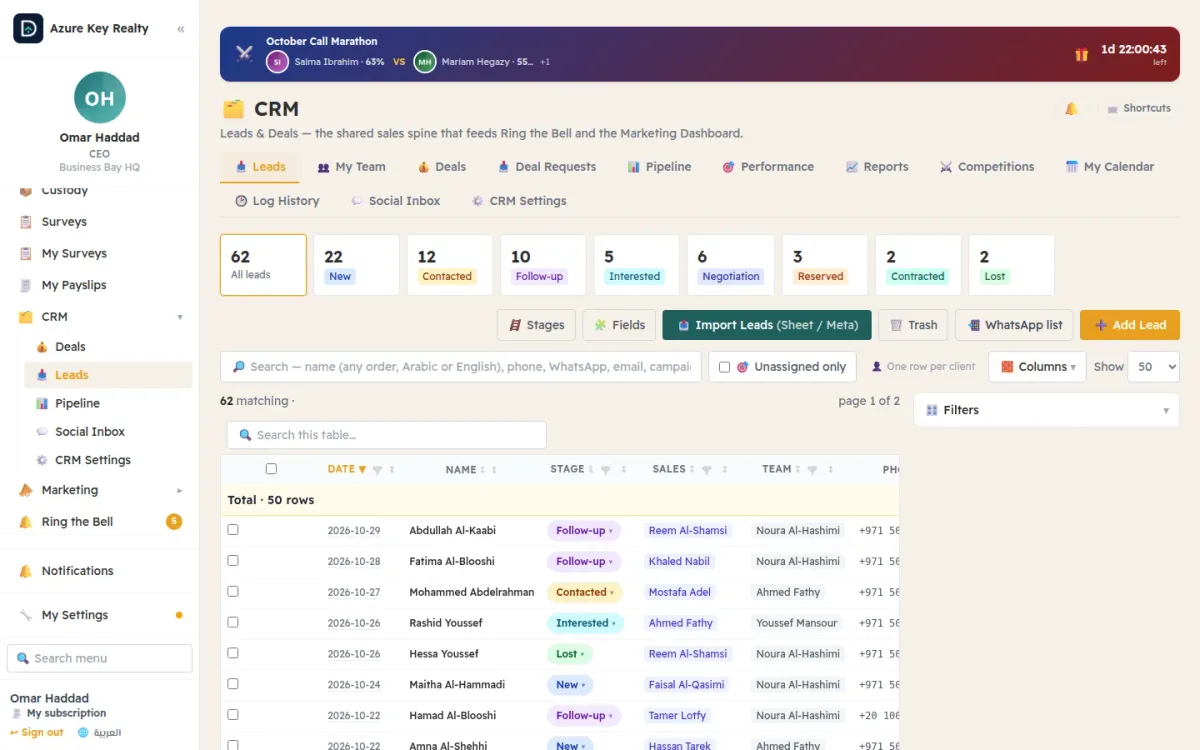
The client page keeps calls, WhatsApp, meetings and site visits in one timeline, so a manager reading a stuck deal sees what actually happened. More on the module is on the Dealora CRM page.
How to review the pipeline every week
Good pipeline management for brokerages is a short meeting held at the same time every week. Thirty to forty-five minutes is enough if the list is prepared. Work from the oldest deals to the newest.
- Contracts and reservations first. These hold the most money. For each deal, name the missing document or payment and who will chase it.
- Offers older than three days. Decide whether to push the owner, adjust the client's expectations or close the deal.
- Viewings without feedback. Each one is a missed chance to learn what the client wants.
- Leads pulled for idleness. Look at which stage loses the most leads and whether the time limit there is realistic or the salesperson is overloaded.
- Sources. Compare sources by deals produced, not registrations received. A cheap source that never reaches reservation is expensive.
- Salesperson and team numbers. Use the reports to compare how many clients each person holds against how many reach each stage.
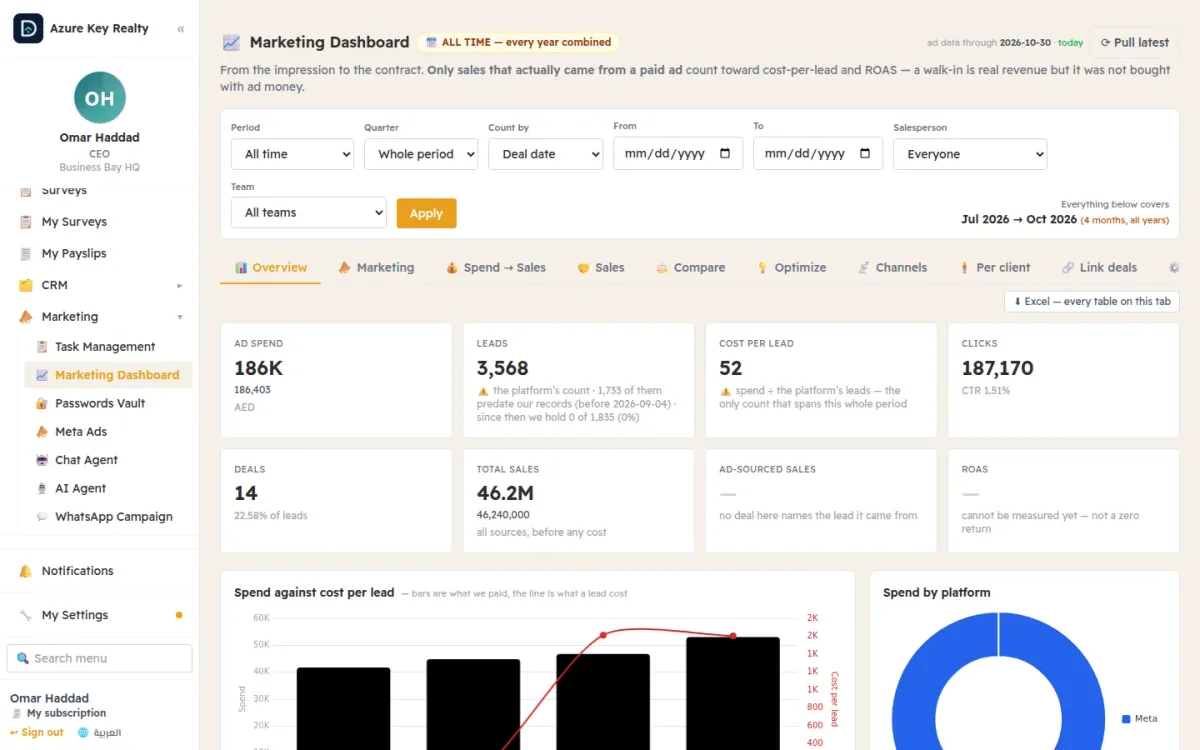
For the sources step, the Marketing Dashboard (Growth plan and above) follows spend to leads to sales, with cost per lead and return on ad spend, so you can see which campaigns end in deals.
Managers who also run daily follow-up will find more routines in 8 tools for managing a real estate sales team.
Where lost leads should go
A lead that will not buy still has value, and deleting it throws that value away. Give lost leads three destinations, and make the salesperson choose one and write a reason.
- Not now. The client is real but the timing is wrong. Log the reason and a date to contact them again, such as after a salary review, a lease ending or a new launch.
- Not a fit. The budget, area or purpose does not match anything you sell, or the number is wrong. Close it with that reason so reports show the quality of the source.
- Lost to another broker or developer. Note who won and why, if the client says. After a few months these notes show whether you lose on price, speed or service.
Create these as stages or closing reasons in CRM Settings rather than free text, so the weekly review can count them. Leads pulled by a stage time limit are a different case: they are not lost, only idle, and they go back to be redistributed. When a salesperson leaves, team leaders can move all their clients to someone else in My Team, so no pipeline walks out with a phone.
A first step for next week
Write your stages on one sheet with an exit rule, a time limit and stuck signs for each. Review them with your team leaders, then enter them in your CRM and run the first weekly review against real deals. Teams that want to see how Dealora handles stages, deals and reports can sign up. If you are still comparing systems, Keys of Success has a real estate CRM comparison to read next.
Sources
Frequently asked
What are the stages of a real estate sales pipeline?
A workable model for brokerages has seven stages: inquiry, qualification, viewing or developer meeting, offer, reservation, contract, and handover with commission. Leads that go nowhere need their own destination so they do not clutter the live stages. Rename stages to match how your team speaks, but keep the order.
How many stages should a brokerage pipeline have?
Between six and nine is usually enough. Fewer stages hide where deals stall, and more stages make salespeople guess which one fits. Add a stage only when it has a different exit rule and a different follow-up time limit from the stage before it.
What is an exit rule in a sales pipeline?
An exit rule is the single fact that must be true and recorded before a deal can move to the next stage, for example a viewing took place and feedback was logged. It stops salespeople from advancing deals on optimism and keeps stage counts honest.
How often should a sales manager review the pipeline?
Weekly, at a fixed time, working through stages from the oldest deals to the newest. Daily checks belong to each salesperson. The weekly review is where the manager decides which stuck deals to save, reassign or close, and which lead sources are producing deals rather than just registrations.
Where should lost leads go?
Keep them on the client record with a reason and, if the client may return, a date to contact again. Do not delete them. A lost lead still holds a phone number, requirements and a source, all of which are useful for the next campaign and for judging lead quality.
Does the pipeline differ for off-plan and resale deals?
The stages are the same, but the documents differ. Off-plan deals pass through a developer meeting, an EOI or reservation with a deposit, and a sale and purchase agreement. Resale deals pass through viewings, a written offer to the owner and a sale contract. Write the exit rules separately for each.
Read next
- How to Test a CRM Free Trial: A 30-Day Plan for Brokerages A week-by-week 30-day plan for brokerage owners: import real leads, run the pipeline with real reps, check dev
- Software for a 20 Agent Brokerage: What to Require A requirements list for a brokerage of about 20 agents: what the software must do on day one, what can wait, h
- How to Scale a Real Estate Brokerage: Systems at 20, 50, 100 Reps A stage-by-stage map of the systems a brokerage needs at about 20, 50 and 100 salespeople: what breaks at each
- Real Estate Sales Dashboard: 3 Views Every Manager Needs One screen, three views: agent, team and project or developer. Which number goes where, who reads it, and whic