
Orcida Alternative for Brokerages: 7 Criteria Before You Switch
By Dealora Published Updated Reviewed by Ali Darwish 10 min read
Signs your current CRM no longer fits how you work, seven criteria to compare before you switch, a migration plan with timing, and a trial test you can run with your own team.

A brokerage should test an Orcida alternative when, in its current setup, leads leak between salespeople, managers cannot see who answered whom, ad spend cannot be tied to deals, and HR runs in separate tools. Compare lead distribution, pipeline control, social inbox, cost per lead, HR, language support and reporting, then test the finalist with real data during a trial.
An Orcida alternative is worth weighing when your brokerage changes: more salespeople, more lead sources, more channels, and a manager who can no longer see the whole pipeline. Nothing here is a verdict on Orcida. We make no claims about that product, and the criteria below work for judging any tool, including ours. What follows is a way to decide whether your current CRM still fits the way you work, what to compare, how to move your data, and how to test the replacement before you commit.
Signs your current CRM no longer fits
Most brokerages do not switch because of one dramatic failure. They switch because small workarounds pile up until the workarounds become the real system. Check how many of these sound familiar.
- The sales manager splits new leads by hand, often in a chat group, and the best leads wait until someone gets to them.
- The same buyer registers on three forms and ends up with three salespeople.
- Nobody can say which messages from Instagram, Messenger or WhatsApp were never answered.
- When a consultant resigns, their clients and their chat history leave with their phone.
- Marketing reports leads, sales reports deals, and nobody can say what a closed deal cost in ad spend.
- Attendance, leave, payroll and employee paperwork live in separate sheets and apps that do not know about the sales team.
- The owner asks for a report and someone spends a day building it from exports.
One or two of these is normal growth friction. Three or more means the tool is now costing you deals, and it is time to compare options properly.
What to compare in an Orcida alternative for brokerages
A feature list is a poor way to compare CRMs, because every vendor ticks the same boxes. Compare how each system behaves in seven situations that decide whether a brokerage keeps its leads. The table shows what to ask for and where Dealora sits against each criterion, based on what its pages describe.
| Criterion | What to ask the vendor to show | How Dealora handles it |
|---|---|---|
| Lead distribution | What happens when a lead arrives for a client nobody owns yet, and when a person registers twice | Phone numbers and emails match to one client record. Pools link tags to salespeople or teams and pick the owner by least loaded, weighted, FIFO or round-robin. A Leads Bank and manual assignment are also available. |
| Pipeline control | Can a stage have a time limit, and can a move be blocked until an action is logged | Pipeline SLA sets a maximum idle time per stage and re-distributes idle leads, with a scan every 30 minutes. Pipeline Rules can require a logged action before a lead moves forward. |
| Social inbox | Do Messenger, Instagram and WhatsApp conversations sit on the client record, and can you see failed sends | The Social Inbox (Growth plan and above) gathers all three channels, links unknown senders to clients and lists every failed send with the reason and the fix. |
| Marketing cost per lead | Can you see spend, leads, cost per lead and deals on one screen | The Marketing Dashboard (Growth plan and above) shows spend to leads to sales, with cost per lead and return on ad spend. |
| HR and operations | Are attendance, leave, payroll and onboarding in the same system as sales | Employees (every plan), Attendance & Leave, Employee Lifecycle and Company Policy (Business plan and above) and Payroll (Enterprise) sit in the same portal as the CRM. |
| Language support | Does the interface and the content work in the languages your team and clients actually use, not just one translated screen | Check this yourself during the trial, with your own team working in its own language. |
| Reporting | Do reports count clients or registrations, and can you split them per salesperson and team | Reports count clients, not registrations, and break down per salesperson and team. |
Run your current tool through the same questions. If it answers all seven well, you may not need to move. If it answers four, you now know exactly which gaps to close.
Lead distribution and pipeline control
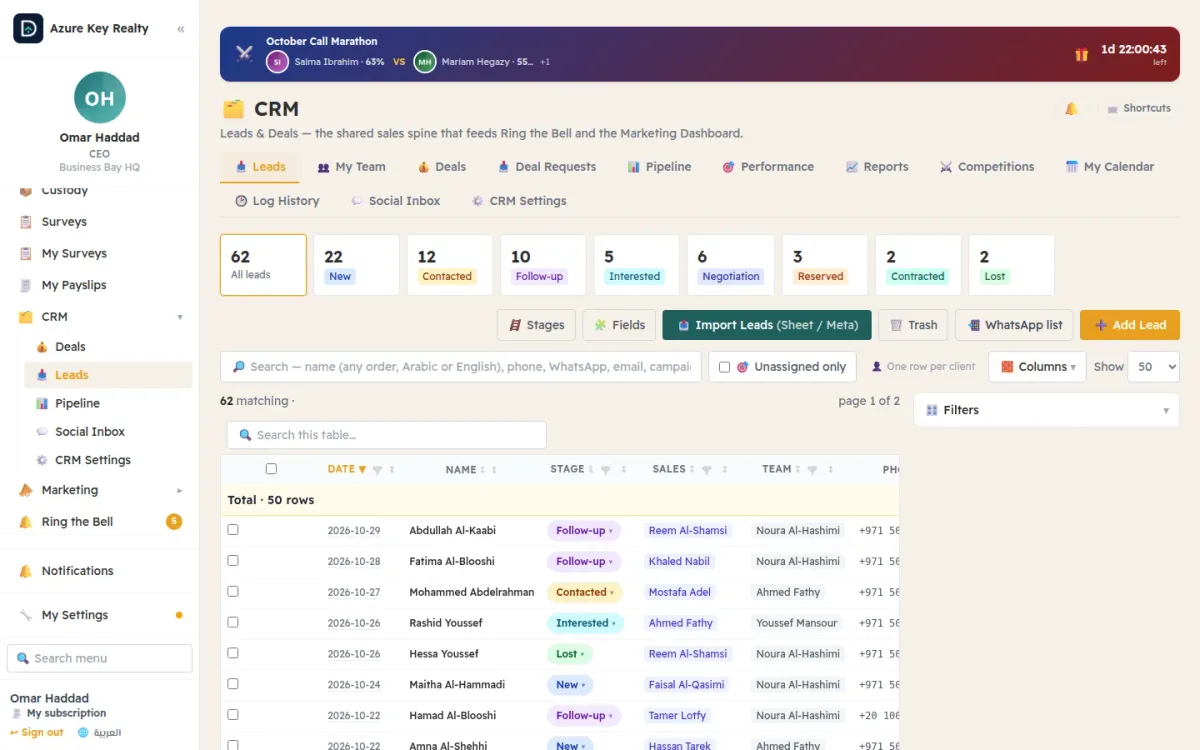
These two decide whether leads are worked or just stored. Distribution should follow written rules, not a manager's availability on Sunday morning. Pipeline control means a lead cannot sit untouched for a week without anyone noticing.
In Dealora the CRM module handles both. An idle lead that exceeds its stage limit is pulled and handed on, and the rules for who receives what are explained in detail in the article on real estate lead distribution. Whatever tool you pick, insist on seeing a demo with a duplicate registration and an idle lead, because those two cases expose weak systems fastest.
Social inbox: what to check
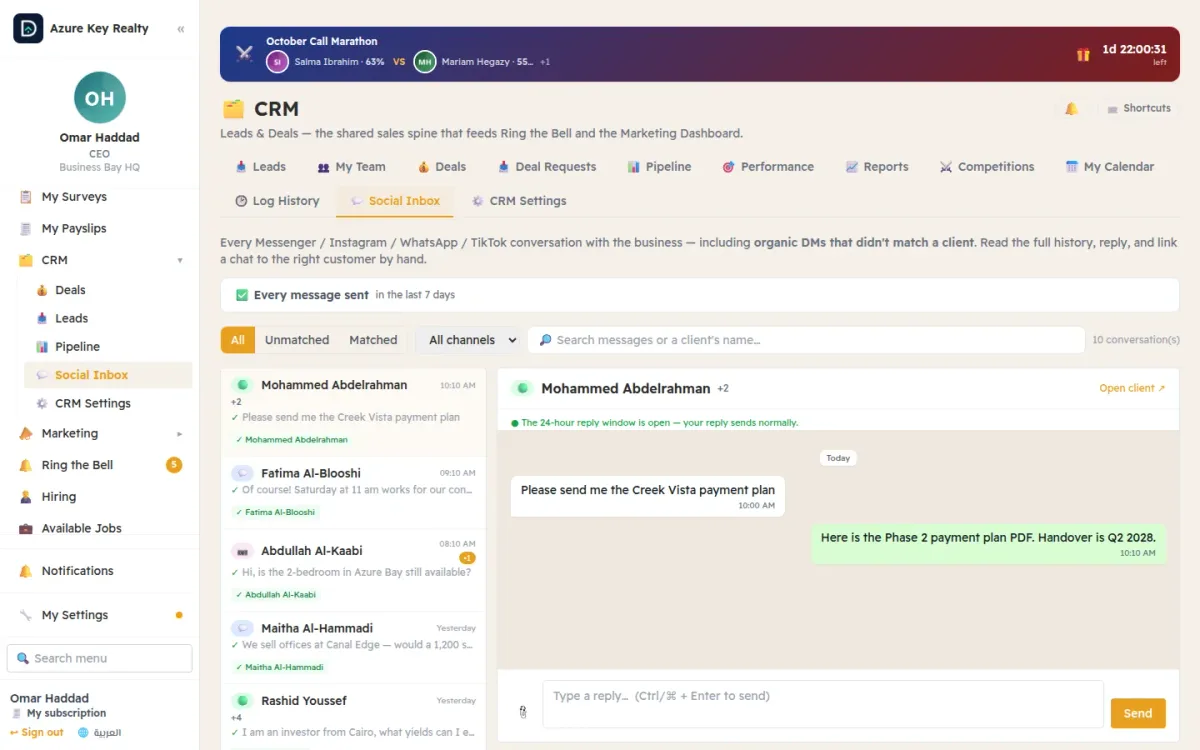
Buyers write on Instagram at night, follow up on WhatsApp in the morning and call in the afternoon. If those messages live on personal phones, nobody sees the whole conversation. A unified inbox puts them on the client record next to calls, meetings and deals.
Check the reply rules in particular. On WhatsApp, a free-form (non-template) reply must go out within 24 hours of the client's last message, after which only an approved template can be sent, and that window resets with each new message from the client. Instagram and Messenger also use a 24-hour window, though a person (not a bot) can reply up to 7 days later with Meta's human agent tag, which is meant for manual support and not for marketing or sales broadcasts. The Dealora Social Inbox (Growth plan and above) shows whether the window is open, and when it has closed it offers a Log sent button so a message sent from the salesperson's own phone is still recorded on the client. Ask any vendor what happens in that situation. Also check the current Meta pricing rules for WhatsApp: from October 1, 2026 Meta charges for service messages after a free tier of 1,000 per business phone number per month, and rates differ by country and message category, so confirm the terms that apply to you.
Marketing cost per lead and reporting
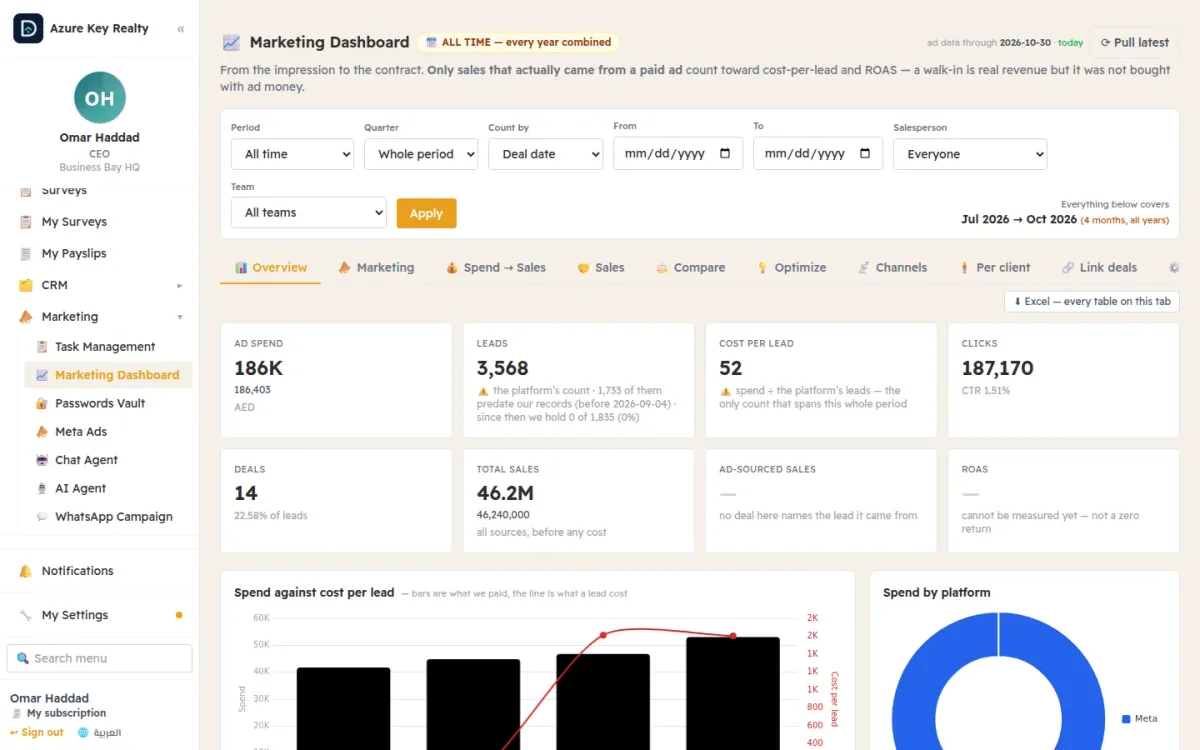
Counting leads is not enough. A growing brokerage needs to know which campaign produced contracted deals and at what cost. That requires lead source, ad spend and deal outcome to live in the same place.
The Marketing Dashboard in Dealora (Growth plan and above) shows spend, leads, cost per lead, deals and a spend chart together. When you compare tools, ask for the same view with your own numbers. If you advertise in Dubai, also keep the advertising permit number for each campaign in your source records, since in Dubai the permit is requested through the Dubai Land Department's Trakheesi system and its number must appear in every real estate ad.
HR and operations: the criterion people forget
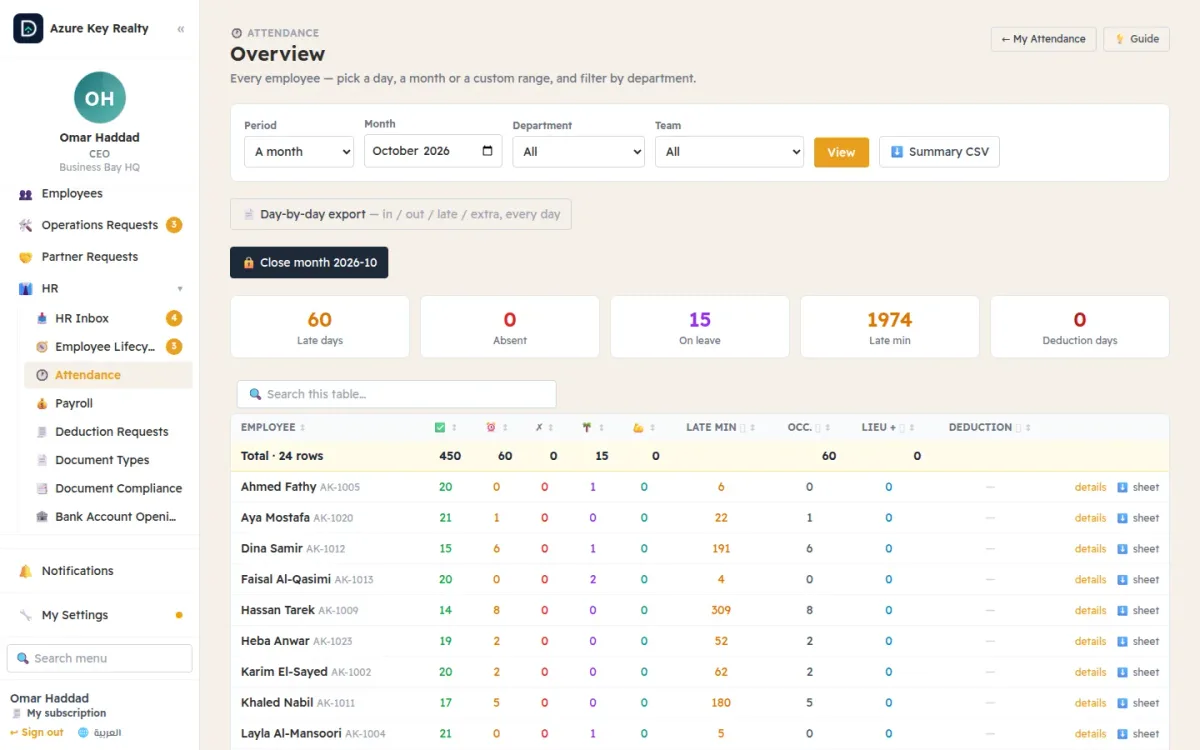
Brokerages grow by hiring, and hiring creates paperwork: attendance, leave, salaries, policies, equipment. When these sit in separate tools, the sales manager and HR work from different lists of who is on the team. A system that holds both removes the second list.
This is where Dealora departs from a pure CRM: it covers attendance, employee onboarding and offboarding, and policy acknowledgement (Business plan and above) and payroll (Enterprise) in the same portal. The wider case is made in the article on real estate ERP software. If you have no plans to grow the team, this criterion may carry no weight for you, and that is a legitimate answer.
A real estate CRM migration checklist
A switch goes wrong when it is treated as a file upload. Treat it as a four-week project with an owner. The timing below suits a mid-sized team; a smaller one can compress it.
Week 1: clean and export
Export in this order, because each item depends on the one before it.
- Clients: names, every phone number and email, source, tags and stated requirements such as unit type, budget and project.
- Consent records: where a client agreed to marketing messages, keep that record with the client. Egypt's Personal Data Protection Law generally prohibits direct electronic marketing without prior consent, and the UAE law prohibits processing personal data without the owner's consent except in the cases it lists.
- Deals: unit, stage, owner and date.
- Activity history: calls, meetings, site visits and notes.
- Users and teams: who reports to whom, since distribution rules depend on it.
Before importing, delete obvious junk and merge known duplicates by phone number. Importing dirty data into a better system only produces a better-organized mess.
Week 2: configure the rules
Set stages, sources, tags, pools and time limits before anyone logs in. The setup order is laid out in the guide to setting up a real estate CRM for brokers in Egypt and the Gulf. Decide who owns each existing client, so no lead is orphaned on day one.
Week 3: run both systems with a small group
Pick one team and one project. New leads go to the new system only; the old one stays read-only for reference. Note every question the team asks, because those questions become your training notes.
Week 4: switch everyone
Move the remaining teams, reconnect the messaging channels, and keep the old tool accessible for a while for lookups. Do not cancel the old subscription until a month-end report has matched your own count.
One more check belongs here. Egypt's data law requires a separate permit from the Personal Data Protection Centre to transfer personal data outside Egypt, and its Executive Regulations, issued on 1 November 2025, gave organizations a one-year transition period that ended on 1 November 2026, so these rules now apply in full. Ask any vendor where your client data will be stored, and take legal advice on your own position.
Test the replacement during the trial
A demo shows the best path through the product. A trial shows your own path. Dealora starts every new company on a free 3-month trial on the Starter plan, which includes the CRM, Employees and Developers modules, and the pricing page lists the plans and add-ons you would choose from afterward. Use the trial like this.
- Import the leads of one project, including the duplicates you know about, and check that they merge into single clients.
- Create two distribution pools and send a test batch of leads through them.
- Let two or three salespeople work live leads for a full week, with no side spreadsheets.
- Leave one lead untouched past its stage limit and see whether the system pulls it back.
- If you will need the Social Inbox (Growth plan and above, not part of the Starter trial), ask for a demo in which one messaging channel is connected and a message fails on purpose, to see how the reason is shown.
- Ask the sales manager to produce a team report without help, then compare it to your own count.
Score each step as pass or fail. A tool that passes five of six on your own data is a better bet than one that impressed in a presentation.
When a simple CRM is still enough
Not every brokerage needs more. A solo broker, or a team of two or three working one project with one lead source, rarely needs pools, stage time limits or a shared inbox. A simple tool is faster to learn and cheaper to run, and switching early would add complexity without benefit.
The balance shifts when a second branch opens, when ad campaigns bring hundreds of registrations in a weekend, or when the owner can no longer answer where a lead went. If you are weighing several systems at that point, the framework in our AqarOS alternative decision guide applies the same logic to larger brokerages, and an outside view such as the real estate CRM comparison from Keys of Success offers another checklist to hold against yours.
A sensible next step: write your seven answers down, pick one project, and start a trial with its leads this week.
Sources
Frequently asked
When does a brokerage need an Orcida alternative?
When the tool no longer matches how the team works. Typical signs are duplicate clients across salespeople, leads distributed by hand in a chat group, no view of unanswered messages, and no link between ad spend and closed deals. One sign is a warning. Three or more means a switch is worth testing.
What should I export first when I switch my real estate CRM?
Start with clients: names, every phone number and email, source, tags and requirements. Then export deals with their units and stage, then activity history, then users and teams. Clients come first because every other record hangs on them, and the new system matches duplicates by phone and email.
How long does a CRM migration take for a brokerage?
Plan 3-4 weeks for a mid-sized team: one week to clean and export, one week to configure stages, sources and distribution rules, one week of parallel running with a small group, then the full switch. A very small team can move faster. The old tool should stay readable for a while afterward.
Is a simple CRM ever enough for a brokerage?
Yes. A solo broker or a team of two or three, with one lead source, no shared inbox and no HR needs, can run well on a simple tool. The case for a larger system starts when leads need rules, managers need visibility, and sales, marketing and HR need to share one record.
How do I test a new CRM during a free trial?
Load a real slice of data, such as one project's leads, and run one live week with two or three salespeople. Check that duplicates merge, distribution follows your rules, messages reach the right person, and a manager can read the report without a spreadsheet. Judge it on those results, not on the demo.
Do data protection laws affect moving client data to a new CRM?
They can. Egypt's Personal Data Protection Law requires prior consent for direct electronic marketing and a separate permit to transfer personal data outside Egypt. The UAE law prohibits processing personal data without the owner's consent, except in the cases it lists. Ask any vendor where data is stored, and keep consent records in your export.
Read next
- Real Estate Software Saudi Arabia: A 10-Point Buying Checklist A buying checklist for Saudi brokerage owners: Arabic and English screens, WhatsApp and Instagram leads, Meta
- Software for a 20 Agent Brokerage: What to Require A requirements list for a brokerage of about 20 agents: what the software must do on day one, what can wait, h
- How to Scale a Real Estate Brokerage: Systems at 20, 50, 100 Reps A stage-by-stage map of the systems a brokerage needs at about 20, 50 and 100 salespeople: what breaks at each
- AI Chat Agent for a Real Estate Brokerage: Test, Trust, Go Live One AI agent can answer property customers on Instagram, Messenger, WhatsApp and TikTok, but only if you give